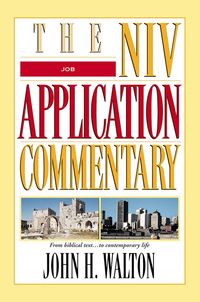
TITLE:
Job (NIV Application Commentary, The)
AUTHOR: John H. Walton
PUBLISHER: Grand Rapids, MI: Zondervan, 2012, (480 pages).
The purpose of the book of Job is not pain or suffering, or mere arguments to debate about this heavy subject. This is because suffering cannot be measured subjectively. Instead, the questions that the book of Job raise, are meant to direct our attention to God Himself.
This is the central purpose of Job, according to this commentary. With this as the hermeneutical key, we are advised to be guarded against any references to Job as a book about suffering. It is about God, and the more significant questions in life. It is not about Job or his friends or family. Neither is it about us. It is to point us to God. We learn to ask:
- What is Job's motivation in serving God?
- Must there always be a reason for suffering and pain?
- How valid is the good-effort-good-result philosophy when it comes to suffering?
- Can we put God to the test?
- Can we question God's policies?
Walton says that the purpose of the book is to "explore God's policies with regards to suffering in the world, especially by the righteous or the innocent." The three big reasons to read Job is this. Firstly, we get to see how frustrating it is to try to understand suffering on our own terms. Secondly, we get an opportunity to see how realistic the book of Job is. Thirdly, when we study Job, we will be transformed in our understanding, especially on how we RESPOND to suffering. Walton's main objective in this commentary is to help us read Job with a transformed understanding of how God works in the world, how much we need to be more concerned with the "nature of righteousness" instead of the "nature of suffering." If we really want to understand suffering humbly, we need help. We need guidance. We need our own mindsets to be modified, prepared, and even silenced, so that in God's time we become more like Job who is able to say:
"My ears had heard of you but now my eyes have seen you. Therefore I despise myself and repent in dust and ashes." (Job 42:5-6)
The framework Walton adopts is a broad three part structure.
- Narrative in the Prologue, Job's lament, and three dialogue cycles. (Job 1-27)
- Interlude (Job 28) followed by two discourses by Job and Elihu. (Job 29-41)
- Ending narrative and God's response. (Job 42).
Personally, I like to view it as a Drama (Job 1-3), Dialogues (Job 4-27) and Discourses (28-37), followed by a Declaration (Job 38-42). Walton gives a good overview of the literature used in the Ancient Near East in the same era as the book of Job. Comparing Mesopotamian literature to Job, there are various similarities. For example, there is commonly a protagonist who suffers. There is a laying out of woes before a Deity. There is an intense level of philosophy and theology going on. The differences are also great. For instance, while the ANE kinds of suffering are primarily health related, the book of Job begins with a heavenly bet. This throws in disarray the "Retribution Principle" greatly held during the time of the Ancient Near East cultures. The book of Job also goes beyond merely talking about God's justice or Job's righteousness. It touches on Sovereignty of God. The answers given in Job to the question of evil and suffering is a significant counter-cultural teaching, and will very well shock the ancient people then. It makes us realize that no matter how much we think we are in control, the truth is, we are never really in control, and we know less than what our arrogant selves wants us to think. Walton is convinced that Job is distinctly Israelite. Here are some of the theological themes from the book of Job.
- Job counters the growth of Retribution Principle (RP), and show how limited it is. It is a poor tool when it comes to theodicy (defending God), and anti-theodicy theme.
- Poor understanding of the issue is due to our flawed understanding of God, theology theme.
- There is a corporate level covenant theme, in which because Israel's rebellion and sin were rampant at that time, it is hard for anyone then to claim any level of innocence, a covenant them.
- For individuals, one can learn wisdom from the book of Job, a wisdom theme.
- The book points to monotheism, where even Satan has to ask for permission from the One and Only God.
Walton also compares Israelite theology with biblical theology, the differences between Bildad, Zophar, and Eliphaz with Elihu, and distinguishing good and bad advice. It is important also to note that Walton is not throwing away RP. He is helping us to see a "modified" view of it. There is also a great observation that God's restoration of Job also defies our understanding of RP. Walton even discusses "open theism" and counters some of the arguments that claims Job supports such a theology. Instead, Walton affirms that God is Sovereign and All-Knowing, and open theism is definitely not the theme in the book.
My Thoughts
I am glad that Walton spends considerable time debunking the idea of RP. Even in our modern culture, RP is wreaking havoc in our philosophies and theologies about God, evil, pain, and suffering. One of the best insights of this book comes across through a forward stance of anticipation. Walton writes with six powerful propositions that are worth our consideration:
- "Suffering is one of the contingencies of creation in process." We are sensitive people who feel pain.
- "Suffering is not intrinsically connected to sin." Not all suffering is due to sin.
- "Suffering is the lot of all humanity." None of us are exempt.
- "Suffering should be faced with trust in God's wisdom." There is hope.
- "Suffering should be viewed as an opportunity to deepen our faith and spiritual maturity as we look forward to understand God's purposes, rather than backward in an attempt to discern reasons. Suffering shapes us - of this there is no doubt. What varies is whether it breaks us."
- "Suffering for the gospel gives us the opportunity to participate in Christ's sufferings." Let us not forget that Christ suffered more than all of us.
There is great wisdom in this commentary. Scholarship material is rich and varied. Walton pulls in practical stories about suffering in our contemporary times, while being faithful to the ancient texts. I like this commentary for three reasons. Firstly, it is a very usable book for teaching or preaching. The structure set out in the book will provide either a teaching syllabus or a sermon series. Secondly, it is a book for personal study. There is a lot of research that goes into the book, with references and bibliography for the advanced student. Thirdly, the wide range of applications in the book makes this ancient text alive for modern listeners. The stories and the contemporary significance throughout the book makes this commentary an exciting one to read. I have one small critique.
When Walton brings up the topic of "intelligent design" in the book, I was thinking that he may be conversing with Hugh Ross's book "
Hidden Treasures in the Book of Job," which is also an apologetic for creationism. That was not to be. That book can be an additional application to be considered in a book of the NIVAC nature. That said, the advantages are huge. I warmly recommend this commentary for your reading, and perhaps your buying.
Rating: 5 stars of 5.
conrade
This book is provided to me free by Zondervan and NetGalley without any obligation for a positive review. All opinions offered above are mine unless otherwise stated or implied.