About This Blog

Showing posts with label Psychology. Show all posts

Thursday, September 7, 2023

"Practicing Presence" (Joy Prouty)

TITLE: Practicing Presence: A Mother's Guide to Savoring Life through the Photos You're Already Taking
AUTHOR: Joy Prouty
PUBLISHER: Grand Rapids, MI: Baker Books, 2023, (pages).
 
It is a familiar sight. At a restaurant, prior to eating the food on the plate, people would bring out their phones to snap a picture. They would then post it on social media to tell the world about what they are eating. Almost everybody has a smartphone these days. Many have more than one due to the rapid technology upgrades and device depreciation. Instead of snapping the picture, posting it, and forgetting it, how about learning to take time to let the photos help us appreciate the little things in life? Not only can that provide a sense of relief in an emotionally fast-paced world, but it also offers some rest and respite for the body to heal. Using the camera as the main tool to capture meaningful moments, author Joy Prouty shares her journey of photography and how the photos enable her to savor life and affirm relationships. She shows us that we do not need to photoshop, crop, or manipulate faces just to appear perfect instead of real. She applies this orientation to herself by taking pictures as they are instead of posed. Take pictures without judgment. Any picture taken would then be considered one that contains something worth remembering. Authentic vs. artificial. Real vs. Posed. Actual vs. Perfect.

Monday, June 12, 2023

"On Getting Out of Bed" (Alan Noble)

TITLE: On Getting Out of Bed: The Burden and Gift of Living
AUTHOR: Alan Noble
PUBLISHER: Downers Grove, IL: InterVarsity Press, 2023, (120 pages).
 
Mental health is increasingly in the news. In the past, the mere mention of mental problems can be taboo. Thus, there is a subconscious effort to dumb down any such talk. That said, times are changing rapidly. At the onset of Covid, talk about mental struggles has come to the fore, primarily because it is experienced in many places, thanks in part to a lockdown world.  This seems to create a greater openness to discussing mental health in a post-covid world. This book is about "mental suffering" which is an all-encompassing term to describe mental afflictions of all forms, both clinical and non-clinical conditions. Author Alan Noble is convinced that for most people, it is less about clinical techniques or medications to solve the mental issue and more about understanding the person's unique situation. The trouble arises when people presume a clinical solution to anything related to mental health. This will be just like a hammer solution that presumes every person is a nail. Another problem is the social stigma that comes with anything mental-related. As the author is not a medical professional, this book is about sharing his thoughts based on Anne Harrison's alternative approach to "mental affliction" that is beyond medical realms. Rather, it is acknowledging the "cultural, social, and familial circumstances" surrounding the person concerned.  The book traces the thoughts of Noble along this line. Noble begins with personal encounters with people struggling with their lives. Hiding behind their external smiling faces, many people do hide their struggles in more ways than one. Some even "choose" the path of suffering. On top of that, they choose their own prescription, thinking that mental issues are problems to be solved, instead of being understood and lived. Noble cautions us about reliance on techniques. He uncovers potential barriers such as "fear of failure," presumptions of "PTSD," over-reliance on "the language of mental health," etc., all of which minimizes the need for simple human touch. This might lead to finding the right prescription for a wrong diagnosis. The author's prescription: Do whatever it takes to motivate one to get out of bed.

Monday, April 18, 2022

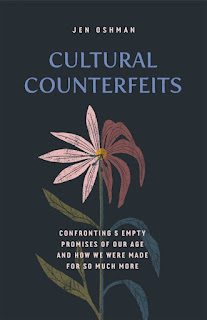
"Cultural Counterfeits" (Jen Oshman)

TITLE: Cultural Counterfeits: Confronting 5 Empty Promises of Our Age and How We Were Made for So Much More
AUTHOR: Jen Oshman
PUBLISHER: Wheaton, IL: Crossway Publishers, 2022, (208 pages).

Since the first sin committed by Adam and Eve, the human race has been living with emptiness in their hearts. Cain was deemed to become a restless wanderer. People become vulnerable to all kinds of temptations. The biggest weapon used by the evil one: Idolatry. As long as people could be led away from the Truth of Jesus, idols are pretty effective ways to stumble all people, especially believers.
The author begins by showing us how our modern culture has shaped our perceptions of feminism, liberal sex, free choice, and negative images of Christianity and the Church. Sadly, mainstream media has coloured people's general perception of the Christian faith. "The Handmaid's Tale" TV series caricatures Christianity as some fundamentalist cult that degrades women into mere child-bearing slaves. The "Da Vinci Code" makes people question the Church about hidden "secrets" of the past. For all the well-intentioned beginnings, parts of modern feminism have degenerated into detrimental movements that promoted the Sexual Revolution, of free love, including illicit sex. On the #MeToo movement, Oshman is convinced that this movement would never have happened "without millennia of influence from the Bible."  In this book, author Jen Oshman highlights five of the idols that pose extreme dangers to our spiritual lives. With women as her key audience, the author describes the five empty promises of the following idols:

Friday, August 28, 2020

"The Virus in the Age of Madness" (Bernard-Henri Lévy)

TITLE: The Virus in The Age of Madness
AUTHOR: Bernard-Henri Lévy
PUBLISHER: New Haven, CT: Yale University Press, 2020, (128 pages).

If we look at the year 2020, most people around the world would agree that life has changed forever. Social distancing is everywhere. People wear masks when they venture outdoors. A lot of people work from home. Air travel has been curtailed. More people are buying take-out instead of dining in. Schools are operating at less than normal capacity. Universities shift classes to online platforms. Welcome to the new normal. For some, this is a crazy phenomeon where entire lifestyles need to change because of a microscopic virus. With keen observation, author Bernard-Henri Lévy notes that the madness is not the virus but the reactions caused. Busy cities emptied out into ghost towns. Popular restaurants shut down. Pollution decreased as the number of stay-home workers increased. Violent demonstrations in HK and terrorism in other parts of the world too seem to have disappeared overnight. Most interestingly, we see how the little virus brings out the behaviours rarely seen under normal circumstances. They also bring out our appreciation for "invisible" group of workers such as caregivers, delivery personnel, garbage collectors, freight shippers, online workers, and so on. In a world that is shivering with fear, how about taking time to deal with the "innermost metaphysics" within us? There are a lot of things to be concerned. What we take at face value is often something that is deeply troubling. The author offers this book as a way to question conventional wisdom and the uncritical acceptance of top-down advice, especially from the politicians and the newly elevated social status of medical or health experts. 

Friday, December 22, 2017

"Reading People" (Anne Bogel)

TITLE: Reading People: How Seeing the World through the Lens of Personality Changes Everything
AUTHOR: Anne Bogel
PUBLISHER: Grand Rapids, MI: Baker Books, 2017, (224 pages).

Why do people behave in a certain way? How can we understand another person based on their behaviour? How can we better understand others and ourselves? Enter personality tests. These help us learn more about ourselves and give us a snapshot of who we are at any particular time. Many of these are based on scientific data and research. With choices lie a new challenge: Of the many  many personality tests out there, how do we choose? What are the differences between them? How do they stack up against one another? Here is where author Anne Bogel can help us navigate the potpourri of models. She talks about how the Myers-Briggs Type Indicator (16 personality types) help her understand her own unique characteristics, how it explains her marital relationship and understanding herself. She dwells on Carl Jung's famous introvert/extrovert temperaments and takes it beyond just human people but church structures. For instance, she observes that most denominational churches have programs that appeal more to extroverts, which becomes a challenge for the introvert. Looking at Elaine Aaron's "Highly Sensitive Person," we become more aware of how sensitive our nervous systems are to various stimulus. This is particularly useful for parents dealing with highly sensitive children. Then there is the popular "Five Love Languages" by Gary Chapman that essentially deals with our primary language that would stir us up emotionally. Kiersey's four basic temperaments are the Artisans (SP); Guardians (SJ); Idealists (NFs); and Rationals (NTs). Bogel goes into detail the Myers-Briggs Type Indicator, showing us what we need to know about the eight cognitive functions (combinations of extrovert/introvert perceptive (sensing or intuiting) and judging (thinking or feeling) functions. She takes time to explain what each of the eight cognitive functions mean and gives us three reasons for persisting in this self-analysis. First, it helps us to be confident of our own MBTI Type. Second, it helps us understand people. Finally, it helps us in our relationship as we adapt ourselves to adapt to the respective persons we deal with. She covers the "Clifton Strengthfinder" and confesses how this tool helps her love reading in the first place. Listing the 34 strengths, we learn about themes in executing; influencing; relationship-building; strategic-thinking; etc. The Enneagram is a personality framework that "fosters self-awareness and self-examination" to help us understand our spirituality. It is based on Evagrius Ponticus's eight or nine vices that impede our relationship with God. She then summarizes all the models and shares about the uniqueness and challenges of personality change vs behavioral change. While the results for us change over time, our core temperaments remain consistent. The more important questions are:

Friday, May 5, 2017

"Lay Counseling, Revised and Updated) (Siang-Yang Tan and Eric Scalise)

TITLE: Lay Counseling, Revised and Updated: Equipping Christians for a Helping Ministry
AUTHOR: Siang-Yang Tan and Eric Scalise
PUBLISHER: Grand Rapids, MI: Zondervan, 2016, (320 pages).

Many like to help but few are adequately trained to help, especially in the area of lay counseling. Most people prefer to leave it to the experts, the professionals, or the trained. Unfortunately, there are many situations in which it is difficult or impossible to get any of the above. It could be due to personal inhibitions or logistical barriers to get the expert. It could also be financial inability or time factors. Some might be willing but lack the training. Others might be trained but lack the opportunity to practice. Many counseling matters do not necessarily require professional help. Just a basic understanding of counseling and initial diagnosis can help channel needy people to the appropriate authorities. In the context of a Christian community, this book sees these cases as a great opportunity to equip the laity. Already a classic since it was published back in 1991, this book is now revised and updated for a new generation.

Like a primer for lay counseling,  the authors begin at the call for all; that being called to be an encourager also implies some levels of counseling and caregiving. Counseling is a big part of pastoral care. However, just the words 'pastoral care' may put off people who are non-clergy. We mught want to simply say 'helping ministry' which is essentially where both Tan and Scalise come from. Experienced counselors and certified psychologists, the authors have a deep desire to move people from superficial levels of help to a deeper more meaningful level. This does not require individuals to have graduate degrees in mental health or some special clergy training. Instead, it gives an introductory appreciation about the basics of counseling and provides tools for the layperson to use. Some of the features in this book include:

Thursday, October 20, 2016

"The Rewired Brain" (Dr Ski Chilton)

TITLE: The ReWired Brain: Free Yourself of Negative Behaviors and Release Your Best Self
AUTHOR: Dr Ski Chilton (with Dr Margaret Rukstalis and A.J. Gregory)
PUBLISHER: Grand Rapids, MI: Baker Books, 2016, (288 pages).

Many of us have heard about the left brain and right brain distinction when it comes to understanding the brain. Others look to the use of neurological concepts and scientific tests to determine how the brain functions. Some would use the different ways namely: brain, mind, experience, learning, and memory. Still, others would segregate the brain into forebrain, midbrain, and the hindbrain. Then there is the outer brain and the inner brain, and so on. In this book, Dr Ski Chilton, a Professor of Physiology and Pharmacology at Wake Forest School of Medicine has come together with an addiction psychiatrist, Dr Margaret Rukstalis, to propose two systems of thought within our brains: a "System 1" and a "System 2" brain.

  • System 1: Limbic and Reptilian systems that deal with human emotions, survival instincts, memory that deals with protection, and base functions like breathing, heartbeat, and main physiological functions of the body. This resides in the inner brain regions.
  • System 2: Neocortex: executive oversight, thinking, planning, visualizing, and decision making that matures around 25 years of age. This resides in the outer brain regions.

The key thesis in this book is that when both systems are balanced and optimal, we will be able to manage our negative behaviors and grow our best selves. The author believes that our brains can be rewired and we can become better people as long as we are conscious of our two systems. Using scientific data and research evidence, readers learn about the way the two systems work; how they interact; how they need each other; and how complex the brain is despite the simplified explanations. It is written in three parts, namely: Reflect; Reframe; and Rewire.

In "Reflect," we are asked to think about how we regularly let our emotions get the better of our decision making. We are reminded about over 25% of the American population having some form of mental illness. Before we can do any change, we need to be first convinced that something is wrong in the first place. We learn the importance of "differentiated parts of the brain" that enable us to maintain some self-control. We learn about the dangers of letting fear dictate our actions. Due to plasticity of brain functioning, both genetics and the environment can play crucial roles in rewiring the brain.

In "Reframe," we learn about what it means to be human; the biblical and the scientific perspectives of human behaviour; and how feelings can render us hopeless and helpless. Chilton also tackles the difficult topic of morality and the roots of what right and wrong means. He believes that morality breeds positive change. Tragedy can be very crippling to one's emotional development. Sharing about his own broken marriage and relationship struggles, he argues for the need to come to terms with our situations and ourselves. Acceptance may very well be the hardest but most necessary stage to arrive at. Apart from that, parenting may very well be the most difficult challenge one would encounter. He applies the System 1 and 2 paradigm to the parenting equation, arguing that parenting by guilt and over-parenting are essentially over-stimulations of System 1 brain functions. A well-differentiated person will be one who knows oneself; able to express appropriate emotions; and manages emotional dysfunctions at a timely and proper manner. He allocates a chapter on sex and intimacy to describe how our brain functions can impact our sexuality and our most intimate relationships. Practiced well, it is a gift. Abuse it and it becomes a liability.

In "Rewire," we have some self-discovery and self-exploratory exercises to stretch our understanding, our learning, and our self-awareness. The question of our own identity helps us to remember our most significant positive and negative moments of our lives. We are challenged to get others to share about their opinions of us. We learn that surrender is a healthy emotion and acknowledgement that we are not always in control. Gradually, we are encouraged to seek forgiveness for our weaknesses, and to find freedom in acceptance.

So What?
The single biggest takeaway for me is how Chilton describes the world of two minds. While admitting that the brain is a complex structure that cannot be hemmed down by any one theory or concept, he argues convincingly that we can still try to understand in broad strokes. These broad strokes cover only a small fraction of the potential of the brain and yet can bring about powerful and beneficial changes. If the brain is changeable, why not change it for the better? Why let ourselves be enslaved by reptilian behavior that can easily unravel our base emotions? Why not learn about positive ways to be a better person?

Each chapter ends with a set of questions for readers to reflect and to discover oneself more. At times, the book does appear to over-simplify aspects of the brain. This is a necessary step because not all of us are neurosurgeons or brain scientists. Neither are we trained to psychoanalyze ourselves. This System 1/2 manner of thinking helps us in ensuring we do not become imbalanced in the use of our brains. Only through practice can we improve and rewire our brains. As relational people, we need others to help us along this journey. Thus, the way forward with regard to practicing the principles of this book is to read it together with someone else. Whether it is one's spouse, friend, or colleague, it has to be done in an environment of trust. I can think of no better place than a community of faith where members are committed to help one another grow and flourish.

Rating: 4.75 stars of 5.

conrade

This book is provided to me courtesy of Baker Books and Graf-Martin Communications in exchange for an honest review. All opinions offered above are mine unless otherwise stated or implied.

Monday, August 15, 2016

"Human Being and Becoming" (David G. Benner)

TITLE: Human Being and Becoming: Living the Adventure of Life and Love
AUTHOR: David G. Benner
PUBLISHER: Grand Rapids, MI: Brazos Press, 2016, (154 pages).

What does it mean to be human? How do we become the fullest expression of ourselves? What is the relationship between being, becoming, and doing? These questions are explored in this latest book by popular spiritual writer, David Benner. Making a distinction between "deeply human" and "more than human," the way is not to look for something beyond ourselves but to dig deeper into the essence of who we are. In a nutshell, the doing flows out of our becoming, and our becoming stems out of our sense of being. There is growth and development. He contrasts this authenticity with some wrong understanding of what human means. It is not about the faulty side of us when we say "we're only human." Neither is being human a chore to be struggled with. Instead, it is a gift to be received. Becoming human is essentially connecting the doing with the becoming, and the becoming with the essence of our beings. It is a human journey that comprises a "symphony of movement and rest, progress and regress, effort and consent, holding and releasing." Becoming human is an exciting venture. The three big themes of the book are:
  1. The Wholeness of Reality
  2. The Importance of the Human Heart
  3. Love as the Foundation of all Being and Becoming

Wednesday, June 29, 2016

"How to Read Water" (Tristan Gooley)

TITLE: How to Read Water: Clues and Patterns from Puddles to the Sea
AUTHOR: Tristan Gooley
PUBLISHER: New York, NY: The Experiment, 2016, (368 pages).

Water is everywhere around us. They are visible in the clouds and the rains; the rivers and the streams; the lakes and the oceans. We use it to hydrate our gardens; to cook our meals; to wash our premises; and many other aspects of life. Just as water has many uses, if we take the time to consider what we are looking for, water can be interpreted in both philosophical as well as practical ways. Rather than to reduce it to the level of meaning only according to the eyes of the beholder, the author believes that with wisdom and intuition, there is more to water than the physical images that meet the eye. Several things move Tristan Gooley on her quest for discovering the meaning of water. First, knowing how to read the clues in puddles and streams can give us a good idea of what it happening underneath them. Second, it is easier to learn about water when our feet is on firm ground. Third, reading water is a unique navigational skill. Four, there is a mystery about water that can deepen the wonder and appreciation of this precious resource.


Monday, July 28, 2014

"Listening to Scent" (Jennifer Peace Rhind)

TITLE: Listening to Scent: An Olfactory Journey With Aromatic Plants and Their Extracts
AUTHOR: Jennifer Peace Rhind
PUBLISHER: Philadelphia, PA: Jessica Kingsley Publishers, 2014, (164 pages).

Of all the five human senses of seeing, hearing, tasting, touch, and smelling, the least developed is arguably the last one. I remember having a conversation among friends about how technology had been able to replicate human sensory patterns upon computers. Visually we use high resolution images. Audibly, we can produce high fidelity sound devices, headsets, and great sound effects. Touch-wise, we have the mouse, the keyboard, and of course the modern touch screens available with tablets and modern computers. The senses of taste and smell are the least developed. This book is about cultivating a sense of smell through listening, learning, and cultivating our olfactory faculties. According to the author, a biologist with a PhD in mycotoxicology, there are other benefits such as improved cognitive abilities, general well-being, even healthy aging! Written in three parts, the book covers smell and scent matters through educating, profiling, and experiencing.

Tuesday, October 1, 2013

"Take Charge of Your Emotions" (Linda J Solie)

TITLE: Take Charge of Your Emotions: Seven Steps to Overcoming Depression, Anxiety, and Anger
AUTHOR: Linda J Solie
PUBLISHER: Bloomington, MN: Bethany House Publishers, 2013, (272 pages).

Healthcare is a huge industry. From physical to mental well-being; from emotional to spiritual care; from the visible to the invisible signs or symptoms, more people are acknowledging that the holistic approach to medicine and personal health is key to a healthy life. Yet, the science of holistic medicine remains largely untapped. Medical professionals are well trained with regards to recognizing and treating symptoms of ailments and illnesses. When it comes to curing and enabling recovery, they require a lot of help from others such as psychological support, mental health counselors, spiritual guides, psychiatrists, medical technologists, and human care. In fact, self-care is also a critical component in the general well-being of a person. In this book, Dr Linda Solie, a licensed psychologist in Minnesota with 30 years of hands-on cognitive and behavioural experience, shares with readers about how one can learn to cultivate self-awareness and self-care, taking charge of one's emotions. Instead of not knowing what to do, this book is a guide for the perplexed, a breath of fresh perspective on understanding oneself, and wise steps to enable one to respond positively during times of depression, anxiety, and anger. Instead of using medication and antidepressants as a first step, Solie recommends it on the basis of three kinds of relationships:
  1. Relationships with our ownselves (mentally, emotionally, behaviorally);
  2. Relationship with Jesus (spiritually);
  3. Relationship with others (socially).

Monday, May 21, 2012

"Praying with the Grain" (Pablo Martinez)

TITLE: Praying with the Grain: How Your Personality Affects the Way You Pray
AUTHOR: Pablo Martinez
PUBLISHER: Grand Rapids, MI: Kregel Publications, 2012, (176 pages).

Why is prayer so easy for some people, and difficult for others? Why are some people uncomfortable about praying in public? How do I learn to pray with pleasure rather than pressurize ourselves to pray? Is there a way to pray in a way that befits how we are created, like our personality types? What about prayer as a psychological projection? Are Christians imagining a divine person in their prayers? These questions and many more are tackled in this very insightful book about personality types, psychology, psychotherapy, Christianity, temperaments and how prayer can be therapeutic and also spiritual.

In this book, Pablo Martinez describes the psychology and the apologetics of prayer. In Part One, "The Psychology of Prayer," Martinez highlights three factors that directly affect our praying, namely; our temperament, our personality, and our circumstances. All of these are not separate entities but play varying roles according to the interactions of our mental, emotional, and spiritual being. For temperament, Martinez uses Carl Jung's classification of two general attitudes (introvert, extrovert) and four psychological types (thinking, sensation, feeling, intuitive). For instance, introverts tend to prefer praying in private while extroverts are comfortable in public prayer gatherings. Introverts prefer meditation while extroverts work better through activities. The author is careful to point out that such classifications are simply tendencies rather than totalities.

Psychological Profiling

Jungian Four Personalities
On the psychological profile, Martinez believes that while everyone exhibits a little of thinking, of sensing, of feeling, and of intuition, only one trait is dominant. The problem occurs when there is an imbalance of all four to the point that this dominant trait grows at the expense of the rest. The healthy condition is for the dominant trait to be strengthened and not undermine the rest. For example, while we can cultivate our strengths, it is good to be aware of our weaknesses. We can train ourselves in such a way to train ourselves accordingly, knowing our psychological tendencies. This helps immensely when it comes to relationships. With this understanding, thinking types tend to be more objective over the subjective. The Apostle Paul and Martin Luther are thinking types.

At the other end of thinking, there is the Feeling types that use emotions more expressively than the thinking types. Feelers are more sympthetic to social causes and reactive to injustice they see. For them, they step forward with heart first. The biblical character, Jeremiah is an example of Feeling personality.

Then there is the Intuitive type that sees the possibilities, contemplate better, and more apt toward the presence of God in prayer. Mystics like Theresa of Avila, St John of the Cross, are known as intuitives. The missionary David Livingstone is also another example. Intuitives shun methodical praying, preferring freedom in approaching God.

On the other end of the vertical spectrum is the sensation which responds more readily to external senses. For them, perception is key in their seeing, their hearing, their touching. While they can enter into prayer quite readily, they are also susceptible to the ups and downs of everyday living.

The three recommendations that Martinez gives are the need to accept ourselves as we are, accepting one another, and to strike a "temperamental balance."

The rest of Part One deals with how the various temperaments and personality types interact with regards to overcoming difficulties and therapeutic element of prayer.

Apologetics of Prayer

Part Two addresses two basic questions. The first is about psychology and prayer. The second covers the comparison between Christian prayer and Eastern meditation. In it, Martinez engages a challenging aspect of psychological versus prayer, painstakingly distinguishing one from the other, clarifying the purposes of each and how they can complement, not supplant each other. There is a powerful explanation that prayer is not another form of "self-suggestion" because of three factors. First, unlike self-suggestion, the purpose of prayer is not evasive from reality, but seeking a known God. Second, the object of prayer is not a hysterical or "uncritical compliance" designed to please man but a journey toward God in peace, order and balance, zeal and fire.Third, the duration of prayer outruns that of self-suggestion. Prayer is also not behaviorism which is essentially us growing out or away from something, but growing in love more toward God. Martinez finishes his book with a brief comparison of Christian prayer and Eastern Meditation in terms of differences in purpose, means, and how it leads to valuing the person concerned.

My Thoughts

This book is rich. It dives in deep into explaining the psychological and temperamental traits of a person without becoming lost in the psychotherapy world. In fact, the author makes it a point to constantly check back on Christian principles and biblical perspective of it all. Even the analyses of each personality profile are measured carefully. It is clear that the author does not want to paint a picture of a one-size-fits-all scenario for all readers. Instead, the author invites us to consider the different personality types, understand the nuances, and the importance of depending on the Holy Spirit to show us ourselves. He deals with some of the most difficult questions asked.

  1. Is pain a spiritual or psychological problem?
  2. How do we make sense of feelings in prayer and intercession?
  3. Is it ok to ask for things for ourselves?
  4. How do we know God's will?
  5. What to do with bad thoughts in our praying?
  6. How do we avoid over-analyzing things when we pray?
What Martinez is trying to drive at throughout the book is that prayer is not only necessary but a vital return back to the first relationship we have with God, through Jesus Christ our Lord. Everyone of us can pray, albeit differently. The book is more descriptive rather than prescriptive. What is missing are some basic questionnaires that can help readers at least to get some snapshot of their own tendencies. For after reading and appreciating the different prayer personality types, I am still not sure where I am. Moreover, while Martinez affirms the unity of the mental, the body, and the spirit, his wholesale adoption of Jungian concepts makes it challenging for the reader in knowing how to integrate them intuitively. It gives me a feeling of the book being easy to understand but difficult to apply.

What is more helpful in the book is the way Martinez answer the various questions regarding overcoming difficulties in prayer, prayer and psychology, eastern meditation and Christian prayer, and the various apologetics. If that is your area of interest, this book is a must read.

Rating: 4 stars of 5.


conrade


This book is provided to me free by Kregel Publications without any obligation for a positive review. All opinions offered above are mine unless otherwise stated or implied.