TITLE: The Art of Preaching Old Testament Poetry
AUTHOR: Steven D. Mathewson
PUBLISHER: Grand Rapids, MI: Baker Academic, 2024, (256 pages).
This is an excellent book about preaching from the wisdom and poetic books of the Old Testament. Filled with lots of biblical insights, historical backgrounds, and illuminating observations, preachers will be excited when reading about the many ways to approach the Psalms, Proverbs, Job, Ecclesiastes, and Song of Songs. Written for those who preach and teach Scripture, author and professor Steven Mathewson takes us through these five books, to give us tips on teaching and preaching strategies. He typically begins with a description of what the texts are saying. He patiently elucidates the purposes of each book by ensuring that we do not put the cart before the horse. For instance, in Psalms, he shows us the emotive components of the Psalms, to ensure we are aware of the stance of each psalm and the emotional plot development. In Proverbs, he reminds us to be mindful of Proverbs 1:1-7, which shows us the purposes of the wisdom texts. In Job, he reminds us to discern the structure and flow of the arguments and counter-arguments. In Ecclesiastes, he calls us to first examine the structure, and understand its perspective, keywords, and concepts, before preaching it. He covers the general and specific structures of the book, taking care to supply the framework of the book before leading us through some powerful strategies for preaching. That is not all. He gives us helpful resources for studying and preaching, leading us to some of the most valuable resources for the Bible book concerned. For instance, in Proverbs, he recommends Bruce Waltke's monumental work on Proverbs. For Job, he highlights John Walton's NIV Application Commentary and Daniel Estes's Teach the Text series, etc. For Ecclesiastes, he takes guidance from Iain Provan, Craig Bartholomew, etc. Many pointers can also be gleaned from "The Big Idea Companion for Preaching and Teaching." Mathewson uses Dr. Haddon Robinson's Big-Idea expository Preaching throughout the book. This is no surprise given that the late professor was his mentor. (Dr. Robinson was my mentor too!) At the end of the book, Mathewson gives us six sample sermons, two from Psalms and one from each of the other Bible books concerned to illustrate his points.
"Good books do not make saints, but they can nudge one a little closer." (Conrade Yap)
Showing posts with label Wisdom. Show all posts
Thursday, December 12, 2024
"The Art of Preaching Old Testament Poetry" (Steven D. Mathewson)
Labels:
Baker Academic,
Bible,
Christianity,
Communications,
Job,
Netgalley,
Old Testament,
People,
Poems,
Poetry,
Preaching,
Psalms,
Theology,
Wisdom
Wednesday, December 4, 2024
"Discern" (Mark E. Thibodeaux)
TITLE: Discern: Listening for God's Whispers
AUTHOR: Mark E. Thibodeaux
PUBLISHER: Chicago, IL: Loyola Press, 2024, (100 pages).
How do we listen to God? The Bible tells how Elijah could distinguish God's voice from the earthly elements of earthquake, wind, and fire? In a busy distraction-filled world, how do we discern God's leading? Based on the teachings of St Ignatius of Loyola, author Mark Thibodeaux leads us through the two key Ignatian themes: Consolation and Desolation. Consolation is feeling uplifted, peaceful, and connected to God. Desolation is a state of emptiness, restlessness, or inner turmoil. The way of discernment is the way of consolation over desolation. Each page comprises a subject to think, ponder, and pray about. Presented with a brief and concise description, the empty spaces let the subject percolate through our minds and encourage us to pray. We learn to distinguish listening to God versus listening to other voices of distraction. This requires fine-tuning our spiritual senses. It puts the being before the doing. Listening helps us detect the forces pulling us away or toward God. Each page shows us how to recognize the tensions between consolation and desolation. This includes questions to challenge ourselves. Discerning desolation are questions like:
AUTHOR: Mark E. Thibodeaux
PUBLISHER: Chicago, IL: Loyola Press, 2024, (100 pages).
How do we listen to God? The Bible tells how Elijah could distinguish God's voice from the earthly elements of earthquake, wind, and fire? In a busy distraction-filled world, how do we discern God's leading? Based on the teachings of St Ignatius of Loyola, author Mark Thibodeaux leads us through the two key Ignatian themes: Consolation and Desolation. Consolation is feeling uplifted, peaceful, and connected to God. Desolation is a state of emptiness, restlessness, or inner turmoil. The way of discernment is the way of consolation over desolation. Each page comprises a subject to think, ponder, and pray about. Presented with a brief and concise description, the empty spaces let the subject percolate through our minds and encourage us to pray. We learn to distinguish listening to God versus listening to other voices of distraction. This requires fine-tuning our spiritual senses. It puts the being before the doing. Listening helps us detect the forces pulling us away or toward God. Each page shows us how to recognize the tensions between consolation and desolation. This includes questions to challenge ourselves. Discerning desolation are questions like:
Labels:
Christian Life,
Discernment,
Loyola Press,
Netgalley,
Prayer,
Spirituality,
Wisdom
Tuesday, July 30, 2024
"Claiming the Courageous Middle" (Shirley A. Mullen)
TITLE: Claiming the Courageous Middle: Daring to Live and Work Together for a More Hopeful Future
AUTHOR: Shirley A. Mullen
PUBLISHER: Grand Rapids, MI: Baker Academic, 2024, (200 pages).
"The nation is divided." "Society is broken." "Why can't we all just get along?" These are common phrases heard these days. From politics to religious matters; human rights to social justice; systemic racism to various inequalities; people are becoming more vocal about their stand. This has led to a host of problems never seen before in the previous century. Largely driven by social media's ease and speed of public expression, people are arguing not just in public places but also on private platforms. In such a polarized climate, there is a tendency for all sides to drag people and opinions either to the left or to the right. Diversity can be divisive. What about the middle? Up comes the notion of a "courageous middle." Seeing the deep divisions across America today, author Shirley Mullen sees the need for this position more than ever. As the world gets pulled apart by binary mindsets, it becomes a challenge to find a middle ground for all. Mullen urges the expansion of the middle space that sees the common good and also does not necessarily take sides. She aims directly at three groups of people. The first group includes those that stereotype the middle position negatively. The second group is for those who want to play the role of peacemakers and reconciliation. The third group is for those who tend to lament but seem helpless to do anything about it. Driven by her concern for the rising levels of polarization in society, media, and churches, she recognizes a sizable number of undecided people; who are on neither end of the poles; or unwittingly caught up in the middle. Mullen argues that taking the middle is "one form of faithful witness" for Jesus.
AUTHOR: Shirley A. Mullen
PUBLISHER: Grand Rapids, MI: Baker Academic, 2024, (200 pages).
"The nation is divided." "Society is broken." "Why can't we all just get along?" These are common phrases heard these days. From politics to religious matters; human rights to social justice; systemic racism to various inequalities; people are becoming more vocal about their stand. This has led to a host of problems never seen before in the previous century. Largely driven by social media's ease and speed of public expression, people are arguing not just in public places but also on private platforms. In such a polarized climate, there is a tendency for all sides to drag people and opinions either to the left or to the right. Diversity can be divisive. What about the middle? Up comes the notion of a "courageous middle." Seeing the deep divisions across America today, author Shirley Mullen sees the need for this position more than ever. As the world gets pulled apart by binary mindsets, it becomes a challenge to find a middle ground for all. Mullen urges the expansion of the middle space that sees the common good and also does not necessarily take sides. She aims directly at three groups of people. The first group includes those that stereotype the middle position negatively. The second group is for those who want to play the role of peacemakers and reconciliation. The third group is for those who tend to lament but seem helpless to do anything about it. Driven by her concern for the rising levels of polarization in society, media, and churches, she recognizes a sizable number of undecided people; who are on neither end of the poles; or unwittingly caught up in the middle. Mullen argues that taking the middle is "one form of faithful witness" for Jesus.
Labels:
Baker Academic,
Christian Life,
Christianity,
Evangelicalism,
Faith,
Hope,
Netgalley,
People,
Politics,
Society,
Theology,
Wisdom
Monday, February 5, 2024
"Practices for Embodied Living: Experiencing the Wisdom of Your Body" (Hilary L. McBride)
TITLE: Practices for Embodied Living: Experiencing the Wisdom of Your Body
AUTHOR: Hillary L. McBride
PUBLISHER: Grand Rapids, MI: Brazos Press, 2024, (160 pages).
Our experiences do not define us. Our real selves do. Our bodies are not simply what we have but they are who we are. We are more than mere subjective people. We are valued for who we are and not what we do. All that we encounter in this life, the highs and the lows, can all be experienced in the very bodies we have. Unfortunately, many people still have not learned how to appreciate their bodies. In doing so, they fall victim to lies and myths that throw negativity to their physique or biological selves. Lies such as the need to subdue our bodies because they are inherently evil; that some bodies are better than others, or fat bodies are unhealthy, etc. As our bodies get devalued, we become disembodied beings. Disembodiment separates our physical selves from the rest of our mental and emotional faculties. Embodiment brings all of them together. More importantly, we are called not to learn or relearn what our bodies are or represent. We simply need to remember that. These and many more underline the premise of this book, which is to bring back a healthy appreciation of the bodies we have so that we can live well. This also means we need to see personhood in a holistic manner: Emotionally, Mentally, Physically, Socially, and even Spiritually. Besides helping us address lies we tell ourselves, this book also looks at the violence on our bodies, such as stress and trauma; illnesses, injuries, and pain; oppressive forces; self-esteem; etc.
AUTHOR: Hillary L. McBride
PUBLISHER: Grand Rapids, MI: Brazos Press, 2024, (160 pages).
Our experiences do not define us. Our real selves do. Our bodies are not simply what we have but they are who we are. We are more than mere subjective people. We are valued for who we are and not what we do. All that we encounter in this life, the highs and the lows, can all be experienced in the very bodies we have. Unfortunately, many people still have not learned how to appreciate their bodies. In doing so, they fall victim to lies and myths that throw negativity to their physique or biological selves. Lies such as the need to subdue our bodies because they are inherently evil; that some bodies are better than others, or fat bodies are unhealthy, etc. As our bodies get devalued, we become disembodied beings. Disembodiment separates our physical selves from the rest of our mental and emotional faculties. Embodiment brings all of them together. More importantly, we are called not to learn or relearn what our bodies are or represent. We simply need to remember that. These and many more underline the premise of this book, which is to bring back a healthy appreciation of the bodies we have so that we can live well. This also means we need to see personhood in a holistic manner: Emotionally, Mentally, Physically, Socially, and even Spiritually. Besides helping us address lies we tell ourselves, this book also looks at the violence on our bodies, such as stress and trauma; illnesses, injuries, and pain; oppressive forces; self-esteem; etc.
Labels:
Brazos,
Christian Life,
Counseling,
Health,
Netgalley,
People,
Religion,
Spiritual Gifts,
Spirituality,
Wisdom
Wednesday, February 15, 2023
"Signals of Transcendence" (Os Guinness)
TITLE:
Signals of Transcendence - Listening to the Promptings of Life
AUTHOR: Os Guinness
PUBLISHER: Downers Grove, IL: InterVarsity Press, 2023, (132 pages).
How do people find faith in God? What led them to recognize the divine presence in their lives? Why do people believe in God? Respected author Os Guinness tells us that it all boils down to positive responses toward divine promptings. These promptings come in many different forms. A lot of us might be expecting amazing signs and wonders happening in the terrestrial heavens or the skies above. Truth is, things often happen amid the ordinary circumstances of life. Sometimes, it occurs in periods of immense crises. "There must be something more to life as we know it." This is the basic question to gear one up toward anticipation of something bigger than ourselves. As people become more inward-looking, society is in need of people to have an outward-looking mindset. Lest we become a nation of self-loving, self-indulgent, and self-centered people. Ironically, the first step toward being more other-centered is the right perspective of oneself. The fundamental questions asked by Guinness all revolve around self-awareness and self-discovery: "Who am I? Why am I here? What is life all about?" I believe everybody asks one or more of these questions from time to time. If not, they would have been prompted in some ways, in what the author entitles, "signals of transcendence." For the Irish, these are "thin places."
AUTHOR: Os Guinness
PUBLISHER: Downers Grove, IL: InterVarsity Press, 2023, (132 pages).
How do people find faith in God? What led them to recognize the divine presence in their lives? Why do people believe in God? Respected author Os Guinness tells us that it all boils down to positive responses toward divine promptings. These promptings come in many different forms. A lot of us might be expecting amazing signs and wonders happening in the terrestrial heavens or the skies above. Truth is, things often happen amid the ordinary circumstances of life. Sometimes, it occurs in periods of immense crises. "There must be something more to life as we know it." This is the basic question to gear one up toward anticipation of something bigger than ourselves. As people become more inward-looking, society is in need of people to have an outward-looking mindset. Lest we become a nation of self-loving, self-indulgent, and self-centered people. Ironically, the first step toward being more other-centered is the right perspective of oneself. The fundamental questions asked by Guinness all revolve around self-awareness and self-discovery: "Who am I? Why am I here? What is life all about?" I believe everybody asks one or more of these questions from time to time. If not, they would have been prompted in some ways, in what the author entitles, "signals of transcendence." For the Irish, these are "thin places."
Labels:
Biography,
Christian Life,
Discernment,
Faith,
IVP,
Life,
Netgalley,
Prayer,
Wisdom
Saturday, December 24, 2022
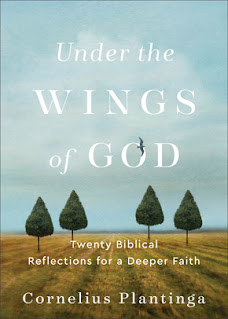
"Under the Wings of God" (Cornelius Plantinga)
TITLE: Under the Wings of God
AUTHOR: Cornelius Plantinga
PUBLISHER: Grand Rapids, MI: Brazos Press, 2023, (192 pages).
Ordinary believers honour the Bible. Church-goers read the Bible. Academics analyze the Bible. Devotees meditate on the Bible. Pastors preach the Bible. Authors write about the Bible. It would seem like the Bible is used in so many different ways. Those seeking a closer walk with God will not be content with any form of superficial reading. They will also meditate and contemplate the Word of God. As purposed in the cover of this book, renowned Professor Cornelius Plantinga shares 20 reflections to help us grow deeper in faith. In each chapter, he begins with the full Bible passage and a brief description. This is followed by a reflection which occupies the bulk of the chapter. Ending each chapter is a prayer. Plantinga starts with Ps 91 where a cursory reading would say it is about security in God. A deeper reading would be an exhortation not to worry. He takes the greatest commandment in Matthew 22:37 and applies it powerfully to the intellectual pursuit of God, something that some ordinary believers tend to dismiss as a mere academic exercise. The key lies in the reason for the study: Loving God more with the mind. We read about Colossians 3's exhortation to patience and how the author connects it with other attributes like anger management. Some of the most powerful reflections happen to be the way conventional beliefs are turned on their heads. For example, in Exodus 32, the text describes how the Israelites turned away from God and worshiped the golden calf. Plantinga describes the episode in such a way that we can all see the dangers and pain of adultery. While most people would dismiss Israel then as the adulterous nation that is only bent on disappointing God, a closer reading reveals that was not the case. They may have worshiped other gods but they still have the desire to worship the True God. They simply are people who practice spiritual polygamy. While the Bible condemns adultery in its strongest terms, there is also grace that overwhelms punishment for sin. Following this thread, in Genesis 4:1-16, there is the story of Cain and Abel where jealousy turned to murder. This led to the banishment of Cain who became cursed to be a restless wanderer. Further reflection points to a man though tarnished by sin still desires a close relationship with God. This is not something that we can pick up unless we observe the way the text was written.
AUTHOR: Cornelius Plantinga
PUBLISHER: Grand Rapids, MI: Brazos Press, 2023, (192 pages).
Ordinary believers honour the Bible. Church-goers read the Bible. Academics analyze the Bible. Devotees meditate on the Bible. Pastors preach the Bible. Authors write about the Bible. It would seem like the Bible is used in so many different ways. Those seeking a closer walk with God will not be content with any form of superficial reading. They will also meditate and contemplate the Word of God. As purposed in the cover of this book, renowned Professor Cornelius Plantinga shares 20 reflections to help us grow deeper in faith. In each chapter, he begins with the full Bible passage and a brief description. This is followed by a reflection which occupies the bulk of the chapter. Ending each chapter is a prayer. Plantinga starts with Ps 91 where a cursory reading would say it is about security in God. A deeper reading would be an exhortation not to worry. He takes the greatest commandment in Matthew 22:37 and applies it powerfully to the intellectual pursuit of God, something that some ordinary believers tend to dismiss as a mere academic exercise. The key lies in the reason for the study: Loving God more with the mind. We read about Colossians 3's exhortation to patience and how the author connects it with other attributes like anger management. Some of the most powerful reflections happen to be the way conventional beliefs are turned on their heads. For example, in Exodus 32, the text describes how the Israelites turned away from God and worshiped the golden calf. Plantinga describes the episode in such a way that we can all see the dangers and pain of adultery. While most people would dismiss Israel then as the adulterous nation that is only bent on disappointing God, a closer reading reveals that was not the case. They may have worshiped other gods but they still have the desire to worship the True God. They simply are people who practice spiritual polygamy. While the Bible condemns adultery in its strongest terms, there is also grace that overwhelms punishment for sin. Following this thread, in Genesis 4:1-16, there is the story of Cain and Abel where jealousy turned to murder. This led to the banishment of Cain who became cursed to be a restless wanderer. Further reflection points to a man though tarnished by sin still desires a close relationship with God. This is not something that we can pick up unless we observe the way the text was written.
Labels:
Brazos,
Christianity,
Devotional,
God,
Netgalley,
Reflections,
Small Groups,
Suffering,
Wisdom
Tuesday, December 13, 2022
"Peaceful Discipline: Story Teaching, Brain Science & Better Behavior" (Sarah R. Moore)
TITLE: Peaceful Discipline: Story Teaching, Brain Science & Better Behavior
AUTHOR: Sarah R. Moore
PUBLISHER: St Paul's, MN: Beaver's Pond Press, 2022, (292 pages).
Taking care of children is challenging. Disciplining them is even harder. For some, it is utterly impossible. Ask any parent and they will quickly tell you about their agonizing stories. For many parents, this will be unsurprisingly familiar, especially when children misbehave or refuse to follow simple instructions. While many in the East will not hesitate to use spanking or some form of physical punishment to instill proper discipline, many of their counterparts in the West prefer the use of verbal and firm instructions. Somehow, the latter might admit privately how they wish they could "hammer" their kids when they are at their wits' end. Author Sarah Moore confesses how her anger had taught her to be gentle, which provides the starting point for this very book: Using non-physical strategies to inculcate better behavior. She calls this process "Peaceful Discipline." Interestingly, her anger rose not from her own kids but from her pediatrician! Rather than to let anger wear her down, she decides to channel this into learning moments. That is her basis for "story teaching" that helps children do four things: Observe, Listen, Research, and Try. She shares about the common storytelling strategies adopted in many cultures around the world. The reason why such strategies work is simply because it is how human beings learn and behave. She takes an additional step to assert how story-teaching is different from story-telling. The former is preventative (preparing), in the moment (grounding), and restorative (redeeming).
AUTHOR: Sarah R. Moore
PUBLISHER: St Paul's, MN: Beaver's Pond Press, 2022, (292 pages).
Taking care of children is challenging. Disciplining them is even harder. For some, it is utterly impossible. Ask any parent and they will quickly tell you about their agonizing stories. For many parents, this will be unsurprisingly familiar, especially when children misbehave or refuse to follow simple instructions. While many in the East will not hesitate to use spanking or some form of physical punishment to instill proper discipline, many of their counterparts in the West prefer the use of verbal and firm instructions. Somehow, the latter might admit privately how they wish they could "hammer" their kids when they are at their wits' end. Author Sarah Moore confesses how her anger had taught her to be gentle, which provides the starting point for this very book: Using non-physical strategies to inculcate better behavior. She calls this process "Peaceful Discipline." Interestingly, her anger rose not from her own kids but from her pediatrician! Rather than to let anger wear her down, she decides to channel this into learning moments. That is her basis for "story teaching" that helps children do four things: Observe, Listen, Research, and Try. She shares about the common storytelling strategies adopted in many cultures around the world. The reason why such strategies work is simply because it is how human beings learn and behave. She takes an additional step to assert how story-teaching is different from story-telling. The former is preventative (preparing), in the moment (grounding), and restorative (redeeming).
Labels:
Children,
Discernment,
Disciplines,
Indie,
Netgalley,
Parenting,
Peace,
Stories,
Wisdom
Thursday, November 18, 2021
"Speaking By the Numbers" (Sean Palmer)
TITLE: Speaking by the Numbers: Enneagram Wisdom for Teachers, Pastors, and Communicators
AUTHOR: Sean Palmer
PUBLISHER: Downers Grove, IL: InterVarsity Press, 2022, (192 pages).
According to the scholar Maurice Nicholl, we all have three "Centers of Intelligence: thinking, feeling, and doing." This is the key concept used in the development of the Enneagram tool, to help us understand more about our personality types and ourselves. From understanding the self, we are reminded of the core essence of life: Relationship and Community. For pastor and public speaker Sean Palmer, the Enneagram is a powerful tool for communications, and more importantly to understand ourselves and how we could play our roles in building the community we are in. Essentially, there are nine ways we could see the world. Yes, that's NINE! It is more than simply a mapping system. It is a lens to help us see what we react to different situations in life. As the saying goes: "We don't see the world as it is, we see it as we are." In other words, we are not what we are but what we see we are. The nine personality types are:
AUTHOR: Sean Palmer
PUBLISHER: Downers Grove, IL: InterVarsity Press, 2022, (192 pages).
According to the scholar Maurice Nicholl, we all have three "Centers of Intelligence: thinking, feeling, and doing." This is the key concept used in the development of the Enneagram tool, to help us understand more about our personality types and ourselves. From understanding the self, we are reminded of the core essence of life: Relationship and Community. For pastor and public speaker Sean Palmer, the Enneagram is a powerful tool for communications, and more importantly to understand ourselves and how we could play our roles in building the community we are in. Essentially, there are nine ways we could see the world. Yes, that's NINE! It is more than simply a mapping system. It is a lens to help us see what we react to different situations in life. As the saying goes: "We don't see the world as it is, we see it as we are." In other words, we are not what we are but what we see we are. The nine personality types are:
- The Perfectionist: "What is wrong with the world?"
- The Giver: "How can I help?"
- The Performer: "What are my goals and accomplishments?"
- The Tragic Romantic: "Why is life so disappointing?"
- The Observer: "What data supports this trend?"
- The Devil's Advocate: "What if Plan A doesn't work?"
- The Epicure: "There is always hope!"
- The Boss: "How do I keep the house in order?"
- The Mediator: "What can I do to maintain peace?"
Labels:
Communications,
Health,
IVP,
Netgalley,
People,
Relationships,
Spirituality,
Wisdom
Monday, November 1, 2021
"On Living Well" (Eugene H. Peterson)
TITLE: On Living Well: Brief Reflections on Wisdom for Walking in the Way of Jesus
AUTHOR: Eugene H. Peterson
PUBLISHER: New York, NY: Waterbrook Multnomah, 2021, (240 pages).
This book is an invitation to live well. Notice life and how people are living it, and learn from it. While ordinary life may seem to be nothing special to most people, learning to notice the meaning in ordinary life can have a special impact. In this never before published collection of reflections and spiritual thoughts from the late Eugene Peterson, we learn of how he manages to draw profound spiritual insights from ordinary life. Just like creation, he manages to focus on the Word as the beginning of all life and laments at how the world treats too casually the dignity of life. Peterson takes us to ponder on the significance of the beginning of the Word without which there is no beginning for any life. He connects birth to our second birth in Christ. Affirming our calling in Christ, we are reminded that spiritual warfare is real and requires believers to be constantly ready to shine for Christ. Yet, he reminds us that Christians are like round holes trying to fit into a square-pegged world. Written like a devotional, the book contains spiritual gems taken from Peterson's two decades of his weekly newsletter he circulated to his Church members at Christ Our King Presbyterian Church. Along with unpublished material from his archives and sermons, the publishers have compiled them into five headings:
AUTHOR: Eugene H. Peterson
PUBLISHER: New York, NY: Waterbrook Multnomah, 2021, (240 pages).
This book is an invitation to live well. Notice life and how people are living it, and learn from it. While ordinary life may seem to be nothing special to most people, learning to notice the meaning in ordinary life can have a special impact. In this never before published collection of reflections and spiritual thoughts from the late Eugene Peterson, we learn of how he manages to draw profound spiritual insights from ordinary life. Just like creation, he manages to focus on the Word as the beginning of all life and laments at how the world treats too casually the dignity of life. Peterson takes us to ponder on the significance of the beginning of the Word without which there is no beginning for any life. He connects birth to our second birth in Christ. Affirming our calling in Christ, we are reminded that spiritual warfare is real and requires believers to be constantly ready to shine for Christ. Yet, he reminds us that Christians are like round holes trying to fit into a square-pegged world. Written like a devotional, the book contains spiritual gems taken from Peterson's two decades of his weekly newsletter he circulated to his Church members at Christ Our King Presbyterian Church. Along with unpublished material from his archives and sermons, the publishers have compiled them into five headings:
Labels:
Christian Life,
Jesus,
Netgalley,
Reflections,
Waterbrook,
Wisdom
Monday, October 18, 2021
"Aging Faithfully" (Alice Fryling)
TITLE: Aging Faithfully: The Holy Invitation of Growing Older
AUTHOR: Alice Fryling
PUBLISHER: Colorado Springs, CO: Tyndale House Publishers, 2021, (192 pages).
Many parts of the developed world are encountering the graying phenomenon. As the average life expectancy increases, there will be greater demands on healthcare, medical insurance, and the social safety net. Countries in North America, Western Europe, Japan, Australia, and many other developed countries constantly grapple with how current welfare infrastructure could be sustained into the future. On top of the social and economic challenges, there are also mental health issues that need to be addressed. Already, Covid-19 has wrecked many families who have lost loved ones in the vulnerable elderly age bracket. The central question in this book is this: How do we age faithfully? Author Alice Fryling starts off with some observations on how society view aging in general. The topic of aging tends to be discussed theoretically when we are in our 50s. When in our 60s, we begin to feel the symptoms of aging. In our 70s, we are forced to finally acknowledge that our bodies can no longer catch up with our mental wills. Beyond 80s, we would be facing increasingly significant physical and mental challenges, assuming we didn't get sick in the first place. Fryling affirms that even when we age, we can live with a purpose: "To understand the uniqueness, the complexities, the needs, and the potential" of our souls as we journey toward old age.
AUTHOR: Alice Fryling
PUBLISHER: Colorado Springs, CO: Tyndale House Publishers, 2021, (192 pages).
Many parts of the developed world are encountering the graying phenomenon. As the average life expectancy increases, there will be greater demands on healthcare, medical insurance, and the social safety net. Countries in North America, Western Europe, Japan, Australia, and many other developed countries constantly grapple with how current welfare infrastructure could be sustained into the future. On top of the social and economic challenges, there are also mental health issues that need to be addressed. Already, Covid-19 has wrecked many families who have lost loved ones in the vulnerable elderly age bracket. The central question in this book is this: How do we age faithfully? Author Alice Fryling starts off with some observations on how society view aging in general. The topic of aging tends to be discussed theoretically when we are in our 50s. When in our 60s, we begin to feel the symptoms of aging. In our 70s, we are forced to finally acknowledge that our bodies can no longer catch up with our mental wills. Beyond 80s, we would be facing increasingly significant physical and mental challenges, assuming we didn't get sick in the first place. Fryling affirms that even when we age, we can live with a purpose: "To understand the uniqueness, the complexities, the needs, and the potential" of our souls as we journey toward old age.
Labels:
Aging,
Christian Life,
Christianity,
Life,
Navpress,
Netgalley,
Spiritual Guidance,
Spirituality,
Tyndale,
Wisdom
Tuesday, October 5, 2021
"Parenting Generation Screen" (Jonathan McKee)
TITLE: Parenting Generation Screen: Guiding Your Kids to Be Wise in a Digital World
AUTHOR: Jonathan McKee
PUBLISHER: Carol Stream, IL: Tyndale House Publishers, 2021, (208 pages).
Did you know that 10 is the average age a kid gets a phone in America? Did you know that the most common reason why parents give kids a smartphone so early is to anticipate emergencies? By the time a kid turns 13, nearly three-quarters of his contemporaries would already have a phone with a screen. How do you parent a young child in a smartphone era? Experts have said that parents ought to wait until kids are older and more mature before giving them the phones. Many caved in to their children's pleas while others simply do not know how to respond to the demand tsunami. Sadly, this has led to uncontrolled and unlimited use of the smartphones by children totally oblivious to the dangers of the Internet. So the key question for parents is this: What are we going to do? Author Jonathan McKee begins by cautioning us not to look for quick fixes. Instead, develop a connection with our kids before correction. Love needs to come before limits; bonding before boundaries; and communication before commandments. Urging us to pause before confiscating the devices, begin with conversation with our kids. That means learning not just to express our concerns but also to understand what our kids are going through. Then there is the question of what age is best to give our kids smartphones. With peer pressure and the torrent of requests, parents will find it increasingly difficult to deny this request. Plus, screen gadgets nowadays are everywhere. They are in computers, laptops, tablets, small gadgets, TV screens, and even in vehicles! If we say no to one, how do we consistently maintain our stance for the others? Perhaps, it is more important to show kids the reasons and the thinking process instead of plainly a yes or a no answer. We have heard scientific evidence about kids staying up late at night and how screens stimulate their brain activity. This in turn affects our children's mental health and sleep patterns which could lead to depression and emotional problems. Then there is social media and the seductive attraction to fame, game, and all kinds of exposure, including illicit ones.
AUTHOR: Jonathan McKee
PUBLISHER: Carol Stream, IL: Tyndale House Publishers, 2021, (208 pages).
Did you know that 10 is the average age a kid gets a phone in America? Did you know that the most common reason why parents give kids a smartphone so early is to anticipate emergencies? By the time a kid turns 13, nearly three-quarters of his contemporaries would already have a phone with a screen. How do you parent a young child in a smartphone era? Experts have said that parents ought to wait until kids are older and more mature before giving them the phones. Many caved in to their children's pleas while others simply do not know how to respond to the demand tsunami. Sadly, this has led to uncontrolled and unlimited use of the smartphones by children totally oblivious to the dangers of the Internet. So the key question for parents is this: What are we going to do? Author Jonathan McKee begins by cautioning us not to look for quick fixes. Instead, develop a connection with our kids before correction. Love needs to come before limits; bonding before boundaries; and communication before commandments. Urging us to pause before confiscating the devices, begin with conversation with our kids. That means learning not just to express our concerns but also to understand what our kids are going through. Then there is the question of what age is best to give our kids smartphones. With peer pressure and the torrent of requests, parents will find it increasingly difficult to deny this request. Plus, screen gadgets nowadays are everywhere. They are in computers, laptops, tablets, small gadgets, TV screens, and even in vehicles! If we say no to one, how do we consistently maintain our stance for the others? Perhaps, it is more important to show kids the reasons and the thinking process instead of plainly a yes or a no answer. We have heard scientific evidence about kids staying up late at night and how screens stimulate their brain activity. This in turn affects our children's mental health and sleep patterns which could lead to depression and emotional problems. Then there is social media and the seductive attraction to fame, game, and all kinds of exposure, including illicit ones.
Monday, May 4, 2020
"Aging" (Will Willimon)
TITLE: Aging: Growing Old in Church (Pastoring for Life: Theological Wisdom for Ministering Well)
AUTHOR: Will Willimon
PUBLISHER: Grand Rapids, MI: Baker Academic, 2020, (192 pages).
One of the world's biggest concerns is a growing aging population. As people live longer, world leaders are increasingly concerned over the costs of medical care and the rising infrastructure requirements to take care of the elderly. In many societies, the aged are no longer net contributors to the economy. It costs the state more money to take care of them. Of course, it can be argued that during their younger days, the aged have done their fair share to bless the economy. Retirement benefits are a way in which the state show appreciation for their past contributions. However, if the aging numbers continue to dwarf all other age groups, it does pose not only a financial concern, but many other issues as well. Projected numbers by various research groups show that if the trends continue, many aged will be living in abject poverty. Measured on such a scale, it can be downright depressing. Author Will Willimon writes that many people in this age group, "unaffordable health care, poverty, housing insecurity, and painful dislocation will fill their last years with anxiety and fear." This is indeed a major concern. For the Church, financial matters are not the main concern. They need to help address the spiritual and emotional side of aging as well. More importantly, we need to ask the question: "Where is God leading me in this time of life?" Willimon aims to help us do just that. This is also something crucial to the author's ministry as the average age of his large Church denomination is 62!
AUTHOR: Will Willimon
PUBLISHER: Grand Rapids, MI: Baker Academic, 2020, (192 pages).
One of the world's biggest concerns is a growing aging population. As people live longer, world leaders are increasingly concerned over the costs of medical care and the rising infrastructure requirements to take care of the elderly. In many societies, the aged are no longer net contributors to the economy. It costs the state more money to take care of them. Of course, it can be argued that during their younger days, the aged have done their fair share to bless the economy. Retirement benefits are a way in which the state show appreciation for their past contributions. However, if the aging numbers continue to dwarf all other age groups, it does pose not only a financial concern, but many other issues as well. Projected numbers by various research groups show that if the trends continue, many aged will be living in abject poverty. Measured on such a scale, it can be downright depressing. Author Will Willimon writes that many people in this age group, "unaffordable health care, poverty, housing insecurity, and painful dislocation will fill their last years with anxiety and fear." This is indeed a major concern. For the Church, financial matters are not the main concern. They need to help address the spiritual and emotional side of aging as well. More importantly, we need to ask the question: "Where is God leading me in this time of life?" Willimon aims to help us do just that. This is also something crucial to the author's ministry as the average age of his large Church denomination is 62!
Labels:
Aging,
Baker Academic,
Calling,
Christian Life,
Christianity,
Church,
Compassion,
Courage,
Culture,
Faith,
Love,
Netgalley,
Pastoral Care,
Pastoral Ministry,
People,
Relationships,
Religion,
Theology,
Wisdom
Friday, April 13, 2018
"Interpreting the Wisdom Books" (Edward M. Curtis)
TITLE: Interpreting the Wisdom Books: An Exegetical Handbook (Handbooks for Old Testament Exegesis)
AUTHOR: Edward M. Curtis
PUBLISHER: Grand Rapids, MI: Kregel Academic, 2018, (208 pages).
One of the challenges of interpreting the Bible is to recognize the literary genres the each book belongs to. Without understanding of genre, we would risk starting on the wrong path. Genre interpretation gives us a clearer perspective that nuances the essence of each book more succinctly and accurately. This is at least far more effective than mere literal interpretation which could render awkward understanding. There are at least eight different genres: Narrative; Law; Poetry; Wisdom; Prophecy; Gospels; Letters; Apocalypse. This handbook treats the wisdom books as Job, Proverbs, Ecclesiastes, and Song of Songs. Very often, we need background information and context in order to better appreciate the proverb or the associated verses that try to highlight a theme. It can be quite a challenge to read the Bible alone as a 21st Century reader, let alone interpret them. Thankfully, we have formidable scholarship, archaeological studies, and historians who could fill in such gaps. This handbook stems from a conviction that the Bible is best studied when we approach the original languages as closely as possible. Aimed at an intermediate to advanced level of seminarians, students, and trained pastors, this handbook follows a familiar six-chapter format:
AUTHOR: Edward M. Curtis
PUBLISHER: Grand Rapids, MI: Kregel Academic, 2018, (208 pages).
One of the challenges of interpreting the Bible is to recognize the literary genres the each book belongs to. Without understanding of genre, we would risk starting on the wrong path. Genre interpretation gives us a clearer perspective that nuances the essence of each book more succinctly and accurately. This is at least far more effective than mere literal interpretation which could render awkward understanding. There are at least eight different genres: Narrative; Law; Poetry; Wisdom; Prophecy; Gospels; Letters; Apocalypse. This handbook treats the wisdom books as Job, Proverbs, Ecclesiastes, and Song of Songs. Very often, we need background information and context in order to better appreciate the proverb or the associated verses that try to highlight a theme. It can be quite a challenge to read the Bible alone as a 21st Century reader, let alone interpret them. Thankfully, we have formidable scholarship, archaeological studies, and historians who could fill in such gaps. This handbook stems from a conviction that the Bible is best studied when we approach the original languages as closely as possible. Aimed at an intermediate to advanced level of seminarians, students, and trained pastors, this handbook follows a familiar six-chapter format:
Monday, January 15, 2018
"Avoiding the Greener Grass Syndrome" (Nancy C. Anderson)
TITLE: Avoiding the Greener Grass Syndrome: How to Grow Affair-Proof Hedges Around Your Marriage
AUTHOR: Nancy C. Anderson
PUBLISHER: Grand Rapids, MI: Kregel Publications, 2017, (152 pages).
Getting married is easy. Staying married is the hard part. What about preparation to stay married? This is where this book fills in the gap. In other words, don't wait until the crisis before doing something about our marriages. Nourish and prepare for the challenges in the road ahead. For all marriages will be challenging in one way or another. Popular author, Nancy Anderson believes that it is possible, even though she had admitted cheating on her husband before. That was then. Having survived infidelity, she is back on a mission to use her story to help others build affair-proof hedges around their marriages. For Anderson, it takes years of rebuilding after that momentary fling with sexual temptation and adultery. Readers will not find lots of theories or concepts about marriage. Instead, they will be witnessing the sudden fall from grace and the long road to recovery. Written in two parts, Part One describes the author's betrayal of her marriage vows; confession of her affair; and the difficult journey of restoring her broken marriage. Each chapter is about what happened in her life that leads to her poor decisions. Before the confession, there was confusion about what was the right thing to do. Would she let her feelings rule the day, or will she return to the fundamental meaning of the marital vows. Plus, how does one apply biblical principles of truth and reconciliation in this complicated web of betrayal and distrust? So, before Anderson and her husband press the divorce button, they realize that recovery is possible. All it takes is commitment and determination to make things right. In starting over, she learns many lessons and takes the time to share these lessons with us. The rest of the book is about her experience and how we can avoid falling into the pitholes of temptations. How to plant and build hedges around one's marriage? Anderson goes through eight whole chapters on how to do just that. Each chapter springboards out of a biblical verse. Anderson uses HEDGES as an acronym for action:
AUTHOR: Nancy C. Anderson
PUBLISHER: Grand Rapids, MI: Kregel Publications, 2017, (152 pages).
Getting married is easy. Staying married is the hard part. What about preparation to stay married? This is where this book fills in the gap. In other words, don't wait until the crisis before doing something about our marriages. Nourish and prepare for the challenges in the road ahead. For all marriages will be challenging in one way or another. Popular author, Nancy Anderson believes that it is possible, even though she had admitted cheating on her husband before. That was then. Having survived infidelity, she is back on a mission to use her story to help others build affair-proof hedges around their marriages. For Anderson, it takes years of rebuilding after that momentary fling with sexual temptation and adultery. Readers will not find lots of theories or concepts about marriage. Instead, they will be witnessing the sudden fall from grace and the long road to recovery. Written in two parts, Part One describes the author's betrayal of her marriage vows; confession of her affair; and the difficult journey of restoring her broken marriage. Each chapter is about what happened in her life that leads to her poor decisions. Before the confession, there was confusion about what was the right thing to do. Would she let her feelings rule the day, or will she return to the fundamental meaning of the marital vows. Plus, how does one apply biblical principles of truth and reconciliation in this complicated web of betrayal and distrust? So, before Anderson and her husband press the divorce button, they realize that recovery is possible. All it takes is commitment and determination to make things right. In starting over, she learns many lessons and takes the time to share these lessons with us. The rest of the book is about her experience and how we can avoid falling into the pitholes of temptations. How to plant and build hedges around one's marriage? Anderson goes through eight whole chapters on how to do just that. Each chapter springboards out of a biblical verse. Anderson uses HEDGES as an acronym for action:
- H = Hearing
- E = Encouraging
- D = Dating
- G = Guarding
- E = Educating
- S = Satisfying
Labels:
Blog Tour,
Culture,
Forgiveness,
Gender,
Kregel Publications,
Marriage,
Relationships,
Wisdom
Thursday, March 16, 2017
"Ministry Mantras" (J.R. Briggs and Bob Hyatt)
TITLE: Ministry Mantras: Language for Cultivating Kingdom Culture
AUTHOR: J.R. Briggs and Bob Hyatt
PUBLISHER: Downers Grove, IL: IVP, 2016, (269 pages).
A mantra is a short word, phrase, or a chant. It can be a proverb or a wise saying. Inspired by Guy Kawasaki's words "Don't write a mission statement, write a mantra," authors Briggs and Hyatt have taken up the challenge to do just that for the Church ministry and Christian ministries in general. Writing a mantra forces one to choose only the most appropriate and significant words to project a thought or a meaning. It brings clarity to the hearers by first bringing clarity to the writers. According to the authors, mantras need four elements.
A ministry mantra is basically describing the organizational mission or vision in a brief statement. It is important because its simplicity promotes clarity; clarity encourages creativity; and creativity inspires ease of communications. Briggs and Hyatt call it "the proverbial seeds of kingdom values planted in local communities of faith." They structure this book in 80 short chapters, with each chapter titled with a mantra. They supply mantras in two parts: for leaders and for the community. For leaders, there are sections pertaining to leadership; vision; motivation; ministry; pastoral care; leadership development; opportunities; success; and Self-Development. For the community, they write on matters to promote community; formation; tips on responding to conflicts; learning to do outreach and stewardship. Many of the mantras have given rise to creative thinking and opportunities to think out of the box. Some of my favourites are:
JR Briggs is founder of Kairos Partnership and calls himself the Pastor/Cultural Cultivator of Renew Community. He has previously written a book entitled "Fail." Bob Hyatt is author, coach, and spiritual director. He is pastor and elder at the Everygreen Community as well as a staff member with Ecclesia Network.
Rating: 5 stars of 5.
conrade
This book has been provided courtesy of Inter-Varsity Press and NetGalley without requiring a positive review. All opinions offered above are mine unless otherwise stated or implied.
AUTHOR: J.R. Briggs and Bob Hyatt
PUBLISHER: Downers Grove, IL: IVP, 2016, (269 pages).
A mantra is a short word, phrase, or a chant. It can be a proverb or a wise saying. Inspired by Guy Kawasaki's words "Don't write a mission statement, write a mantra," authors Briggs and Hyatt have taken up the challenge to do just that for the Church ministry and Christian ministries in general. Writing a mantra forces one to choose only the most appropriate and significant words to project a thought or a meaning. It brings clarity to the hearers by first bringing clarity to the writers. According to the authors, mantras need four elements.
- It is wise and truthful
- The message is clear
- It is compelling
- It is memorable
A ministry mantra is basically describing the organizational mission or vision in a brief statement. It is important because its simplicity promotes clarity; clarity encourages creativity; and creativity inspires ease of communications. Briggs and Hyatt call it "the proverbial seeds of kingdom values planted in local communities of faith." They structure this book in 80 short chapters, with each chapter titled with a mantra. They supply mantras in two parts: for leaders and for the community. For leaders, there are sections pertaining to leadership; vision; motivation; ministry; pastoral care; leadership development; opportunities; success; and Self-Development. For the community, they write on matters to promote community; formation; tips on responding to conflicts; learning to do outreach and stewardship. Many of the mantras have given rise to creative thinking and opportunities to think out of the box. Some of my favourites are:
- "Leadership is Purposefully Choosing Whom You will disappoint"
- "Structure must always submit to Spirit"
- "Don't Try to make Church relevant to the crowds; Make the Gospel Relatable to the Context"
- "If they know you love them, you can say anything to them"
- "Ministry is Meeting People where they are and Journeying with them to where God wants them to Be "
- "Ministry happens in the interruptions"
- "The essence of discipleship i snot knowledge, but imitation"
- "Quit looking for leaders and start building them"
- "It's kingdom, not competition"
- "We will let you down: If we're close enough to help, we're close enough to hurt"
- "Community is made, not found"
- "Rotate your crops"
- "Church is free, but it ain't cheap"
Mantras are languages spoken or written in a clear and brief manner. It cuts away the spaghetti of mass information to yield an important point. While we can always say that context is important, being able to communicate something is better than people disengaging completely. In an attention-deficit world, many are jumping on the bandwagon of short quips and easy quotes. They prefer abbreviations and straight to the point messages. They have no time to bother with long essays. Reading has also taken a beating, with more people choosing electronic media over print. This is why I believe books like this will reach a segment of readers in a way that traditional books could not. It is a great resource for leaders to learn how to do ministry without letting unrealistic expectations overwhelm them. The mantras does three things.
First, it challenges our set thinking. Just because things have been done a certain way in the past does not mean it must be so for the present and future. Indeed, churches that are struggling tend to look back at the good-old-days, forgetting that the past can never be repeated in new contexts. By shaking up the status quo, leaders are forced to be creative and innovative in their ministry approaches. This does not mean throwing the past away. It means being open to change. This openness enables us to humbly seek God for what is best for the Church or ministry. Second. it helps us think out of the box. The ideas like "disagreeing without disengaging" forces us to learn how to disagree without running away from the disagreement altogether. For every conflict, there is a chance to learn more about the other parties and ourselves. Learning to work together is a core need in the Church. If churches fail to work together, what kind of a testimony will that present to outsiders? Third, the book may comprise of brief chapters but what it lacks in depth it more than compensates in the breadth of coverage of issues in ministry.
JR Briggs is founder of Kairos Partnership and calls himself the Pastor/Cultural Cultivator of Renew Community. He has previously written a book entitled "Fail." Bob Hyatt is author, coach, and spiritual director. He is pastor and elder at the Everygreen Community as well as a staff member with Ecclesia Network.
Rating: 5 stars of 5.
conrade
This book has been provided courtesy of Inter-Varsity Press and NetGalley without requiring a positive review. All opinions offered above are mine unless otherwise stated or implied.
Labels:
Christian Life,
Christianity,
Church,
IVP,
Kingdom,
Leadership,
Ministry,
Mission,
Netgalley,
People,
Vision,
Wisdom
Friday, July 29, 2016
"The Christian Book of Mystical Verse" (A.W. Tozer)
TITLE: The Christian Book of Mystical Verse: A Collection of Poems, Hymns, and Prayers for Devotional Reading
AUTHOR: Collected by A.W. Tozer
PUBLISHER: Chicago, IL: Moody Publishers, 2016, (176 pages).
The late A.W. Tozer is well known for many of his insightful and challenging books about Christian living and faith. Some of his most popular books are the Pursuit of God; The Knowledge of the Holy; Man the Dwelling Place of God; The Root of the Righteous; and many more. In fact, so powerful are his writings that books have been written based on compilation of the best of his insights. Not as many people know that the former Chicago pastor is also a deep reader. According to the publisher, Tozer has intentionally put together poems, hymns, prayers, and spiritual writings from across the spectrum of Christian writers and evangelicals through the ages. Meant more for the worshiper rather than a student, this book arranges the works in theological themes.
AUTHOR: Collected by A.W. Tozer
PUBLISHER: Chicago, IL: Moody Publishers, 2016, (176 pages).
The late A.W. Tozer is well known for many of his insightful and challenging books about Christian living and faith. Some of his most popular books are the Pursuit of God; The Knowledge of the Holy; Man the Dwelling Place of God; The Root of the Righteous; and many more. In fact, so powerful are his writings that books have been written based on compilation of the best of his insights. Not as many people know that the former Chicago pastor is also a deep reader. According to the publisher, Tozer has intentionally put together poems, hymns, prayers, and spiritual writings from across the spectrum of Christian writers and evangelicals through the ages. Meant more for the worshiper rather than a student, this book arranges the works in theological themes.
- Adoration of the Godhead (God and Trinity)
- Devotional Meditations on the Cross of Christ (Atonement)
- Penitential Reflections on Our Sins (Compunction)
- Rejoicing in Forgiveness and Justification (Repentance)
- Yearning for Purity of Heart (Sanctification)
- Aspirations After God (Spirituality)
- Delighting in God's Presence (God's Omnipresence)
- The Raptures of Divine Love
- The Rest of Faith
- Spiritual Warfare
- Victory Through Praise
- The Prayer of Quiet
- The Bliss of Communion
- Joyous Anticipation of Christ's Return
- Immortality and the World to Come
Labels:
Christianity,
Hymns,
Moody Publishers,
Poems,
Prayer,
Songs,
Spirituality,
Wisdom
Thursday, April 21, 2016
"Tozer for the Christian Leader" (Compiled by Ron Eggert)
TITLE: Tozer for the Christian Leader: A 365-Day Devotional
AUTHOR: AW Tozer (compiled by Ron Eggert)
PUBLISHER: Chicago, IL: Moody Publishers, 2014, (432 pages).
Aiden Wilson Tozer is one of my favourite spiritual writers of all time. He is bold, passionate, and staunchly biblical. He is not afraid to be tough when it comes to God's truth. Having written many books, he has impacted many people not only when he was a pastor at Chicago's Southside Alliance Church, but many more around the world. From individual books, publishers have compiled "The Best of AW Tozer" and other combinations. Due to his insightful writings, publishers have also put together devotionals based on themes from his many books. This devotional contains 365 excerpts from the many books and booklets written by Tozer. While the writings are Tozer's, the collection of articles according to the leadership them is owed to Ron Eggert, a regional representative for Mastermedia International. Limited to one page per day, each devotional as a title for the Christian leader, a Bible passage, a prayer, and an excerpt from one of Tozer's many writings. They are arranged in monthly leadership themes that cover a wide range of areas.
AUTHOR: AW Tozer (compiled by Ron Eggert)
PUBLISHER: Chicago, IL: Moody Publishers, 2014, (432 pages).
Aiden Wilson Tozer is one of my favourite spiritual writers of all time. He is bold, passionate, and staunchly biblical. He is not afraid to be tough when it comes to God's truth. Having written many books, he has impacted many people not only when he was a pastor at Chicago's Southside Alliance Church, but many more around the world. From individual books, publishers have compiled "The Best of AW Tozer" and other combinations. Due to his insightful writings, publishers have also put together devotionals based on themes from his many books. This devotional contains 365 excerpts from the many books and booklets written by Tozer. While the writings are Tozer's, the collection of articles according to the leadership them is owed to Ron Eggert, a regional representative for Mastermedia International. Limited to one page per day, each devotional as a title for the Christian leader, a Bible passage, a prayer, and an excerpt from one of Tozer's many writings. They are arranged in monthly leadership themes that cover a wide range of areas.
- January: The Leader's Personal Life
- February: The Holy Spirit in the Leader's Life
- March: Pastoral Ministry and Leadership
- April: Prayer
- May: Preaching
- June: Worship
- July: The Church
- August: Evangelism
- September: Revival
- October: Failure and Success
- November: Spiritual Warfare and Sin
- December: Trials and Pain
Labels:
Blogging,
Christianity,
Leadership,
Moody Publishers,
Wisdom
Friday, November 14, 2014
"The Drama of Living" (David Ford)
TITLE: The Drama of Living: Becoming Wise in the Spirit
AUTHOR: David F. Ford
PUBLISHER: Grand Rapids, MI: Brazos Press, 2014, (240 pages).
In his earlier work, the Shape of Living, Ford talks about the need to live wisely amid three guidelines to help us deal with the "overwhelming" forces in life. He calls it the NDA: Name-It; Describe-It; and Attend-to-it. This book continues the flow which I call as "Live-It." In this sequel, Regius Professor of Divinity at the University of Cambridge, Dr David Ford continues with another trio of Bible, poetry, and life. The operative words in this book are "drama," "improvisation," and "wisdom."
On the Bible, Ford focuses on the gospel of John, calling it the "most dramatic book of the New Testament." The first chapter of the book tells us what the book is about. Using the same name as the title, Ford observes how Jesus' public life intersects with the lives of ordinary people, and how Jesus shaped them. He then ponders on the question of how our own lives are shaped by noting the need for patient listening to truth matters, and gentle entering into the brokenness of this world. Public drama influences us in more ways than one. In a world crowded with famous people, we can be influenced by what they say or do. We need to be selective on which character we allow to influence us. More importantly, we need a better grip of the ordinary, and not to be easily swayed by popular persons or fads that do not last. He praises the ordinary because it is a great environment to promote "promises, commitments, habits, disciplines, and routines." This calls for an "ongoing improvisation in the Spirit," something that is about embracing Jesus' love, following after Jesus, and manifesting his love in daily living.
AUTHOR: David F. Ford
PUBLISHER: Grand Rapids, MI: Brazos Press, 2014, (240 pages).
In his earlier work, the Shape of Living, Ford talks about the need to live wisely amid three guidelines to help us deal with the "overwhelming" forces in life. He calls it the NDA: Name-It; Describe-It; and Attend-to-it. This book continues the flow which I call as "Live-It." In this sequel, Regius Professor of Divinity at the University of Cambridge, Dr David Ford continues with another trio of Bible, poetry, and life. The operative words in this book are "drama," "improvisation," and "wisdom."
On the Bible, Ford focuses on the gospel of John, calling it the "most dramatic book of the New Testament." The first chapter of the book tells us what the book is about. Using the same name as the title, Ford observes how Jesus' public life intersects with the lives of ordinary people, and how Jesus shaped them. He then ponders on the question of how our own lives are shaped by noting the need for patient listening to truth matters, and gentle entering into the brokenness of this world. Public drama influences us in more ways than one. In a world crowded with famous people, we can be influenced by what they say or do. We need to be selective on which character we allow to influence us. More importantly, we need a better grip of the ordinary, and not to be easily swayed by popular persons or fads that do not last. He praises the ordinary because it is a great environment to promote "promises, commitments, habits, disciplines, and routines." This calls for an "ongoing improvisation in the Spirit," something that is about embracing Jesus' love, following after Jesus, and manifesting his love in daily living.
Labels:
Baker Books,
Brazos,
Christian Life,
Christianity,
Gospel,
John,
Life,
Netgalley,
New Testament,
Poetry,
Spirituality,
Wisdom
Thursday, December 19, 2013
"Discovering Joye" (Jim Stovall)
TITLE: Discovering Joye: Uncovering the Treasures Inside Ordinary People
AUTHOR: Jim Stovall
PUBLISHER: Shippensberg, PA: Destiny Image Publishers, 2013, (176 pages).
This book looks back at the life of Joye Kanelakos, the mother of one of the author's colleagues. While the author writes books, Joye writes poems about life. These poems are part of the treasure left behind when Kanelakos passed away. The title of the book essentially is a series of 17 reflections on the works of Joye.
Stovall is a well-known author, especially his bestselling book, The Ultimate Gift, which has since been made into a movie. Being blind himself, he depends on hearing the poems read aloud so that he can visualize the moving poetry. Wisdom abounds as he allows himself to be transported back to when he was a young boy at 10, just before he lost his sight. At 10, he remembers a French masterpiece of art. As he lets the poetry he hears and the French art he remembers, to inform each other, he puts down words of wisdom that readers will find very meaningful and applicable for life.
Some snippets of Wisdom
When looking for treasure, one needs to be willing to dig a little deeper beyond the superficial layers of people. Like the unveiling of a masterpiece, quiet discovery will lead to deeper insights of life. All of us have gifts to be discovered, and the discovery of these gifts add to the meaning of life. Knowing that life is short, we need to make the most use of time to spend with the most important people in our lives. While life can be hard, without laughter, life will be even harder. Time is a gift, so we need to spend them wisely. Any career must be rooted in our passion to do things well. Life is more than just making a living. It is making a life. On money, it is good to remember that it can enslave us. True wealth is not in terms of how much we have but on the quality of friendships. Problems are opportunities to better ourselves. Learning must be ongoing. Do not look for perfection in any family, otherwise, we ourselves will be excluded. Dreams are not a product of our imagination, but we are a product of our dreams.
I like the part about giving, where in any giving and receiving, there are two beneficiaries. The one who receives something is blessed by generosity. The one who gives is blessed by the blessing of seeing others blessed. Gratitude is big because it shapes our perspective of life. All of us have today, and so we ought to make the best of the present. Love when in its fullest form makes one fully satisfied. We make our holidays special every time because, while holidays will always be there, our loved ones may not be. Inspiration can be found in the most ordinary, if only we learn to notice. Calling is ultimately the key to recognizing our purpose in life.
What Stovall does well is the way he is able to notice the treasures of life with simple observations. Far too often, those of us with regular sight and hearing tend to take such senses for granted. We breeze past life. We rush from place to place. We hurry ourselves and in the process hurry others too. In trying to accomplish everything, the tragedy is we may very well accomplish very little, even nothing. Poetry is a great device to helm our noticing skills. Do not let the simplicity of this book deceive you. Stay with the poetry. Reflect on the observations. Ponder about the discovery at the end of each chapter. You will find yourselves amazed at another treasure written by a blind author.
Rating:5 stars of 5.
conrade
This book is provided to me courtesy of Destiny Image Publishers and NetGalley in exchange for an honest review. All opinions offered above are mine unless otherwise stated or implied.
AUTHOR: Jim Stovall
PUBLISHER: Shippensberg, PA: Destiny Image Publishers, 2013, (176 pages).
This book looks back at the life of Joye Kanelakos, the mother of one of the author's colleagues. While the author writes books, Joye writes poems about life. These poems are part of the treasure left behind when Kanelakos passed away. The title of the book essentially is a series of 17 reflections on the works of Joye.Stovall is a well-known author, especially his bestselling book, The Ultimate Gift, which has since been made into a movie. Being blind himself, he depends on hearing the poems read aloud so that he can visualize the moving poetry. Wisdom abounds as he allows himself to be transported back to when he was a young boy at 10, just before he lost his sight. At 10, he remembers a French masterpiece of art. As he lets the poetry he hears and the French art he remembers, to inform each other, he puts down words of wisdom that readers will find very meaningful and applicable for life.
Some snippets of Wisdom
When looking for treasure, one needs to be willing to dig a little deeper beyond the superficial layers of people. Like the unveiling of a masterpiece, quiet discovery will lead to deeper insights of life. All of us have gifts to be discovered, and the discovery of these gifts add to the meaning of life. Knowing that life is short, we need to make the most use of time to spend with the most important people in our lives. While life can be hard, without laughter, life will be even harder. Time is a gift, so we need to spend them wisely. Any career must be rooted in our passion to do things well. Life is more than just making a living. It is making a life. On money, it is good to remember that it can enslave us. True wealth is not in terms of how much we have but on the quality of friendships. Problems are opportunities to better ourselves. Learning must be ongoing. Do not look for perfection in any family, otherwise, we ourselves will be excluded. Dreams are not a product of our imagination, but we are a product of our dreams.
I like the part about giving, where in any giving and receiving, there are two beneficiaries. The one who receives something is blessed by generosity. The one who gives is blessed by the blessing of seeing others blessed. Gratitude is big because it shapes our perspective of life. All of us have today, and so we ought to make the best of the present. Love when in its fullest form makes one fully satisfied. We make our holidays special every time because, while holidays will always be there, our loved ones may not be. Inspiration can be found in the most ordinary, if only we learn to notice. Calling is ultimately the key to recognizing our purpose in life.
What Stovall does well is the way he is able to notice the treasures of life with simple observations. Far too often, those of us with regular sight and hearing tend to take such senses for granted. We breeze past life. We rush from place to place. We hurry ourselves and in the process hurry others too. In trying to accomplish everything, the tragedy is we may very well accomplish very little, even nothing. Poetry is a great device to helm our noticing skills. Do not let the simplicity of this book deceive you. Stay with the poetry. Reflect on the observations. Ponder about the discovery at the end of each chapter. You will find yourselves amazed at another treasure written by a blind author.
Rating:5 stars of 5.
conrade
This book is provided to me courtesy of Destiny Image Publishers and NetGalley in exchange for an honest review. All opinions offered above are mine unless otherwise stated or implied.
Labels:
Destiny Image Publishers,
Indie,
Life,
Netgalley,
Wisdom
Thursday, August 16, 2012
"Wisdom Meets Passion"
TITLE: Wisdom Meets Passion: When Generations Collide and Collaborate
AUTHOR: Dan Miller and Jared Angaza
PUBLISHER: Nashville, TN: Thomas-Nelson, 2012, (272 pages).
This book maintains that both wisdom and passion are needed for whatever work we do. It aims to help blend together accomplishing financial goals and creating meaningful work. Wisdom ties everything together, thus the title of the book. Using an intergenerational approach to describe the differences among two generations, the authors themselves each represent one end of the spectrum. Dan represents the "passion" end where stewardship, responsibility and hard work defines their tradition. Jared represents the go-getter generation, daring to breech traditional boundaries in order to fulfill his dream. The focus is not on questioning traditions or perspectives, but on accepting ourselves the way God has accepted and created us to be.
The book begins with a clarion call for readers to dream big. It is one thing to be faithful with what we have. It is yet another, to seek out better future through passion and dreaming. Knowing that there are many who grew up in a conservative tradition, the authors show sensitivity to the culture among the Baby Boomers, and the older generation, recognizing the inner need for some form of security. Gently, the authors point out seven areas in which one can improve and excel in. Areas such as financial, social, personal development, physical, spiritual, family, and career. They acknowledge the level of debt by many families which can easily stifle any desire to achieve one's dreams. That did not stop the authors from teaching ten steps to education, and becoming rich too! In the new generation, traditional barriers are no longer career or dream limiting. With Facebook, internet, and the social media, as long as one can dream, anything is possible. Throughout the book, the emphasis is consistent. Dream big. Attempt big. Live a great life and do not settle simply for a good life.
Chapter 5 offers a theological perspective on work excellence. Develop a passion that is contagious. Chapter 6 probes the identity and destiny. Learn to imagine, to dream, to anticipate, to set realistic goals, to plan, to act, and to realize one's dreams. This book is pure perk-me-up vocational challenge for us to go all out, to dare to dream, and to dare to make that dream a reality. Most importantly, one needs to be crystal clear that it is a path one desires to do. There is no shame in wanting to make more money, only shame if we fail to exercise our talents when God has given us talents.
I am reminded of Mark Twain's famous words.
This book is another way of showing us how and why. The generation gap is not meant to be a barrier to bridging wisdom of the old with the passion of the new. Instead, it is meant to show us the strengths and weaknesses of both eras, that the best way to move forward is to work together. I like the way the book is summarized through the following:
The last chapter on work is indeed one of the strongest parts of the book. It also shows us the common ground both traditional as well as the modern generation has in common. Both will reach old age one day. Perhaps, when that day comes, it may very well be too late to regret not fulfilling our dreams. Take this book as an apt reminder that we are called to be the best that we are created to be. No more. No less.
Rating: 4.5 stars of 5.
conrade
This book is provided to me free by Thomas-Nelson and NetGalley without any obligation for a positive review. All opinions offered above are mine unless otherwise stated or implied.
AUTHOR: Dan Miller and Jared Angaza
PUBLISHER: Nashville, TN: Thomas-Nelson, 2012, (272 pages).
This book maintains that both wisdom and passion are needed for whatever work we do. It aims to help blend together accomplishing financial goals and creating meaningful work. Wisdom ties everything together, thus the title of the book. Using an intergenerational approach to describe the differences among two generations, the authors themselves each represent one end of the spectrum. Dan represents the "passion" end where stewardship, responsibility and hard work defines their tradition. Jared represents the go-getter generation, daring to breech traditional boundaries in order to fulfill his dream. The focus is not on questioning traditions or perspectives, but on accepting ourselves the way God has accepted and created us to be.
The book begins with a clarion call for readers to dream big. It is one thing to be faithful with what we have. It is yet another, to seek out better future through passion and dreaming. Knowing that there are many who grew up in a conservative tradition, the authors show sensitivity to the culture among the Baby Boomers, and the older generation, recognizing the inner need for some form of security. Gently, the authors point out seven areas in which one can improve and excel in. Areas such as financial, social, personal development, physical, spiritual, family, and career. They acknowledge the level of debt by many families which can easily stifle any desire to achieve one's dreams. That did not stop the authors from teaching ten steps to education, and becoming rich too! In the new generation, traditional barriers are no longer career or dream limiting. With Facebook, internet, and the social media, as long as one can dream, anything is possible. Throughout the book, the emphasis is consistent. Dream big. Attempt big. Live a great life and do not settle simply for a good life.
Chapter 5 offers a theological perspective on work excellence. Develop a passion that is contagious. Chapter 6 probes the identity and destiny. Learn to imagine, to dream, to anticipate, to set realistic goals, to plan, to act, and to realize one's dreams. This book is pure perk-me-up vocational challenge for us to go all out, to dare to dream, and to dare to make that dream a reality. Most importantly, one needs to be crystal clear that it is a path one desires to do. There is no shame in wanting to make more money, only shame if we fail to exercise our talents when God has given us talents.
I am reminded of Mark Twain's famous words.
"Twenty years from now you will be more disappointed by the things that you didn't do than by the ones you did do. So throw off the bowlines. Sail away from the safe harbor. Catch the trade winds in your sails. Explore. Dream. Discover."
This book is another way of showing us how and why. The generation gap is not meant to be a barrier to bridging wisdom of the old with the passion of the new. Instead, it is meant to show us the strengths and weaknesses of both eras, that the best way to move forward is to work together. I like the way the book is summarized through the following:
- Find your story.
- Face your fears.
- Be resourceful without resources.
- Keep it simple.
- Build trust.
- Giving is good business.
The last chapter on work is indeed one of the strongest parts of the book. It also shows us the common ground both traditional as well as the modern generation has in common. Both will reach old age one day. Perhaps, when that day comes, it may very well be too late to regret not fulfilling our dreams. Take this book as an apt reminder that we are called to be the best that we are created to be. No more. No less.
Rating: 4.5 stars of 5.
conrade
This book is provided to me free by Thomas-Nelson and NetGalley without any obligation for a positive review. All opinions offered above are mine unless otherwise stated or implied.
Labels:
Christianity,
Marketplace,
Netgalley,
Thomas-Nelson,
Vocation,
Wisdom,
Workplace
Subscribe to:
Posts (Atom)