TITLE: Prayers for the Pilgrimage: A Book of Collects for All of Life
AUTHOR: W. David O. Taylor
PUBLISHER: Downers Grove, IL: InterVarsity Press, 2024, (208 pages).
There are many different ways that Christians can pray. From Sunday worship time to daily thanksgiving over a meal, prayer is a sign of devotion to God. It is a reminder that for all of our talents and know-how, we still need God. Many Christians learn to pray using the ACTS acronym: Adoration-Confession-Thanksgiving-Supplication. Each of them helps us focus on a particular form of prayer. Whether it is for worship or prayers for forgiveness, gratitude, or request, we can connect with God in all circumstances of life. For the most part, people have understood prayer in terms of asking for things, especially when they are in dire need. Realizing this great need, author David Taylor has collected a series of prayers for all occasions and for all of life. He calls these "collect prayers." What is a "Prayer of Collect?" There are written prayers focused on a specific item. Traditionally, the mainline churches like the Roman Catholics, the Anglicans, and other Protestant churches have used the term "collect" as a way to describe collecting all forms of prayer requests, needs, and desires for God to take action. It recognizes that God loves His people and this world and the prayer is a way to connect us with God, trusting that He knows and will assure us that things will be well, even when we feel helpless and hopeless.
"Good books do not make saints, but they can nudge one a little closer." (Conrade Yap)
Showing posts with label Regent. Show all posts
Tuesday, March 19, 2024
"Prayers for the Pilgrimage" (W. David O. Taylor)
Labels:
Christian Life,
Church,
IVP,
Lent,
Life,
Netgalley,
Prayer,
Regent,
Spiritual Growth,
Spirituality
Wednesday, March 8, 2023
"Paul, the Spirit, and the People of God" (Gordon D. Fee)
TITLE: Paul, the Spirit, and the People of God
AUTHOR: Gordon D. Fee
PUBLISHER: Grand Rapids, MI: Baker Academic, 2023, (240 pages).
The Holy Spirit is God's Empowering Presence. Paul teaches and lives it. He urges the people of God to do the same. How do we not only learn more about the Holy Spirit? Is it possible to experience the presence of the Holy Spirit, maybe like what the Early Church had experienced? Perhaps, before we move into the actual application, we need to learn more about the continuity and discontinuity gap between the Old and New Covenant. Recognizing the struggles to link these two important truths, well-respected professor, Dr. Gordon Fee has written his Magnus opus on the Holy Spirit from the perspective of Pauline theology. From Paul's window into the Holy Spirit, he draws out the connection between what Paul says and what we experience in our present life in Christ, before extending it to the relevance of the Holy Spirit's work in the lives of the Church. For that to happen, we need to draw a series of connections between the past and the present. This includes relationships between:
AUTHOR: Gordon D. Fee
PUBLISHER: Grand Rapids, MI: Baker Academic, 2023, (240 pages).
The Holy Spirit is God's Empowering Presence. Paul teaches and lives it. He urges the people of God to do the same. How do we not only learn more about the Holy Spirit? Is it possible to experience the presence of the Holy Spirit, maybe like what the Early Church had experienced? Perhaps, before we move into the actual application, we need to learn more about the continuity and discontinuity gap between the Old and New Covenant. Recognizing the struggles to link these two important truths, well-respected professor, Dr. Gordon Fee has written his Magnus opus on the Holy Spirit from the perspective of Pauline theology. From Paul's window into the Holy Spirit, he draws out the connection between what Paul says and what we experience in our present life in Christ, before extending it to the relevance of the Holy Spirit's work in the lives of the Church. For that to happen, we need to draw a series of connections between the past and the present. This includes relationships between:
- Understanding and experiencing the Theology of the Holy Spirit;
- The old covenant and the new;
- The Individual and the Community;
- Present and Future
- Soteriology and Eschatology;
- Conversion to Covenant;
- and more...
Thursday, March 4, 2021
"Journey to the Common Good, Updated Edition" (Walter Brueggemann)
TITLE: Journey to the Common Good, Updated Edition
AUTHOR: Walter Brueggemann
PUBLISHER: Louisville, KY: Westminster John Knox Press, 2021, (143 pages).
Our world is in a crisis. Whether it is economic or financial, social or spiritual, the pandemic is rocking the world from its sense of normalcy and security. The economies of the world are mostly in recession and with the continuing loss of jobs experienced by many, and with many more to come, people need hope more than ever. There is also the continuing tussle between opposing groups with opposing philosophies of life. The Right vs the Left; the East vs the West, and the various other divisions that are split based on age, education, ethnicity, gender, nationality, and others. What is good? How do we progress to a better world? The way forward is actually to learn about lessons from the past. Author and esteemed professor Walter Brueggemann urges us to go all the way back to the wilderness narrative experienced by ancient Israel. Calling wilderness as "the hard work of alternative," Brueggemann reminds us that such an environment pushes us toward greater dependence on God and exposes our innate sinful tendency to complain. It forces us to look toward life according to the mercy and providence of God instead of self-dependence or self-centered subsistence. More importantly, we are reminded that life is a gift from God and it takes a wilderness crisis to wake us to the reality of how God had provided for us through all times and how we all need God. Under Pharaoh, Isreal could neither protest nor complain. Living freely in the wilderness, the freed slaves of Israel could even complain against God! Brueggemann observes how our modern culture has "freed" the various people groups who had previously faced "repression, brutality, and abandonment." In this book, Bruggemann offers three paths toward a common good. From the Exodus narrative, he attempts to show us how hope could progress from personal anxieties to the practice of neighborly love. Readers are challenged with the question: "What is the common good?" Like how Jews welcomed Christians to share in the joy of seeing Israel liberated from Egypt, we also share in the natural common anxieties surrounding food, safety, security, and freedom. We see how Pharaoh exploited the Israelites and how God eventually delivered Isreal from slavery into freedom. Seeing how God had provided for His people should encourage us to hope in the future of promised abundance. For that, we need to recognize our anxieties caused by a scarcity narrative that often prevents us from generosity for the common good. We need to depart from the old to enter the new. These movements away from scarcity to abundance are essential in order to avoid extreme nationalism, toleration of poverty, policies that harm the environment for the sake of selfish profits, and so on. It is a mindset revolution that is needed.
AUTHOR: Walter Brueggemann
PUBLISHER: Louisville, KY: Westminster John Knox Press, 2021, (143 pages).
Our world is in a crisis. Whether it is economic or financial, social or spiritual, the pandemic is rocking the world from its sense of normalcy and security. The economies of the world are mostly in recession and with the continuing loss of jobs experienced by many, and with many more to come, people need hope more than ever. There is also the continuing tussle between opposing groups with opposing philosophies of life. The Right vs the Left; the East vs the West, and the various other divisions that are split based on age, education, ethnicity, gender, nationality, and others. What is good? How do we progress to a better world? The way forward is actually to learn about lessons from the past. Author and esteemed professor Walter Brueggemann urges us to go all the way back to the wilderness narrative experienced by ancient Israel. Calling wilderness as "the hard work of alternative," Brueggemann reminds us that such an environment pushes us toward greater dependence on God and exposes our innate sinful tendency to complain. It forces us to look toward life according to the mercy and providence of God instead of self-dependence or self-centered subsistence. More importantly, we are reminded that life is a gift from God and it takes a wilderness crisis to wake us to the reality of how God had provided for us through all times and how we all need God. Under Pharaoh, Isreal could neither protest nor complain. Living freely in the wilderness, the freed slaves of Israel could even complain against God! Brueggemann observes how our modern culture has "freed" the various people groups who had previously faced "repression, brutality, and abandonment." In this book, Bruggemann offers three paths toward a common good. From the Exodus narrative, he attempts to show us how hope could progress from personal anxieties to the practice of neighborly love. Readers are challenged with the question: "What is the common good?" Like how Jews welcomed Christians to share in the joy of seeing Israel liberated from Egypt, we also share in the natural common anxieties surrounding food, safety, security, and freedom. We see how Pharaoh exploited the Israelites and how God eventually delivered Isreal from slavery into freedom. Seeing how God had provided for His people should encourage us to hope in the future of promised abundance. For that, we need to recognize our anxieties caused by a scarcity narrative that often prevents us from generosity for the common good. We need to depart from the old to enter the new. These movements away from scarcity to abundance are essential in order to avoid extreme nationalism, toleration of poverty, policies that harm the environment for the sake of selfish profits, and so on. It is a mindset revolution that is needed.
Labels:
Christianity,
Culture,
Love,
Netgalley,
People,
Politics,
Regent,
Relationships,
Society,
Westminster John Knox Press
Monday, January 11, 2021
"J.I. Packer" (Alister McGrath)
TITLE: J. I. Packer: His Life and Thought
AUTHOR: Alister McGrath
PUBLISHER: Downers Grove, IL: InterVarsity Press, 2020, (192 pages).
To many Christians around the world, he is known as the author of the bestselling book, "Knowing God." To North American evangelicals, he is known as the Puritan evangelical from England. To students at Tyndale, he was remembered as the theologian who impacted their ministry and preaching. For those in Regent College, he was their beloved professor, a friend of Regent's co-founder, James Houston, a scholar who is passionate about equipping the layperson for ministry. For budding authors, he was always willing to contribute a preface, a foreword, or a brief commendation about a book waiting to be published. In a richly informative and inspirational biography of Dr James Innell Packer, Oxford scholar Alister McGrath has written a beautiful tribute. It is a story of the life of a man that simply needs to be told, for the benefit of anyone considering ministry or theological education. In it, McGrath gives us wonderful snippets of Packer's life and most interestingly, some of Packer's most famous quips. His reminder about the value of old books as well as the three ways to engage tradition with theological reflection is worth the price of the book.
AUTHOR: Alister McGrath
PUBLISHER: Downers Grove, IL: InterVarsity Press, 2020, (192 pages).
To many Christians around the world, he is known as the author of the bestselling book, "Knowing God." To North American evangelicals, he is known as the Puritan evangelical from England. To students at Tyndale, he was remembered as the theologian who impacted their ministry and preaching. For those in Regent College, he was their beloved professor, a friend of Regent's co-founder, James Houston, a scholar who is passionate about equipping the layperson for ministry. For budding authors, he was always willing to contribute a preface, a foreword, or a brief commendation about a book waiting to be published. In a richly informative and inspirational biography of Dr James Innell Packer, Oxford scholar Alister McGrath has written a beautiful tribute. It is a story of the life of a man that simply needs to be told, for the benefit of anyone considering ministry or theological education. In it, McGrath gives us wonderful snippets of Packer's life and most interestingly, some of Packer's most famous quips. His reminder about the value of old books as well as the three ways to engage tradition with theological reflection is worth the price of the book.
Labels:
Biography,
Christian Education,
Christian Life,
Evangelicalism,
History,
Inspiration,
IVP,
Netgalley,
Puritan,
Regent,
Theology
Thursday, November 12, 2020
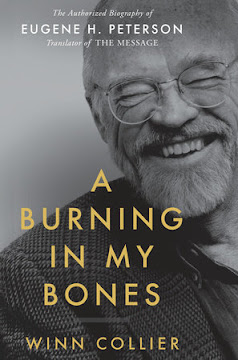
"A Burning in My Bones" (Winn Collier)
TITLE: A Burning in My Bones: The Authorized Biography of Eugene Peterson, Translator of The Message
AUTHOR: Winn Collier
PUBLISHER: New York, NY: Waterbrook, 2020, (368 pages).
This is a biography of one of evangelicalism's best known authors, Eugene Peterson. For his beloved Church, he will always be their beloved pastor. For Regent College students, he will be remembered as a quiet, patient, and wise teacher. In the literature world, he is respected for his ability to weave words into meaning and nuance the words into spectrum of meanings. For many leaders and professors, he is an authority in spiritual theology. For the rest of the world, he is the translator of the popular paraphrase of the Bible: THE MESSAGE. Before his death in 2018, author Winn Collier was given permission to write an authorized biography about Eugene Peterson. Given free access to Peterson's journals, papers, letters, manuscripts, as well as personal interviews, Collier had unprecedented insight into the personal life of Eugene. Most of all, it was the way that he knew God so personally that we would want to learn about.
The book is written in three parts. Part One describes the early years of Eugene's Norwegian grandparents, Andre and Juditta Odegard Hoiland moving to America in 1902. Flathead Valley in Montana was where they eventually moved to. It was where Eugene was born to Evelyn and Don. His creativity and imagination were credit to his mother. If Eugene had learned about creativity and contemplation from his mother, he learned about companionship and community from his father. He experienced what it meant to lose a family member at a tender young age when his 2-year old sister Lois died of pneumonia. Knowing the deeper connections to Eugene's family helps us appreciate his background and how it shapes his spirituality. Then there was his time in Seattle Pacific University where he rubbed shoulders with people of different denominational backgrounds. He learned the importance of manageable size from his early experience as President of a student body. Hence, he developed this principle of not pastoring a church larger than 300 people. He refuses to put himself up on a pedestal, but chooses the humble path by identifying himself with the rest of us, that he too like many have lived haphazard lives of discovery rather than a clearly defined path. Sometimes, the discovery has to do with what one does not want to do instead of one wants to do. This was Eugene's posture when he opts for ministry instead of getting involved in the Korean war. He shares about what it meant to be a butcher's son and subsequently a butcher's life. It was not to be as his direction shifts again after much rejection from existing Church denominations. He went to Bible School hoping to do some teaching after that. Gradually, the Bible became less of a book to be studied but an invitation to a conversation with God. He learned ministry from George Buttrick, philosophy from Soren Kierkegaard, prayer from his Pentecostal roots, and theology from Karl Barth. He eventually became ordained in the Presbyterian Church USA. He studied at New York Theological Seminary and continued with a doctoral program at John Hopkins University, focusing on semitic languages. He was blessed to study under the supervision of Bill Albright. However, he did not complete his dissertation as he decided to go into full time pastoral work instead.
AUTHOR: Winn Collier
PUBLISHER: New York, NY: Waterbrook, 2020, (368 pages).
This is a biography of one of evangelicalism's best known authors, Eugene Peterson. For his beloved Church, he will always be their beloved pastor. For Regent College students, he will be remembered as a quiet, patient, and wise teacher. In the literature world, he is respected for his ability to weave words into meaning and nuance the words into spectrum of meanings. For many leaders and professors, he is an authority in spiritual theology. For the rest of the world, he is the translator of the popular paraphrase of the Bible: THE MESSAGE. Before his death in 2018, author Winn Collier was given permission to write an authorized biography about Eugene Peterson. Given free access to Peterson's journals, papers, letters, manuscripts, as well as personal interviews, Collier had unprecedented insight into the personal life of Eugene. Most of all, it was the way that he knew God so personally that we would want to learn about.
The book is written in three parts. Part One describes the early years of Eugene's Norwegian grandparents, Andre and Juditta Odegard Hoiland moving to America in 1902. Flathead Valley in Montana was where they eventually moved to. It was where Eugene was born to Evelyn and Don. His creativity and imagination were credit to his mother. If Eugene had learned about creativity and contemplation from his mother, he learned about companionship and community from his father. He experienced what it meant to lose a family member at a tender young age when his 2-year old sister Lois died of pneumonia. Knowing the deeper connections to Eugene's family helps us appreciate his background and how it shapes his spirituality. Then there was his time in Seattle Pacific University where he rubbed shoulders with people of different denominational backgrounds. He learned the importance of manageable size from his early experience as President of a student body. Hence, he developed this principle of not pastoring a church larger than 300 people. He refuses to put himself up on a pedestal, but chooses the humble path by identifying himself with the rest of us, that he too like many have lived haphazard lives of discovery rather than a clearly defined path. Sometimes, the discovery has to do with what one does not want to do instead of one wants to do. This was Eugene's posture when he opts for ministry instead of getting involved in the Korean war. He shares about what it meant to be a butcher's son and subsequently a butcher's life. It was not to be as his direction shifts again after much rejection from existing Church denominations. He went to Bible School hoping to do some teaching after that. Gradually, the Bible became less of a book to be studied but an invitation to a conversation with God. He learned ministry from George Buttrick, philosophy from Soren Kierkegaard, prayer from his Pentecostal roots, and theology from Karl Barth. He eventually became ordained in the Presbyterian Church USA. He studied at New York Theological Seminary and continued with a doctoral program at John Hopkins University, focusing on semitic languages. He was blessed to study under the supervision of Bill Albright. However, he did not complete his dissertation as he decided to go into full time pastoral work instead.
Labels:
Biography,
Christian Life,
Christianity,
Church,
Culture,
Netgalley,
Pastoral Ministry,
People,
Random House,
Regent,
Spirituality,
Waterbrook
Monday, April 14, 2014
"Planted" (Leah Kostamo)
TITLE: Planted: A Story of Creation, Calling, and Community
AUTHOR: Leah Kostamo
PUBLISHER: Eugene, OR: Cascade Books, 2013, (172 pages).
This is a beautiful book. Few books have managed to capture the essence of nature, the joys of community, and the affirmation of a simple calling like this one. Leah Kostamo, a wife, a former campus ministry worker, as well as a co-founder of the A Rocha ministry based in BC Canada, has shown us how good stories can be told with simplicity, with insight, and with humour. Combining her love for creation and conservation, her natural talent for observing details in ordinary things, her passion for community building, coupled with her eloquent use of words, this book is destined for greatness in the literary world. As a memoir, readers will be humbled at how the author and her husband Markku would give up lucrative careers, sell their house, and to pour all their assets into a non-profit ministry without guarantee that it would even survive its initial years. Yet, it did and it did so marvelously, blessing, teaching, and enabling thousands of visitors and volunteers at their farm facility. The ministry in Canada began as a seed back in 1996 at a Regent College course entitled, "Incarnational Mission" led by Peter and Miranda Harris, who had founded A Rocha in Portugal. Eight years later, the idea took root, and sprouted trunks and branches through personal investments as well as generous givers and loaners by those who expressed faith enough to walk with the Kostamos.
The book is also a mini-ecological guide. We learn about the threats of worldwide extinction of 13% of birds, 25% of mammals, and 41% of amphibians. We see how a tiny shrimp plays its microscopic role in a complex and delicate ecological environment, that benefits beavers, bears, and big trees. We read about invasive species, weeds, the birds, and even slugs. Along the way, Kostamo makes sure we do not get carried away in the natural world and forget about the technological world. With a deft touch of humour, she compares and contrasts pods of orcas with iPods! It can also be used as a primer in becoming more nature aware. We are encouraged to think about the tap water we have, to think about its source, its distribution channels, and all the resources poured into the whole system. We are challenged to think about the gardens, how the seasons impact life, the variety of birds and nature around us, and even rocks and minerals that seem so mundane for the busy individual.
It is also a guide for a deeper awareness of what eating entails. For those of us whose limited vocabulary of eating centered around restaurants, the food on our tables, or the kitchen, we get invited into a world of farming, of growing our own food, and the beauty of real food over processed stuff. Food is not just something to be consumed, but it can incorporate a work of art in itself. Beyond the feasting, we will appreciate the preparation beyond mere cook books, and to be respectful in the way we partake of God's providence for us. Slowly but surely, the book becomes a rallying point in the practice of Micah 6:8, that we learn to live justly, love mercy, and to walk humbly. Very aptly, the book closes with a relook at the biblical Sabbath, reminding us that working hard and doing good have their limits. Man can only do so much. Everything else totally depends on God alone. The keeping of the Sabbath is a powerful reminder that we by ourselves are limited. That is why Sabbath keeping enables us to be natural ourselves one day a week, as we busy ourselves with nature on the other six days.
This book is a rare find. More accurately, the book found me. When contacted to do this review, I promptly agreed because of curiosity in part, and to support a fellow Regent alum as well. Little did I know that I would be receiving a literary gem, a unique seed that germinates in me a greater appreciation of nature and creation. Most of all, I am humbled by how the Kostamos' passion-turned-reality have blessed people of all ages from all walks of life. There is a lot of material in this humble looking book. Open it up at any one page and you can easily find a point or two to learn from and to contemplate after.
I am full of praise of the quality of this book. I particularly appreciate the three points to show us the way forward, namely; 1) Practice Gratitude; 2) Practice Generosity; and 3) Practice the Sabbath Keeping. On all three counts, I say a hearty Amen! A clear best of the best so far in my 2014 stack of books.
Thank you, Leah Kostamo for letting me know that this book even existed.
Rating: 5 stars of 5.
conrade
This book is provided to me courtesy of the author in exchange for an honest review. All opinions offered above are mine unless otherwise stated or implied.
AUTHOR: Leah Kostamo
PUBLISHER: Eugene, OR: Cascade Books, 2013, (172 pages).
This is a beautiful book. Few books have managed to capture the essence of nature, the joys of community, and the affirmation of a simple calling like this one. Leah Kostamo, a wife, a former campus ministry worker, as well as a co-founder of the A Rocha ministry based in BC Canada, has shown us how good stories can be told with simplicity, with insight, and with humour. Combining her love for creation and conservation, her natural talent for observing details in ordinary things, her passion for community building, coupled with her eloquent use of words, this book is destined for greatness in the literary world. As a memoir, readers will be humbled at how the author and her husband Markku would give up lucrative careers, sell their house, and to pour all their assets into a non-profit ministry without guarantee that it would even survive its initial years. Yet, it did and it did so marvelously, blessing, teaching, and enabling thousands of visitors and volunteers at their farm facility. The ministry in Canada began as a seed back in 1996 at a Regent College course entitled, "Incarnational Mission" led by Peter and Miranda Harris, who had founded A Rocha in Portugal. Eight years later, the idea took root, and sprouted trunks and branches through personal investments as well as generous givers and loaners by those who expressed faith enough to walk with the Kostamos.The book is also a mini-ecological guide. We learn about the threats of worldwide extinction of 13% of birds, 25% of mammals, and 41% of amphibians. We see how a tiny shrimp plays its microscopic role in a complex and delicate ecological environment, that benefits beavers, bears, and big trees. We read about invasive species, weeds, the birds, and even slugs. Along the way, Kostamo makes sure we do not get carried away in the natural world and forget about the technological world. With a deft touch of humour, she compares and contrasts pods of orcas with iPods! It can also be used as a primer in becoming more nature aware. We are encouraged to think about the tap water we have, to think about its source, its distribution channels, and all the resources poured into the whole system. We are challenged to think about the gardens, how the seasons impact life, the variety of birds and nature around us, and even rocks and minerals that seem so mundane for the busy individual.
It is also a guide for a deeper awareness of what eating entails. For those of us whose limited vocabulary of eating centered around restaurants, the food on our tables, or the kitchen, we get invited into a world of farming, of growing our own food, and the beauty of real food over processed stuff. Food is not just something to be consumed, but it can incorporate a work of art in itself. Beyond the feasting, we will appreciate the preparation beyond mere cook books, and to be respectful in the way we partake of God's providence for us. Slowly but surely, the book becomes a rallying point in the practice of Micah 6:8, that we learn to live justly, love mercy, and to walk humbly. Very aptly, the book closes with a relook at the biblical Sabbath, reminding us that working hard and doing good have their limits. Man can only do so much. Everything else totally depends on God alone. The keeping of the Sabbath is a powerful reminder that we by ourselves are limited. That is why Sabbath keeping enables us to be natural ourselves one day a week, as we busy ourselves with nature on the other six days.
This book is a rare find. More accurately, the book found me. When contacted to do this review, I promptly agreed because of curiosity in part, and to support a fellow Regent alum as well. Little did I know that I would be receiving a literary gem, a unique seed that germinates in me a greater appreciation of nature and creation. Most of all, I am humbled by how the Kostamos' passion-turned-reality have blessed people of all ages from all walks of life. There is a lot of material in this humble looking book. Open it up at any one page and you can easily find a point or two to learn from and to contemplate after.
I am full of praise of the quality of this book. I particularly appreciate the three points to show us the way forward, namely; 1) Practice Gratitude; 2) Practice Generosity; and 3) Practice the Sabbath Keeping. On all three counts, I say a hearty Amen! A clear best of the best so far in my 2014 stack of books.
Thank you, Leah Kostamo for letting me know that this book even existed.
An American
transplant to Canada, Leah Kostamo has a background in campus ministry
and education. For the past twelve years, Leah has worked alongside her
husband, Markku, to show God’s love for all of creation through the
ministry of A Rocha. She lives and thrives on Kingfisher Farm near
Vancouver, BC.
Rating: 5 stars of 5.
conrade
This book is provided to me courtesy of the author in exchange for an honest review. All opinions offered above are mine unless otherwise stated or implied.
Labels:
Cascade Books,
Christianity,
Contemplation,
Creation,
Discipleship,
Nature,
Regent,
Spirituality,
Wipf and Stock
Subscribe to:
Posts (Atom)