"Good books do not make saints, but they can nudge one a little closer." (Conrade Yap)
Wednesday, February 5, 2025
"Reviving Mission" (Linson Daniel, Jon Hietbrink, and Eric Rafferty)
AUTHOR: Linson Daniel, Jon Hietbrink, and Eric Rafferty
PUBLISHER: Downers Grove, IL: InterVarsity Press, 2024, (240 pages).
Are missions outdated? Does God still speak today with signs and wonders? Is there any similar outpouring of the Spirit like the 20th-century Azuza Street revival? Are revivals a thing of the past? Are revivals in general considered anomalies? Inspired by the Asbury revival of 2023 which spread to several campuses in America, the authors of this book excitedly proclaimed that mission can be revived. This book is about reviving: a) our conceptions of mission; b) the impact of mission on the people we are sent to; and c) the impact of mission on the people who are sent. Instead of jettisoning the old ways of mission, the authors urge us to renew our old ways in terms of re-contextualization. Go back to Jesus as the root of all missions. Follow the ways of Jesus in everyday living. Be Christlike to all. Claiming that "The Old Way is an Everyday Way," they encourage us to follow Jesus' ordinary life in an ordinary society. Once we recognize the many similarities of first-century culture and our modern society, we can breathe new life into the ordinary.
Thursday, November 28, 2024
"The Church in Dark Times" (Mike Cosper)
AUTHOR: Mike Cosper
PUBLISHER: Grand Rapids, MI: Baker Academic, 2024, (208 pages).
What are dark times? What are the risks facing the evangelical churches today? How do ordinary churches fall down the path of shame? What are the signs of seduction? What are the social and cultural influences that we need to be aware of? What ideological, spiritual, or structural factors are involved in scandals? These questions are dealt with in depth by Mike Cosper who had previously produced and hosted the podcast, "The Rise and Fall of Mars Hill." Writing with Hannah Arendt's insights on human behaviour and experiences of abuse, he defines dark times under the umbrella of totalitarianism, and how totalitarian ideology is seductive to the modern mind. Churches need to discern and resist the temptation toward evil within their organizations. Anchored on the Bible verse to "Resist the devil, and he will flee from you," (James 4:7), author Mike Cosper exposes the telltale signs of abuses, conspiracies, denials, violence, and the infiltration of devilish ideologies that sought to hide the Truth. Using the defunct Mars Hill Church as a backdrop to the book, Cosper seeks to extend Arendt's reflections on her experiences with the evil Nazi regime. Dark times are not simply about totalitarianism. It includes how the world becomes disconnected from goodness and purpose.
Thursday, November 21, 2024
"Citizenship Without Illusions" (David Theodore Koyzis)
AUTHOR: David Theodore Koyzis
PUBLISHER: Downers Grove, IL: IVP Academic, 2024, (168 pages).
The year 2024 is an Election Year in America. How do we vote? What guidelines are there to help us decide on which candidates are best for the country? What is the role of the Church in society? Should Christians get involved in politics at all? After the election, what should we do when our candidates of choice get outvoted? At the core of the discussion is the question of citizenship. Author David Koyzis is convinced that citizenship not only has its privileges, it carries a heavy responsibility. With this in mind, many are aware of the deep divisions in the country over the different political affiliations. With a keen awareness of the political turmoil happening throughout the country, he explores the nature, meaning, and history of citizenship matters. He looks at what it means to be a good citizen. That includes standing up for justice, being informed of matters around us; supporting our communities; volunteering in needy areas; and the courage to engage in activities that honour God. On voting, Koyzis first affirms one's right to vote and offers his perspectives on the issue of wasting one's votes. He regularly compares the political systems of Canada and the US to give context before providing his views. He even offers caveats for anyone wanting to set up a "Christian" political party. Recognizing that there will always be diverse views, the author urges all to maintain open conversational channels regardless of political alliances.
Thursday, October 31, 2024
"Films For All Seasons" (Abby Olcese)
AUTHOR: Abby Olcese
PUBLISHER: Downers Grove, IL: InterVarsity Press, 2024, (240 pages).
Films are often influenced by the culture around us. After all, moviemakers are familiar with the need for relevance. This is necessary to reach popular appeal. In the same way, Christians living in this world ought to be aware of the cultural appeal happening in their realms of influence. Yet, culture does not stand still. It changes rapidly with various fads, fashion, and trends. How do we interpret culture from a Christian perspective? One avenue is through films. Author Abby Olcese is an avid observer of film and popular culture. She believes we can better understand the mood of the times just by noticing the messages and stories behind the movies. Believing that "stories rule our lives," just like how stories in the Bible communicate central biblical themes, the stories in movies can reveal cultural trends that we can be aware of.
Tuesday, October 15, 2024
"Becoming by Beholding" (Lanta Davis)
AUTHOR: Lanta Davis
PUBLISHER: Grand Rapids, MI: Baker Academic, 2024, (240 pages).
When young, our parents tell us fairy tales and other bedtime stories. In school, we learn through play and imagination. At home, we love watching cartoons with happy endings. Tales often begin with the familiar words "A Long time ago..." and end with that memorable phrase "... And they lived happily ever after." As we grow, imagination seems to take a backseat. Life then becomes a crazy rat race that leaves little room for imagination. Fantasies dissipate. Realities mandate. Imagination stagnate. Author Lanta Davis asserts that it is time to restore a healthy sense of imagination, in particular, to Christian Spiritual Formation. This is done by learning from our forefathers of the faith through tradition and the historical expressions of the faith. If we unearth the treasures of Christian artistic tradition, we can rediscover the rich legacies of the past. We can renew a fresh imagination to breathe creativity into our present world. We can also restore our understanding of identity and beyond. From an archeological dig into history and tradition, the author develops for us a three-pronged approach: "Right Belief," "Right Practice," and "Moral Character."
Tuesday, August 27, 2024
"Faithful Politics" (Miranda Zapor Cruz)
TITLE: Faithful Politics: Ten Approaches to Christian Citizenship and Why It Matters
AUTHOR: Miranda Zapor Cruz
PUBLISHER: Downers Grove, IL: InterVarsity Press, 2024, (216 pages).
Friday, August 9, 2024
"Discipleship for Every Stage of Life" (Chris A. Kiesling)
TITLE: Discipleship for Every Stage of Life: Understanding Christian Formation in Light of Human Development
AUTHOR: Chris A. Kiesling
PUBLISHER: Grand Rapids, MI: Baker Academic, 2024, (216 pages).
Monday, July 8, 2024
"The New Testament in Color" (Esau McCaulley, Janette H. Ok, Osvaldo Padilla, & Amy Peeler)
AUTHOR: Esau McCaulley, Janette H. Ok, Osvaldo Padilla, & Amy Peeler
PUBLISHER: Downers Grove, IL: IVP Academic, 2024, (792 pages).
There are many commentaries out there in the market. Most are written by scholars and theologians who are male, white and live in the North Western Hemisphere. Contributions from women are just becoming more regular. Those from Asian, African, and non-white backgrounds are also appearing. We have all been shaped by commentaries from the Majority-White cultural backgrounds. For all their good intent, there is a danger of mainstream commentaries that lack diversity in biblical interpretation. All commentaries are interpretations from a specific background. They are influenced by culture, historical contexts, and to some extent, ethnic backgrounds. How can we present a more holistic commentary that encompasses a wider representation of the human race? This book is an attempt to do just that. With esteemed scholars from all over the Christian world, this "Multiethnic Bible Commentary" brings together a host of scholars from different ethnic groups. The African-American section interprets from the lens of slavery and the quest for fuller acceptance in society. The Asian-American chapter interprets from an immigrant's perspective while the Hispanic-American views Scriptures from a marginalized position. For the Native-American, they see things from the goodness of their culture. Writing on the White-Majority perspective, the starting point is "repentance, humility, unity, and communion."
Monday, June 10, 2024
"Deep Reading" (Rachel B. Griffis, Julie Ooms, & Rachel M. De Smith Roberts)
AUTHOR: Rachel B. Griffis, Julie Ooms, & Rachel M. De Smith Roberts
PUBLISHER: Grand Rapids, MI: Baker Academic, 2024, (240 pages).
Recently, there has been a swath of books about reading, good reading. Since Mortimer Adler's classic on "How to Read a Book," there has been various additions from various authors like Robert Alter, Jeffrey Bilbro, Harold Bloom, Susan Gallagher & Roger Lundin, Alan Jacobs, Karen Swallow Prior, Jessica Hooten Wilson, etc. This book is a compelling addition to this library of excellent perspectives on reading. It is a treasure to behold. The key thesis in this book is that reading is a powerful mechanism for spiritual formation. Before embarking on this journey, there are three major impediments to overcome: Distraction, Hostility, and Consumerism. The way to achieve deep reading is to adopt practices to subvert these three vices. Otherwise, we become vulnerable to the ills of technology, adopt superficial reading, and lose the opportunity to grow the virtues of good reading. This book asks and probes not just the things we read but also questions surrounding who we are, why we read, and how we are reading. In other words, readers will not only be reminded about the need for deeper reading skills, they will recognize how modern culture is impacting general reading habits. These are warnings to be heeded wisely. We ignore them at our peril. The authors ask some poignant questions such as:
Wednesday, May 15, 2024
"Listen, Listen, Speak" (Jay Y. Kim)
AUTHOR: Jay Y. Kim
PUBLISHER: New York, NT: Faithwords, 2024, (256 pages).
We want to be heard and understood. More often than not, people tend to mistake one for the other. In this social media culture, visibility is often linked to those who can speak the loudest, share the most, and attract the most attention. That is not always true. In fact, once the dust settles, we can see that there is more than meets the eye. Our world tends to be filled with all kinds of noises. Many clamour for attention but few bother to listen. In a wonderful push-back against the temptations of a noisy world, author Jay Kim has written an important book about learning to listen doubly hard before speaking. He calls us to distinguish "clarity" from "volume" by saying: ".. loudness often grabs our attention, it’s clarity that holds our attention. Grabbing attention is transactional. Holding attention is relational." Wise words. Listening is a key spiritual discipline. Elijah practices it. Jesus lives it. We are all called to do the same. Unfortunately, there are many barriers to listening. The author begins by helping us take down these barriers.
In Part One, he shows us the pitfalls of the lack of listening. With the rise of fake news and the malicious use of AI technology by scammers, we all need to learn the basics of discernment.
Wednesday, May 1, 2024
"Worth Seeing" (Amy L. Williams)
AUTHOR: Amy Lyn Williams
PUBLISHER: Downers Grove, IL: InterVarsity Press, 2024, (232 pages).
Our society often elevates the externals over the internals, the visible instead of the invisible. In many developed economies, people rush headlong toward attaining the 5Cs: Cars, Cash, Condominiums, Credit Cards, and Country Clubs. With that, people tend to gravitate toward those who are famous, rich, and powerful. Fact is, not everyone can be world famous, materially rich, and powerful. What happens to the rest of us? What about the marginalized and those despised by society? Can we learn to see all people for who they are, regardless of their reputations or ill-repute, poverty or riches, seen and unseen? More importantly, how do we learn to see our fellow human beings the way that God has intended for us to see? Beginning with the story of how Sarai mistreated Hagar in Genesis 16, author Amy Williams shows us that amid Hagar's depressing situation, God sees her and encourages her. God assures her that even when the world do not, God sees her for what she is worth. As one who ministers frequently to gang members, high-risk youths, and people who fell into a life of crime, she calls herself a "Hope Dealer." She also works as a "female gang-intervention specialist and juvenile justice advocate." The key is to learn to see people from God's point of view as best as we can. Williams shows us the four fundamental ways of seeing:
Thursday, March 28, 2024
"Crisis of Confidence" (Carl R. Trueman)
AUTHOR: Carl R. Trueman
PUBLISHER: Wheaton, IL: Crossway Publishers, 2024, (216 pages).
Why should anyone take creeds seriously? Why do we need creeds when we have the Bible? Why should churches incorporate creedal statements especially when the words are not in the Bible? Are not the creeds some old-fashioned documents that are no longer relevant for our era? What will we lose if we ignore the creeds? What is the crisis of confidence all about? Essentially, this book is a vigorous pushback against the modern notion of "expressive individualism" that threatens to unseat the use of confessions, creeds, and many aspects of tradition. Author Carl Trueman spends some time unpacking what he means by this. He notes how "expressive individualism" has taken root in many aspects of life. Feelings have dethroned the importance of facts. Science assumes that the present and future are better than the past, which unwittingly creeps into the philosophical domain when understanding religious truth. Consumerism militates against historical truths. Other reasons against creeds include the state of antiauthoritarianism, rejection of authority, and the fear of exclusion just because one recites the creeds. He then makes a case for the use of creeds in churches today. He outlines the history of creedal statements, showing us the contexts behind each written creed. This is not something that only the Early Church had done. With the Reformation, even more creeds were published. Groups outside the mainline stream also possess confessions and creeds, even though they were not written in the traditional forms. One of the key things that enable us to worship in spirit and in truth is the use of creeds to remind us that worship is not about self-expression but about corporate confession to God and for God. The big truth is, that creeds do not necessarily take the place of Scripture but affirm biblical Truth in concrete ways.
Thursday, March 21, 2024
"Trust" (Dominique Shelton Leipzig)
AUTHOR: Dominique Shelton Leipzig
PUBLISHER: Charleston, SC: Forbes Books, 2024, (399 pages).
It is not easy to trust what we see today. From Artificial Intelligence to Deep Fake technologies, it is becoming easier to manipulate data for illegitimate ends. With innovation comes the tendency for cheating and criminal activities. Data security is critical to preserve the integrity of businesses and maintain positive public trust. All it takes is a data leak, hacking, systems malfunction, or an infiltration of ransomware, and the corporation's activities easily come to a standstill. According to Dominique Shelton Leipzig, the problem with modern corporate boardrooms is that data management is typically delegated to backroom staff, like data scientists or IT professionals. Some don't know the right questions to ask about their data in the first place. This calls for a more proactive approach when dealing with data and information in the company. Data stewardship cannot be left to consultants, or engineers in the data center, or outsourced to cheaper IT professionals outside. They need to be managed responsibly. Senior management needs to be held accountable. Data breaches and data security lapses cannot be blamed on data center staff. CEOs must take an active interest in the integrity and use of data in their organizations. With more businesses and information being collected and stored both inside and outside the organizations, there needs to be a heightened awareness and responsibility about its collection, management, protection, and usage. Companies of all sizes need a proper data strategy. The thesis in this book is that to re-establish trust in organizations, it is high time for senior management to take leadership of their corporate data as a critical asset. In Leipzig's words, one must "lead with trust." That means three things:
Friday, January 19, 2024
"The Lost World of the Prophets" (John H. Walton)
AUTHOR: John H. Walton
PUBLISHER: Downers Grove, IL: InterVarsity Press, 2024, (192 pages).
What comes to mind when we hear the words, "prophets," "prophecies," and "prophetic word?" For many, prophets are seen as "predictors" of the future, and "prophecies" are like future events waiting to be fulfilled. Such an understanding has unfortunately crippled the original meaning of what biblical prophecies mean. Calling this situation a "lost world of the prophets," esteemed author-professor John Walton helps us to recover the original meaning according to the Bible and to rediscover a deeper understanding of the different types and forms of prophecies. The author laments how prophetic books have been misunderstood by so many people. The "potential misuse" includes the unhealthy focus on end times (eschatology) and the use of prophetic texts merely to prove Jesus' deity (apologetics). He says that both of these are paths toward "fulfillment" theology. Using "cultural rivers" as a metaphor, he reminds us that if we want to understand the biblical prophecies, we need to soak ourselves in the biblical cultural river. At the same time, we need to avoid superimposing our modern cultural rivers on the Bible. This book is essentially about helping us swim and rediscover the lost world of the prophets. Walton guides us through five parts, each part leading us through the history, the process, and the ways to interpret the events based on the original authorial intent. The whole process is detailed and informative. Each part delineates various aspects of understanding the ancient cultural rivers. Using sixteen propositions as titles, Walton supports each proposition with examples and alternative readings.
Friday, January 12, 2024
"Rethinking the Police" (Daniel Reinhardt)
AUTHOR: Daniel Reinhardt
PUBLISHER: Downers Grove, IL: InterVarsity Press, 2023, (224 pages).
The general perception of the Police force has taken a beating these days. From Michael Brown to Breonna Taylor, Daniel Prude to George Floyd, instances of police brutality on minority communities are becoming far too common. Those who claim that the issue is due to individual racists will have to explain why in 2023, five African American policemen killed Tyre Nichols, a black. According to author Daniel Reinhardt, the problem is beyond individuals. It is embedded in a system that nourishes systemic discrimination. In other words, if the perpetrators are guilty, the environment that breeds them is worse. As a 24-year-veteran of the police force, Reinhardt knows the system from the academy to street patrols. The question remains. If law enforcement agencies, courts, the federal agencies are aware of the problem, then why is there so little progress for better policing? Reinhardt puts his finger on the lack of changes from the inside out. With so much attention on external factors, internal factors have unwittingly been minimized. These factors refer to culture, worldview, and "implicit social structures." He goes on to describe the three key cultural factors: "Social distance," "Unchecked power," and "social structures."
Friday, January 5, 2024
"Reforming Criminal Justice A Christian Proposal" (Matthew T. Martens)
AUTHOR: Matthew T. Martens
PUBLISHER: Wheaton, IL: Crossway Publishers, 2023, (416 pages).
The American leadership system comprises three branches that counterbalance one another: The Executive, the Legislative, and the Judicial branches of government. This ingenious system of government was first drawn up by the framers during the Declaration of Independence. Most people would have taken sides in the oft-divisive decisions taken by the first two branches. On a relative scale, the legal system seems to be the last branch standing when it comes to having a fair and just society. The Executive and the Congress frame the laws. The judicial system enforces the laws of the land. By definition, the American criminal justice system is essentially about "state-sponsored violence." This is because the state is legally empowered to inflict physical punishment on lawbreakers. While most of the time the punishment is legitimate, there are times in which injustice happens. As far as the law is concerned, justice means enforcing the laws of the land. The highest court of the country is the Supreme Court. As far as the Word of God is concerned, the highest order is love. This book is essentially about how the imperfect and flawed American criminal justice system can be reformed from this biblical perspective. Such flaws include the "us-versus-them" mentality that leads to societal divisions, the presumed "law and order" which could be overly subjective for comfort, and the infusion of political concerns into the practice of laws. Written in two parts, author Matthew Martens aims to "fashion a criminal justice system more in line with biblical teaching." Part One looks at what a biblical justice system looks like where Martens sketches out the contours of Christian ethic of justice. The first thing he does is to blur the lines of "social justice" and "criminal justice" to put them under the umbrella of redemption: of forgiven past and present love. Monday, October 30, 2023
"Mind Your Manners" (Sara Jane HO)
AUTHOR: Sara Jane HO
PUBLISHER: New York, NY: Hachette Books, 2024, (304 pages).
Human beings are social creatures. Even for the most individualistic person, one cannot avoid interacting with another person, unless one lives as a hermit in some secluded part of the world. In general, we all need to learn some forms of social behavior and etiquette. This is necessary for society to function well, and it is applicable for both children and adults. Unfortunately, schools do not often teach such stuff. Those that do often cover them at a superficial level. Etiquette is about connection, says author Sara Jane Ho, a vocal advocate for meaningful social communications in various settings. It is also contextual, meaning we need to adapt our understanding and practice of etiquette based on the geographical locations. In our globalized interconnected world, we also need to expand that to cultural settings. Popularized by a Netflix series with the same name as the book's title, this book is a print version of the streaming platform. In meaningful etiquette, we need "social fluency" which is essentially about reading people quickly and accurately as well as interacting with them confidently and effectively. Mindful of the growing mental health concerns globally, she helps us remember that therapy alone cannot solve issues related to social awkwardness. In a post-pandemic world, some might even need to relearn "social fluency" to help us relate to people.
Wednesday, September 27, 2023
"Persuasive Apologetics" (Jeffrey M. Robinson)
AUTHOR: Jeffrey M. Robinson
PUBLISHER: Grand Rapids, MI: Kregel Academic, 2023, (152 pages).
Apologetics is not simply about facts or clever arguments. It has a lot to do with emotional sensitivity to the receiver. Like the age-old phrase, "People don't care how much we know until they know how much we care." In this book, the author's key point is that one needs to speak respectfully in order to persuade effectively. The mode and tone of communication matters because people matter. Instead of a typical comparative religion manner of argument, Robinson guides us through several levels of doing apologetics. One of the key reasons why people find apologetics difficult is because they lack anticipation of the objections thrown at them. Being able to explain our theological reasons is one thing. Responding in a manner that does not become combative is yet another. That calls for both self-examination and preparation. In self-examination, we are called to avoid positional pitfalls such as the "Church Curmudgeon" who does not care about the opposition. Neither should we go to the other extreme of compromise. In addition, we should not remain silent but need to be prepared to give an answer to anyone asking why we hope in Jesus. Anticipation also means understanding the worldviews the opposition might have. Many objections are often based on erroneous presuppositions. Dealing with these will help remove a major obstacle. Anticipation also means equipping, which is why Robinson gives an overview of various approaches one should learn of. From the abrasive classical methods to the use of Reformed Epistemology, there are many popular ways in which Christians tend to adopt primarily, at the risk of pushing biblical reasons to the secondary level. Respectable apologetics also means we learn to listen well without compromising our biblical faith. If there is one key point, it is the importance of biblical grounding for anyone who wants to do apologetics.
Monday, September 18, 2023
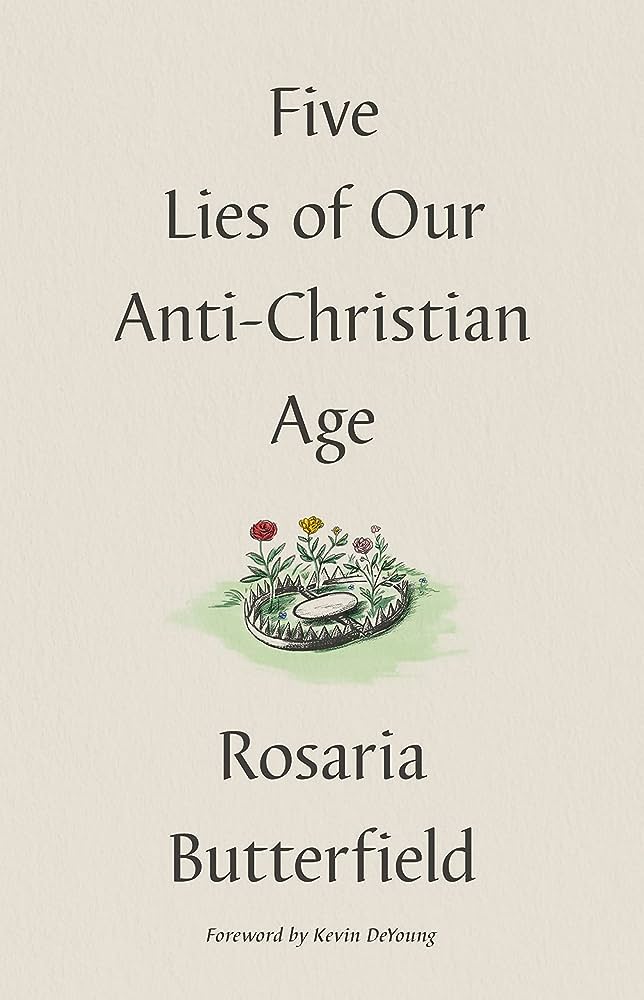
"Five Lies of Our Anti-Christian Age" (Rosaria Butterfield)
AUTHOR: Rosaria Butterfield
PUBLISHER: Wheaton, IL: Crossway, 2023, (368 pages).
In a post-Christian world, speaking out against mainstream societal beliefs is becoming harder. In some cases, it is virtually impossible to speak out without becoming ostracized or persecuted for asserting biblical truth. Politicians wanting to be elected or re-elected often have to mirror the mainstream opinions about some of the most divisive issues of this age. Ongoing divisive issues include Abortion, liberal views on Sexuality, Gender Bias, Women's roles, etc. Before anyone starts labeling the author with nasty labels, note that author Rosaria Butterfield writes with a specific audience in mind: "This book is for Christians not embarrassed by the Bible and its teaching on women’s roles and callings." She writes with conviction on what the Bible teaches. Her targets are not fellow humans per se but on how the devil is poisoning society with lies, in particular, lies that accelerate the anti-Christian mindset. Such mindset has emboldened extremists to threaten anyone holding on to a biblical standpoint with increasing hate, verbal abuse, and even violence. Instead of obeying the laws of God, humans are increasingly building a modern tower of Babel, one that defies biblical wisdom and challenges God's authority. Highlighting five lies in such an anti-Christian era, Butterfield boldly challenges the status quo that claims the following:
Tuesday, September 12, 2023
"Culture Making" (Andy Crouch, expanded edition)
AUTHOR: Andy Crouch
PUBLISHER: Downers Grove, IL: InterVarsity Press, 2023, (320 pages).
Culture wars are nothing new. Whether outside or inside, there are different cultures that exist in many places. Organizations too possess a mixture of different cultures within themselves. In many Christian circles, one of the key catchphrases to depict our Christian witness was "cultural engagement." This is a strategy of bringing the gospel to the places where ordinary people are found. What actually is "cultural engagement?" The two extremes of cultural assimilation and cultural rejection are non-starters. Many might think that the solution lies somewhere between the two. Author Andy Crouch gives us a paradigm-shifting perspective to argue for creative culture-making. This necessitates the introduction of "new vocabulary, a new story, and a new set of questions." Part One is an attempt to understand cultural vocabulary from a sociological perspective. This is essential because culture often means different things to different people. Crouch takes us through a historical survey of how culture changes with a particular focus on the interactions between Christianity and culture. One of the most intriguing discussions happened to be the way he interacts with the various methods of dealing with culture. He makes a distinction between "gestures and postures," the former a mere somewhat passive acknowledgment of the method compared to the latter which is a more active, default, or conscientious attitude.