TITLE: Surprised By Grace: A Spiritual Journey from West to East and Back
AUTHOR: Kevin Patrick Joyce
PUBLISHER: New York, NY: Crossroad Publishing, 2024, (240 pages).
This book is about the author's spiritual memoir of his journey from faith to commitment; theological education to ordination; and his engagement with spiritual experiences from both East and West. Since he was 11, Kevin Joyce has strong calling for the priesthood, so strong that he chose it over romance, a career in medicine, and other youthful endeavors. He grappled with various emotions and contexts throughout his youth. He left the seminary for a time to pursue other goals instead of the priesthood. He nearly committed to a long-term relationship with Antonia, only to realize he was not ready. Ultimately, together with his family background, prominent spiritual influence from his maternal grandmother, his positive impressions of Church Mass, and realizing the reality of Jesus' Resurrection, he returned to his religious vocation. He has two purposes in this book. First, to share his learning from spiritual masters. Second, to compare the spiritual paths and traditions of both East (Vedic) and West (Christian). This is Kevin Joyce's conversion, confession, exploration, redemption, and re-commitment story.
"Good books do not make saints, but they can nudge one a little closer." (Conrade Yap)
Showing posts with label Grace. Show all posts
Saturday, February 15, 2025
"Surprised by Grace" (Kevin P. Joyce)
Labels:
Apologetics,
Catholicity,
Crossroad Publishing,
Grace,
Memoir,
Netgalley,
Religion,
Spirituality,
Theology
Tuesday, July 25, 2023
"Composition as Conversation" (Heather M. Hoover)
TITLE: Composition as Conversation: Seven Virtues for Effective Writing
AUTHOR: Heather M. Hoover
PUBLISHER: Grand Rapids, MI: Baker Academic, 2023, (176 pages).
In general, there are four ways in which we can communicate. We can read and write. We can also hear and speak. All of these ways help us to better comprehend and converse with others. However, academic writing is a different beast altogether. It can be dry or downright boring. As the author points out: "academic writing should cultivate lively discussion and promote critical and creative thinking." How do we do that? Author-Professor Heather Hoover poses this to her students, whose feedback led to this book. The purpose is to utilize the power of words to inspire others. She highlights seven ways in which writing leads to "conversational virtues." She begins with the basic task to "Be Curious" by asking appropriate questions. These questions are often open-ended and need to demonstrate a genuine desire to want to connect with others. Asking good questions can help but its effectiveness can be limited. It requires a kind of asking that shows forth a genuine interest to hear the responses. Such a task requires some level of "humility, risk, and commitment." She lists various ways to help us build our vocabulary of interesting questions. The second virtue is that of attentiveness. She points out the difference between writing for writing's sake versus writing for others' sake.
AUTHOR: Heather M. Hoover
PUBLISHER: Grand Rapids, MI: Baker Academic, 2023, (176 pages).
In general, there are four ways in which we can communicate. We can read and write. We can also hear and speak. All of these ways help us to better comprehend and converse with others. However, academic writing is a different beast altogether. It can be dry or downright boring. As the author points out: "academic writing should cultivate lively discussion and promote critical and creative thinking." How do we do that? Author-Professor Heather Hoover poses this to her students, whose feedback led to this book. The purpose is to utilize the power of words to inspire others. She highlights seven ways in which writing leads to "conversational virtues." She begins with the basic task to "Be Curious" by asking appropriate questions. These questions are often open-ended and need to demonstrate a genuine desire to want to connect with others. Asking good questions can help but its effectiveness can be limited. It requires a kind of asking that shows forth a genuine interest to hear the responses. Such a task requires some level of "humility, risk, and commitment." She lists various ways to help us build our vocabulary of interesting questions. The second virtue is that of attentiveness. She points out the difference between writing for writing's sake versus writing for others' sake.
Labels:
Art,
Baker Academic,
Communications,
Creativity,
Grace,
Humility,
Netgalley,
Writing
Wednesday, March 15, 2023
"Evangelical Pharisees" (Michael Reeves)
TITLE: Evangelical Pharisees: The Gospel as Cure for the Church's Hypocrisy
AUTHOR: Michael Reeves
PUBLISHER: Wheaton, IL: Crossway Publishers, 2023, (128 pages).
During Jesus' time, some of Jesus' harshest criticisms were leveled at the Pharisees and religious leaders. The key reason: Hypocrisy. Jesus uses words like "blind guides," "fools," "leaven," "vipers," "whitewashed tombs," and "hypocrites." If there is any one word that would sum up how Jesus saw the religious establishment then, it would be the latter: Hypocrites. Author Michael Reeves adds to this pot of nouns with "hidden cancer," and points out the three major theological problems with the Pharisees; namely, their approach to Scripture; their understanding of salvation; and their disregard for regeneration. Reeves then introduces the three Rs to correct these three problems: Revelation, Redemption, and Regeneration. Each chapter is then devoted to unpacking each of these Rs. Embedded within these chapters are frequent comparisons of modern evangelicals with the Pharisees of old as well as warnings not to make the study and interpretation of Scripture become an end in itself. We need to gospel to correct our lens of interpretation. We need to get the salvation message clear that we are saved not by works but by grace alone. Each of these Rs parallels the members of the Triune Godhead. The Revelation of the Bible is to be seen in the light of God the Father who graciously reveals Himself to the world through the Word of God. The Redemption according to the Bible is about Christ coming down to earth to rescue us from our sins. The Regeneration aspect refers to the work of the Holy Spirit to enable us to do the will of God.
AUTHOR: Michael Reeves
PUBLISHER: Wheaton, IL: Crossway Publishers, 2023, (128 pages).
During Jesus' time, some of Jesus' harshest criticisms were leveled at the Pharisees and religious leaders. The key reason: Hypocrisy. Jesus uses words like "blind guides," "fools," "leaven," "vipers," "whitewashed tombs," and "hypocrites." If there is any one word that would sum up how Jesus saw the religious establishment then, it would be the latter: Hypocrites. Author Michael Reeves adds to this pot of nouns with "hidden cancer," and points out the three major theological problems with the Pharisees; namely, their approach to Scripture; their understanding of salvation; and their disregard for regeneration. Reeves then introduces the three Rs to correct these three problems: Revelation, Redemption, and Regeneration. Each chapter is then devoted to unpacking each of these Rs. Embedded within these chapters are frequent comparisons of modern evangelicals with the Pharisees of old as well as warnings not to make the study and interpretation of Scripture become an end in itself. We need to gospel to correct our lens of interpretation. We need to get the salvation message clear that we are saved not by works but by grace alone. Each of these Rs parallels the members of the Triune Godhead. The Revelation of the Bible is to be seen in the light of God the Father who graciously reveals Himself to the world through the Word of God. The Redemption according to the Bible is about Christ coming down to earth to rescue us from our sins. The Regeneration aspect refers to the work of the Holy Spirit to enable us to do the will of God.
Labels:
Christian Life,
Christianity,
Crossway,
Evangelicalism,
Gospel,
Grace,
Jesus,
Netgalley,
Revelation
Tuesday, September 13, 2022
"Grace at Work" (Bryan Chapell)
TITLE: Grace at Work: Redeeming the Grind and the Glory of Your Job
AUTHOR: Bryan Chapell
PUBLISHER: Wheaton, IL: Crossway, 2022, (240 pages).
Our work matters to God. In fact, the kinds of work we do are also opportunities for us to glorify God and to make His Glory known. The end of a Church service should mark the beginning of our service out in the world. Yet, how many believers actually know that or practice that? Sadly, very few. Worship is connected to our vocation. Our vocation is an act of worship. It is not limited to simply a Sunday worship service. Just like the popular song "Consuming Fire" by Tim Hughes, worship must be something more than Sunday worship. Author Bryan Chapell helps us by giving us a resource to enable us to see our jobs as opportunities to worship God. With many of us intensely immersed in our respective jobs and responsibilities, we need to learn how to take our faith to work. We need to adopt a grace mindset when performing our jobs. He looks at grace at work from ten angles. He begins with dignity and the dignity of the work set out for us. Our work has inherent meaning and significance, and our participation should enhance that dignity as well. Just like how God had created the world and called it good, we need to look at the world we live in and acknowledge its inherent goodness. We are also reminded not to base our own personal worth on the work we do. With sin having tarnished the world, work has also been tarnished and it is via God's redemptive work that has made all things new.
AUTHOR: Bryan Chapell
PUBLISHER: Wheaton, IL: Crossway, 2022, (240 pages).
Our work matters to God. In fact, the kinds of work we do are also opportunities for us to glorify God and to make His Glory known. The end of a Church service should mark the beginning of our service out in the world. Yet, how many believers actually know that or practice that? Sadly, very few. Worship is connected to our vocation. Our vocation is an act of worship. It is not limited to simply a Sunday worship service. Just like the popular song "Consuming Fire" by Tim Hughes, worship must be something more than Sunday worship. Author Bryan Chapell helps us by giving us a resource to enable us to see our jobs as opportunities to worship God. With many of us intensely immersed in our respective jobs and responsibilities, we need to learn how to take our faith to work. We need to adopt a grace mindset when performing our jobs. He looks at grace at work from ten angles. He begins with dignity and the dignity of the work set out for us. Our work has inherent meaning and significance, and our participation should enhance that dignity as well. Just like how God had created the world and called it good, we need to look at the world we live in and acknowledge its inherent goodness. We are also reminded not to base our own personal worth on the work we do. With sin having tarnished the world, work has also been tarnished and it is via God's redemptive work that has made all things new.
Labels:
Christian Life,
Christianity,
Crossway,
Grace,
Marketplace,
Netgalley,
Work,
Workplace
Thursday, April 14, 2022
"Professional Christian" (Sarah Bereza)
TITLE: Professional Christian: Being Fully Yourself in the Spotlight of Public Ministry
AUTHOR: Sarah Bereza
PUBLISHER: Louisville, KY: Westminster John Knox Press, 2022, (198 pages).
Are Christian ministers more "play-actors," mere "professionals," or "authentic persons?" With sky-high expectations from the public, the temptation is to become something less of ourselves. As the famous Shakespeare phrase says, "All the world’s a stage, and all the men and women merely players." With a keen understanding of the human psyche, Shakespeare's comedy, "As You Like It," reminds us of the way we all tend to behave in front of other people. Like the professionals in a commercial on TV, people get paid to put on a facade by exaggerating the quality of a particular product or service. In fact, anyone in a public-facing environment would be tempted toward becoming something that they are not. Those of us in public ministries are not exempted from such temptations. We prefer praises rather than criticisms. If acting a little bit unlike ourselves would win more applause, many would. If doing something authentic invites vicious criticism, most dare not. This book casts a spotlight on situations where ministry personnel become professionals to look good in front of people rather than humble servants faithful to God's calling in Jesus. The thesis of this book is that the more we are in Christ, the more ourselves we become which in turn improves our authenticity in ministry. What does it mean to be fully ourselves? This is the key question that the author, Sarah Bereza will address. She adds that the closer we are to God's glorious light, the truer our colours will shine. Before one could deal with authentic ministering in love, there are seven barriers to overcome. These are:
AUTHOR: Sarah Bereza
PUBLISHER: Louisville, KY: Westminster John Knox Press, 2022, (198 pages).
Are Christian ministers more "play-actors," mere "professionals," or "authentic persons?" With sky-high expectations from the public, the temptation is to become something less of ourselves. As the famous Shakespeare phrase says, "All the world’s a stage, and all the men and women merely players." With a keen understanding of the human psyche, Shakespeare's comedy, "As You Like It," reminds us of the way we all tend to behave in front of other people. Like the professionals in a commercial on TV, people get paid to put on a facade by exaggerating the quality of a particular product or service. In fact, anyone in a public-facing environment would be tempted toward becoming something that they are not. Those of us in public ministries are not exempted from such temptations. We prefer praises rather than criticisms. If acting a little bit unlike ourselves would win more applause, many would. If doing something authentic invites vicious criticism, most dare not. This book casts a spotlight on situations where ministry personnel become professionals to look good in front of people rather than humble servants faithful to God's calling in Jesus. The thesis of this book is that the more we are in Christ, the more ourselves we become which in turn improves our authenticity in ministry. What does it mean to be fully ourselves? This is the key question that the author, Sarah Bereza will address. She adds that the closer we are to God's glorious light, the truer our colours will shine. Before one could deal with authentic ministering in love, there are seven barriers to overcome. These are:
Thursday, November 4, 2021
"When Everything's On Fire" (Brian Zahnd)
TITLE: When Everything's on Fire: Faith Forged from the Ashes
AUTHOR: Brian Zahnd
PUBLISHER: Downers Grove, IL: Inter-Varsity Press, 2021, (192 pages).
When the dark leads to emotional gloom and thoughts of doom, any light helps. For author and pastor Brian Zahnd, he notices how the pandemic has turned the world upside down. The economy is in upheaval. People's lives are uncomfortably rocked. Christians struggle with political views. Churches are mired in scandals. In times like these, it is easy to become discouraged amid the challenges of theological deconstruction. Yet, even when everything seems to be on fire, BZ reminds us that fire has one more quality: The purification of our faith. How do we recover from the ashes and be renewed in the Truth of living in the hope of the Resurrected Christ? Is Christian faith still viable in a secular age? BZ affirms that it is not only possible to survive, one can also flourish. Acknowledging the reality of skepticism, the challenges of cynicism, and the opposition of secularism is the first step to making sense of faith. Not only that, BZ identifies with the critics of past philosophers like Friedrich Nietzsche, and in an imaginary conversation with the late German philosopher, BZ agrees with Nietzsche's sentiments but not necessarily the conclusions. BZ appreciates the struggles of life but not the dumbing down of faith. When everything is on fire for Nietzsche, the famed atheist declares that God is dead. BZ shows us that many critiques of Christendom while valid do not mean we should throw the baby out with the bathwater. Instead, Christians ought to learn how to critique so as to refine the faith, just like how fire refines. Otherwise, one might end up like a pastor who turned to atheism when he could not distinguish the historic Christianity faith from modern fundamentalist beliefs. One of BZ's key convictions is to nurture a culture of sustained belief for his grandchildren and their generation. Reasons to believe are not enough. The beauty of the gospel is better. BZ shares about an experience in Paris talking with a young man who had lost his faith, only to be renewed once he is able to see the beauty of Christ.
AUTHOR: Brian Zahnd
PUBLISHER: Downers Grove, IL: Inter-Varsity Press, 2021, (192 pages).
When the dark leads to emotional gloom and thoughts of doom, any light helps. For author and pastor Brian Zahnd, he notices how the pandemic has turned the world upside down. The economy is in upheaval. People's lives are uncomfortably rocked. Christians struggle with political views. Churches are mired in scandals. In times like these, it is easy to become discouraged amid the challenges of theological deconstruction. Yet, even when everything seems to be on fire, BZ reminds us that fire has one more quality: The purification of our faith. How do we recover from the ashes and be renewed in the Truth of living in the hope of the Resurrected Christ? Is Christian faith still viable in a secular age? BZ affirms that it is not only possible to survive, one can also flourish. Acknowledging the reality of skepticism, the challenges of cynicism, and the opposition of secularism is the first step to making sense of faith. Not only that, BZ identifies with the critics of past philosophers like Friedrich Nietzsche, and in an imaginary conversation with the late German philosopher, BZ agrees with Nietzsche's sentiments but not necessarily the conclusions. BZ appreciates the struggles of life but not the dumbing down of faith. When everything is on fire for Nietzsche, the famed atheist declares that God is dead. BZ shows us that many critiques of Christendom while valid do not mean we should throw the baby out with the bathwater. Instead, Christians ought to learn how to critique so as to refine the faith, just like how fire refines. Otherwise, one might end up like a pastor who turned to atheism when he could not distinguish the historic Christianity faith from modern fundamentalist beliefs. One of BZ's key convictions is to nurture a culture of sustained belief for his grandchildren and their generation. Reasons to believe are not enough. The beauty of the gospel is better. BZ shares about an experience in Paris talking with a young man who had lost his faith, only to be renewed once he is able to see the beauty of Christ.
Labels:
Apologetics,
Christian Life,
Christianity,
Church,
Culture,
Faith,
Grace,
IVP,
Jesus,
Netgalley,
PostModernism
Wednesday, October 6, 2021
"When Words matter Most" (Cheryl Marshall and Caroline Newheiser)
TITLE: When Words Matter Most: Speaking Truth with Grace to Those You Love
AUTHOR: Cheryl Marshall and Caroline Newheiser
PUBLISHER: Wheaton, IL: Crossway, 2021, (224 pages).
Jesus has said that we shall know the Truth and the Truth shall set us free. This is in the context of God's Word, to abide in Jesus, and to follow Him. In a world that has been devastated by the coronavirus, many are not only struggling with basic needs, but they also needed a greater dose of human interaction and encouragement. Words matter and they matter even more in times of need. With many stories of how different people have impacted them, authors Marshall and Newheiser share with us stories of how family, friends, and fellow believers had blessed them with hope, strength, and faith. There was a mother of five who gave them a friendship anchored on transparency and unconditional love. There was a teacher with a servant's heart who engages them with Truth and loyalty. There was also one with a pillar of faith that even in the midst of difficulties, one can exuberate joy in service. Calling these people gifts, they share with us how in times of acute need, these people were there for them. With gratitude, the authors are expanding their scope of encouragement through this book of stories and Truth-Telling about how words can make a difference, especially during this pandemic. Written in two parts, Part One explains the impact of words, and how the Word of God reminds us about our calling to speak words of Truth to one another, especially in crucial moments we discerned in the Spirit. We are called to build up the body not with our human wisdom but with the counsel of God through His Word. We are given three goals when we interact with one another:
AUTHOR: Cheryl Marshall and Caroline Newheiser
PUBLISHER: Wheaton, IL: Crossway, 2021, (224 pages).
Jesus has said that we shall know the Truth and the Truth shall set us free. This is in the context of God's Word, to abide in Jesus, and to follow Him. In a world that has been devastated by the coronavirus, many are not only struggling with basic needs, but they also needed a greater dose of human interaction and encouragement. Words matter and they matter even more in times of need. With many stories of how different people have impacted them, authors Marshall and Newheiser share with us stories of how family, friends, and fellow believers had blessed them with hope, strength, and faith. There was a mother of five who gave them a friendship anchored on transparency and unconditional love. There was a teacher with a servant's heart who engages them with Truth and loyalty. There was also one with a pillar of faith that even in the midst of difficulties, one can exuberate joy in service. Calling these people gifts, they share with us how in times of acute need, these people were there for them. With gratitude, the authors are expanding their scope of encouragement through this book of stories and Truth-Telling about how words can make a difference, especially during this pandemic. Written in two parts, Part One explains the impact of words, and how the Word of God reminds us about our calling to speak words of Truth to one another, especially in crucial moments we discerned in the Spirit. We are called to build up the body not with our human wisdom but with the counsel of God through His Word. We are given three goals when we interact with one another:
Labels:
Christian Living,
Communications,
Crossway,
Grace,
Love,
Netgalley,
Truth
Thursday, April 29, 2021
"Glimmers of Grace" (Kathryn Butler, MD)
TITLE: Glimmers of Grace: A Doctor's Reflections on Faith, Suffering, and the Goodness of God
AUTHOR: Kathryn Butler, MD
PUBLISHER: Wheaton, IL: Crossway Publishers, 2021, (224 pages).
Faith and Fear; Hope or Despair; Health or Sickness; Life and Death. These are the daily issues that plague hospitals all over the world. As a critical care surgeon who sees patients experiencing struggles of life and death, author Kathryn Butler has seen a wide spectrum of human ups and downs. As a Christian, she has also questioned why God had allowed people to go through pain and suffering. Where is God in all of these? What happens when one does not see the promises of God fulfilled in their lives? How do we locate our feelings in the field of grace? This is what this book is about. Seeing God's grace in the midst of medical calamities. Written in three parts, Part One shows us how medical situations could challenge our faith. Part Two looks to the Bible for insights into who God is and how we can find comfort in God. Part Three moves forward to show us how to live with hope based on the Resurrection Promise.
AUTHOR: Kathryn Butler, MD
PUBLISHER: Wheaton, IL: Crossway Publishers, 2021, (224 pages).
Faith and Fear; Hope or Despair; Health or Sickness; Life and Death. These are the daily issues that plague hospitals all over the world. As a critical care surgeon who sees patients experiencing struggles of life and death, author Kathryn Butler has seen a wide spectrum of human ups and downs. As a Christian, she has also questioned why God had allowed people to go through pain and suffering. Where is God in all of these? What happens when one does not see the promises of God fulfilled in their lives? How do we locate our feelings in the field of grace? This is what this book is about. Seeing God's grace in the midst of medical calamities. Written in three parts, Part One shows us how medical situations could challenge our faith. Part Two looks to the Bible for insights into who God is and how we can find comfort in God. Part Three moves forward to show us how to live with hope based on the Resurrection Promise.
Butler shares many stories about the amazing grace in the hospital room. She sees how a dying man was able to hang on to his very last breath until his wife arrives. She marvels at how one Christian by the name of David continues to minister to his Church members in spite of his health condition. She remembers a strong and independent friend who just needed prayer even in the midst of discouragement. She notices how the best of medical sciences cannot measure up to the miracle of God's design. God heals from the inside out and the outside in when humans can only apply a band-aid. Each chapter comes with reflections about various medical situations and assurances from the Bible. Readers can sense quickly that the author needs the assurances herself too. Recognizing the limits of science and medicine propels her to embrace the mystery of God's assurance and eternal comfort. Science might define life as a beating and death as flatlining. Faith enables one to go beyond these parameters into the mysteries of the afterlife.
Labels:
Crossway,
Death,
Faith,
God,
Grace,
Inspiration,
Life,
Love,
Medicine,
Netgalley,
Pain,
Pastoral Care,
Reflections,
Suffering,
Thanksgiving
Thursday, December 24, 2020
"How to Love the World" (Various Contributors, edited by James Crews)
TITLE: How to Love the World: Poems of Gratitude and Hope
AUTHOR: Various Contributors, edited by James Crews
PUBLISHER: North Adams, MA: Storey Publishing, 2021, (208 pages).
Can gratitude be taught? Well, we can teach children to say "Thank You" when young, but that is no guarantee they will learn to be thankful when they grow up. The key question in this book of poems is this: "Are you happy to be alive?" It is a given that in the West, the pursuit of happiness is not only deemed a necessary purpose, it is also considered a right in itself. With experience and thoughtful reflections, the contributors to this collection of poems help maneuver ourselves along the rivers of hope through the vessels of gratitude. The beauty of this is that these poems come from a diversity of people from all over the world. There are artists, farmers, engineers, professors, speakers, teachers, medical professionals, etc, all trying their hand on writing poetry. There is a poem for many different circumstances to describe this journey toward hope via gratitude. Some of these are quite painful. Injecting hope can be a challenge but when expressed through meaningful words, it brings lots of comfort and peace. Though the poems are not categorized specifically, they are collected and separated by reflective pauses. In the necessity of joy, the poems teach us how to appreciate the small things in our daily lives. Even the humble dandelion can show us the way if we have eyes to see. In racially charged environments, sometimes we are tempted to look down even on our own skin colour, especially when we have been discriminated against. Joy comes when we willingly accept who we are and not to be derailed by the behaviour of others on the basis of skin colour. Just observing the love of a father to his son parallels the vision of angels watching over us.
AUTHOR: Various Contributors, edited by James Crews
PUBLISHER: North Adams, MA: Storey Publishing, 2021, (208 pages).
Can gratitude be taught? Well, we can teach children to say "Thank You" when young, but that is no guarantee they will learn to be thankful when they grow up. The key question in this book of poems is this: "Are you happy to be alive?" It is a given that in the West, the pursuit of happiness is not only deemed a necessary purpose, it is also considered a right in itself. With experience and thoughtful reflections, the contributors to this collection of poems help maneuver ourselves along the rivers of hope through the vessels of gratitude. The beauty of this is that these poems come from a diversity of people from all over the world. There are artists, farmers, engineers, professors, speakers, teachers, medical professionals, etc, all trying their hand on writing poetry. There is a poem for many different circumstances to describe this journey toward hope via gratitude. Some of these are quite painful. Injecting hope can be a challenge but when expressed through meaningful words, it brings lots of comfort and peace. Though the poems are not categorized specifically, they are collected and separated by reflective pauses. In the necessity of joy, the poems teach us how to appreciate the small things in our daily lives. Even the humble dandelion can show us the way if we have eyes to see. In racially charged environments, sometimes we are tempted to look down even on our own skin colour, especially when we have been discriminated against. Joy comes when we willingly accept who we are and not to be derailed by the behaviour of others on the basis of skin colour. Just observing the love of a father to his son parallels the vision of angels watching over us.
Labels:
Grace,
Hope,
Indie,
Literature,
Netgalley,
Poems,
Thanksgiving
Tuesday, January 7, 2020
"3 Words That Will Change Your Life" (Mike Novotny)
TITLE: 3 Words That Will Change Your Life
AUTHOR: Mike Novotny
PUBLISHER: Bloomington, MN: Bethany House Publishers, 2020, (192 pages).
Is God far away? How can we experience God more intimately? All you need are three words: "God is Here." Sounds too good to be true? Perhaps, but author and pastor Mike Novotny has creatively used this phrase as a powerful catchphrase to connect us with our relationship with God. It is simple and easy to follow. Before that, he shows us some "life killers" that could derail us from properly following God. Some of these warnings include treating God like some kind of a distant "vague higher power." Some people are mystified when they think about God. In fact, many young people don't even think about God when asked about their life goals. They don't even live with any thoughts of God as they make their life decisions. Apart from thinking God as some distant irrelevant being, the other danger is to see God as some future celestial coming, which is another way of pushing away God's relevance in our lives. For if God is only God of the future and not for the present, then is He really God? Another mistake is to see God as relevant for others but not for us. This is a sad misreading. With Novotny putting to death the three erroneous "life killers," we are set to see God as Someone who is here for us now, in the present, and also in the future. God is here always. The author shares about how Ps 73 saved him and guided him to a deeper and personal relationship with God. God is bigger than any of our problems. Our biggest problem is that we don't think much of God in the first place. This needs to be corrected because it is simply not true. The Lord's Prayer is a reminder to us that we pray to a Living God who is here. Otherwise, that prayer has no meaning.
AUTHOR: Mike Novotny
PUBLISHER: Bloomington, MN: Bethany House Publishers, 2020, (192 pages).
Is God far away? How can we experience God more intimately? All you need are three words: "God is Here." Sounds too good to be true? Perhaps, but author and pastor Mike Novotny has creatively used this phrase as a powerful catchphrase to connect us with our relationship with God. It is simple and easy to follow. Before that, he shows us some "life killers" that could derail us from properly following God. Some of these warnings include treating God like some kind of a distant "vague higher power." Some people are mystified when they think about God. In fact, many young people don't even think about God when asked about their life goals. They don't even live with any thoughts of God as they make their life decisions. Apart from thinking God as some distant irrelevant being, the other danger is to see God as some future celestial coming, which is another way of pushing away God's relevance in our lives. For if God is only God of the future and not for the present, then is He really God? Another mistake is to see God as relevant for others but not for us. This is a sad misreading. With Novotny putting to death the three erroneous "life killers," we are set to see God as Someone who is here for us now, in the present, and also in the future. God is here always. The author shares about how Ps 73 saved him and guided him to a deeper and personal relationship with God. God is bigger than any of our problems. Our biggest problem is that we don't think much of God in the first place. This needs to be corrected because it is simply not true. The Lord's Prayer is a reminder to us that we pray to a Living God who is here. Otherwise, that prayer has no meaning.
Labels:
Bethany House,
Christianity,
God,
Grace,
Jesus,
Netgalley
Monday, February 11, 2019
"How the Body of Christ Talks" (C. Christopher Smith)
TITLE: How the Body of Christ Talks: Recovering the Practice of Conversation in the Church
AUTHOR: C. Christopher Smith
PUBLISHER: Grand Rapids, MI: Brazos Press, 2019, (224 pages).
We are made for conversations. Even our body cells reflect our inclination toward community and communal living. Unfortunately, individualism and privatism have taken over much of society. People are increasingly isolated. Even church people are no longer able to converse as well as they ought to. Calling our bodies as conversations "among proteins," author Christopher Smith aims to bring back the lost art of conversations in the Church, beginning with ourselves. For the healthiest people are those in active conversations with one another. The strongest communities are those that frequently communicate and talk to one another. In this book, Smith has a passion to help churches cultivate this art of talking and to build relationships through conversations. He even calls it a "transformative power of conversation." Smith invites us along in the three phases as follows:
1) Setting Out the Journey
2) Spirituality for the Journey
3) Sustaining the Journey
AUTHOR: C. Christopher Smith
PUBLISHER: Grand Rapids, MI: Brazos Press, 2019, (224 pages).
We are made for conversations. Even our body cells reflect our inclination toward community and communal living. Unfortunately, individualism and privatism have taken over much of society. People are increasingly isolated. Even church people are no longer able to converse as well as they ought to. Calling our bodies as conversations "among proteins," author Christopher Smith aims to bring back the lost art of conversations in the Church, beginning with ourselves. For the healthiest people are those in active conversations with one another. The strongest communities are those that frequently communicate and talk to one another. In this book, Smith has a passion to help churches cultivate this art of talking and to build relationships through conversations. He even calls it a "transformative power of conversation." Smith invites us along in the three phases as follows:
1) Setting Out the Journey
2) Spirituality for the Journey
3) Sustaining the Journey
Labels:
Brazos,
Church,
Communications,
Community,
Grace,
Love,
Netgalley,
Prayer,
Small Groups,
Spirituality
Wednesday, November 7, 2018
"Redeeming How We Talk" (Ken Wytsma and A.J. Swoboda)
TITLE: Redeeming How We Talk: Discover How Communication Fuels Our Growth, Shapes Our Relationships, and Changes Our Lives
AUTHOR: Ken Wytsma and A.J. Swoboda
PUBLISHER:Chicago, IL: Moody Publishers, 2018, (224 pages).
We have lots of ways to communicate and to build bridges with one another. With the advancement of science and technology, we are spoiled with regard to the means of communication. We can choose long distance video conferencing, social media interactions, mobile telephony, emails, and face to face meetings. Unfortunately, for all the scientific advancements, there is something else that has not kept up: Progression of human graciousness. Impatient replies could result in quick tempered reactions. Mass distribution of highly charged opinions could lead to social unrest. With many demanding to be understood rather than to understand, people hurl accusations based on a limited perspective. As a result, relationships break down. Walls are strengthened. Bridges are torn apart. There must be a better way. Instead of rejection and abandonment, we need to redeem how we communicate. We need to arrest the decline in good old conversations and work on constructive words and redeem how we talk. This is the key point in the entire book. Some of the highlights in the book include:
AUTHOR: Ken Wytsma and A.J. Swoboda
PUBLISHER:Chicago, IL: Moody Publishers, 2018, (224 pages).
We have lots of ways to communicate and to build bridges with one another. With the advancement of science and technology, we are spoiled with regard to the means of communication. We can choose long distance video conferencing, social media interactions, mobile telephony, emails, and face to face meetings. Unfortunately, for all the scientific advancements, there is something else that has not kept up: Progression of human graciousness. Impatient replies could result in quick tempered reactions. Mass distribution of highly charged opinions could lead to social unrest. With many demanding to be understood rather than to understand, people hurl accusations based on a limited perspective. As a result, relationships break down. Walls are strengthened. Bridges are torn apart. There must be a better way. Instead of rejection and abandonment, we need to redeem how we communicate. We need to arrest the decline in good old conversations and work on constructive words and redeem how we talk. This is the key point in the entire book. Some of the highlights in the book include:
- Learning the nature, purpose, and practicing godly speech;
- Recognize what technology is doing to the way we communicate
- Practice the art of silence, loving listening, and tough talk
- Believing that we can redeem our talk.
Labels:
Christian Living,
Church,
Communications,
Community,
Grace,
Moody Publishers,
People,
Relationships
Friday, June 30, 2017
"One Dominion" (Paul Richardson & Bob Beasley)
TITLE: One Dominion, Celebrating Canada
AUTHOR: Paul Richardson & Bob Beasley
PUBLISHER: Grimsby, Ontario: Bible League Canada, 2017, (96 pages).
This year is a special year. It is the 150th year of the confederation of Canada, a nation that began with just four provinces, but now comprises ten provinces and three territories. It is also the second largest country in the world by land mass. Widely recognized by many to be one of the best places in the world to live in, the country boasts of many strengths. It is an economic power, a member of the G7 (now G8). It also has a strong banking system; is a reliable trading partner; one of the best education systems in the world; a leading advocate for human rights; resource rich, and proud multicultural nation. In 1867, the Dominion of Canada was formed with Ontario, Quebec, New Brunswick, and Nova Scotia. By 1949, Newfoundland became the tenth province to become the Canada we have today. Canada only became a fully independent nation from Britain in 1982. To celebrate this momentous event, Bible League Canada and Graf-Martin Communications have come together to publish this special book.
AUTHOR: Paul Richardson & Bob Beasley
PUBLISHER: Grimsby, Ontario: Bible League Canada, 2017, (96 pages).
This year is a special year. It is the 150th year of the confederation of Canada, a nation that began with just four provinces, but now comprises ten provinces and three territories. It is also the second largest country in the world by land mass. Widely recognized by many to be one of the best places in the world to live in, the country boasts of many strengths. It is an economic power, a member of the G7 (now G8). It also has a strong banking system; is a reliable trading partner; one of the best education systems in the world; a leading advocate for human rights; resource rich, and proud multicultural nation. In 1867, the Dominion of Canada was formed with Ontario, Quebec, New Brunswick, and Nova Scotia. By 1949, Newfoundland became the tenth province to become the Canada we have today. Canada only became a fully independent nation from Britain in 1982. To celebrate this momentous event, Bible League Canada and Graf-Martin Communications have come together to publish this special book.
Labels:
Bible,
Canada,
Canadian Bible Society,
Culture,
Faith,
Grace,
Graf-Martin,
History,
Nature,
People
Wednesday, April 12, 2017
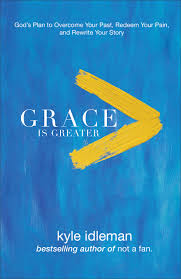
"Grace is Greater" (Kyle Idleman)
TITLE: Grace Is Greater: God's Plan to Overcome Your Past, Redeem Your Pain, and Rewrite Your Story
AUTHOR: Kyle Idleman
PUBLISHER: Grand Rapids, MI: Baker Books, 2017, (193 pages).
Like the word 'love,' 'grace' has also become a much touted word in the Christian community. If familiarity breeds contempt, overuse breeds apathy, even sarcasm. As I pick up this book, I wonder what else is there to talk about grace? Are there things still left unsaid? Philip Yancey has famously described grace as follows: "Grace means there is nothing I can do to make God love me more, and nothing I can do to make God love me less." Jonathan Edwards declares: "Grace is but Glory begun, and Glory is but Grace perfected." The famous hymn writer, John Newton puts it beautifully: "I am not what I ought to be. I am not what I want to be. I am not what I hope to be. But still, I am not what I used to be. And by the grace of God, I am what I am." So what can author and pastor Kyle Idleman add to the overwhelming topic of grace? He begins by challenging us to see it as a new word. Using Hebrews 12:15 as the anchor verse, Idleman declares that the lack of grace is spiritually poisonous. Not practicing grace is toxicity in action. Yet when we adopt a life of grace, the rewards are immense. The three key focuses in this book is that grace is greater than our mistakes; our hurts; and our circumstances.
AUTHOR: Kyle Idleman
PUBLISHER: Grand Rapids, MI: Baker Books, 2017, (193 pages).
Like the word 'love,' 'grace' has also become a much touted word in the Christian community. If familiarity breeds contempt, overuse breeds apathy, even sarcasm. As I pick up this book, I wonder what else is there to talk about grace? Are there things still left unsaid? Philip Yancey has famously described grace as follows: "Grace means there is nothing I can do to make God love me more, and nothing I can do to make God love me less." Jonathan Edwards declares: "Grace is but Glory begun, and Glory is but Grace perfected." The famous hymn writer, John Newton puts it beautifully: "I am not what I ought to be. I am not what I want to be. I am not what I hope to be. But still, I am not what I used to be. And by the grace of God, I am what I am." So what can author and pastor Kyle Idleman add to the overwhelming topic of grace? He begins by challenging us to see it as a new word. Using Hebrews 12:15 as the anchor verse, Idleman declares that the lack of grace is spiritually poisonous. Not practicing grace is toxicity in action. Yet when we adopt a life of grace, the rewards are immense. The three key focuses in this book is that grace is greater than our mistakes; our hurts; and our circumstances.
Labels:
Baker Books,
Christian Life,
Grace,
Graf-Martin,
Hope,
Pain,
People,
Relationships
Monday, July 25, 2016
"When There Are No Easy Answers" (John S. Feinberg)
TITLE: When There Are No Easy Answers: Thinking Differently About God, Suffering and Evil, and Evil
AUTHOR: John S. Feinberg
PUBLISHER: Grand Rapids, MI: Kregel Publications, 2016, (160 pages).
Another book on suffering? Do we really need people to tell us what to do when bad things happen to us? Maybe, not everyone of us will need to be reminded how suffering and evil are real. Some people choose to avoid it. Others see it as something unavoidable that can be ignored for the time being. Still, suffering can have a numbing effect as long as feelings of helplessness remain. This is not an academic book that argues about theodicy or philosophy of suffering. Neither is it like CS Lewis's A Grief Observed, D.A. Carson's How Long O Lord?, or Nicholas Wolterstorff's Lament For a Son. It is a personal testimony of how Professor and Pastor John Feinberg journeys through the valley of the shadow of suffering and pain. In a book that resembles the title of Rabbi Harold Kushner's seminal bestseller about pain and suffering, Feinberg tells us about how he grapples with matters up close and personal. In 1987, his wife was diagnosed with an incurable genetically transmitted disease. At that time, distant theology and personal experience cross each other. Feinberg is not simply philosophizing or theorizing about the question of suffering. He feels it deep down inside. He wrestles with questions instead of answers. He knows what it means to be in a place where there are no easy answers.
AUTHOR: John S. Feinberg
PUBLISHER: Grand Rapids, MI: Kregel Publications, 2016, (160 pages).
Another book on suffering? Do we really need people to tell us what to do when bad things happen to us? Maybe, not everyone of us will need to be reminded how suffering and evil are real. Some people choose to avoid it. Others see it as something unavoidable that can be ignored for the time being. Still, suffering can have a numbing effect as long as feelings of helplessness remain. This is not an academic book that argues about theodicy or philosophy of suffering. Neither is it like CS Lewis's A Grief Observed, D.A. Carson's How Long O Lord?, or Nicholas Wolterstorff's Lament For a Son. It is a personal testimony of how Professor and Pastor John Feinberg journeys through the valley of the shadow of suffering and pain. In a book that resembles the title of Rabbi Harold Kushner's seminal bestseller about pain and suffering, Feinberg tells us about how he grapples with matters up close and personal. In 1987, his wife was diagnosed with an incurable genetically transmitted disease. At that time, distant theology and personal experience cross each other. Feinberg is not simply philosophizing or theorizing about the question of suffering. He feels it deep down inside. He wrestles with questions instead of answers. He knows what it means to be in a place where there are no easy answers.
Labels:
Grace,
Kregel Publications,
Pain,
Pastoral Care,
Suffering,
Testimony
Monday, May 9, 2016
"Between Pain and Grace" (Gerald W. Peterman and Andrew J. Schmutzer)
TITLE: Between Pain and Grace: A Biblical Theology of Suffering
AUTHOR: Gerald W. Peterman and Andrew J. Schmutzer
PUBLISHER: Chicago, IL: Moody Publishers, 2016, (352 pages).
Suffering is one of the toughest, if not the toughest barrier to overcome with regards to people coming to faith. So people write songs, sing melancholic tunes, compose poems, and use artistic creativity to express themselves. Pain and suffering are real and often personal. The biblical writers are also well adapted and equipped to write about such things. The Psalms are filled with laments. The prophet Jeremiah has a whole book called "Lamentations." The apostle Peter acknowledges the suffering church and writes letters to encourage them to persevere. Paul himself is no stranger to suffering, having to endure an unknown thorn inflicted on his body. Job the righteous man also suffered tremendously. Of course, we have Jesus who suffered for all the world at the cross. Why then do we need another book on pain and suffering? Surely, lots have already been written about it. What is so unique about this book? In a nutshell, the authors in this book believe that we can learn a lot from the Bible with regard to pain, suffering, and of course the grace of God. The topics are wide-ranging.The contributors are many. All the Both contributors believe that pain and suffering are not something to be suppressed or repressed. Instead, it should be openly expressed.
AUTHOR: Gerald W. Peterman and Andrew J. Schmutzer
PUBLISHER: Chicago, IL: Moody Publishers, 2016, (352 pages).
Suffering is one of the toughest, if not the toughest barrier to overcome with regards to people coming to faith. So people write songs, sing melancholic tunes, compose poems, and use artistic creativity to express themselves. Pain and suffering are real and often personal. The biblical writers are also well adapted and equipped to write about such things. The Psalms are filled with laments. The prophet Jeremiah has a whole book called "Lamentations." The apostle Peter acknowledges the suffering church and writes letters to encourage them to persevere. Paul himself is no stranger to suffering, having to endure an unknown thorn inflicted on his body. Job the righteous man also suffered tremendously. Of course, we have Jesus who suffered for all the world at the cross. Why then do we need another book on pain and suffering? Surely, lots have already been written about it. What is so unique about this book? In a nutshell, the authors in this book believe that we can learn a lot from the Bible with regard to pain, suffering, and of course the grace of God. The topics are wide-ranging.
Labels:
Christian Life,
Christianity,
Grace,
Moody Publishers,
Netgalley,
Pain,
Suffering
Tuesday, November 10, 2015
"Awe" (Paul David Tripp)
TITLE: Awe: Why It Matters for Everything We Think, Say, and Do
AUTHOR: Paul David Tripp
PUBLISHER: Wheaton, IL: Crossway, 2015, (208 pages).
We need to make space for wonder. We need to find room to discover the divine. We need to be still in awe of God's presence. Confessing that he wrote this book for himself, author and pastor Paul David Tripp gives several reasons why awe is more necessary than ever. First, God's creation is already wonderful in itself as it reflects a beauty that can stimulate our senses. Second, for a fickle and wandering soul, we need something to keep our roving thoughts in check. Third, we need more attentiveness for the presence of God. Fourth, we need to "recapture, refocus, and redirect" our heart's attention to God over and over again. Fifth, with awe, one will be able to shape our words, thoughts, and deeds, according to the spiritual awareness of God. It is awe that many of us lack. When we think we have everything under control, where is there a need for awe?
Tripp takes us through thirteen windows of awe, beginning with HUMANITY, where there are so many things we can share and appreciate together because we are all created with the ability to wonder. Even when we have all the answers the the everyday problems we face, without awe, we will be stuck in cycles of discontent. He thinks about WAR and becomes aware of "awe wrongedness" (AWN) which happens when we feel wronged, victimized, received the shorter end of the stick, unjustly treated. Wars happen when this AWN takes root. The world through the past century have endured two world wars, and many more scattered across various continents. Even today, wars are happening not only in the Middle East but in Eastern Europe, restless pockets of strife in Asia, unrest in Africa and the Americas. On MINISTRY, Tripp sometimes wonder if he has truly been called to ministry in the first place. If worshiping God is foremost, why then are people constantly getting stuck in doing things that do not resemble any act of worship? He surmises: "Only a functional, heart-directed, ministry-shaping awe of God has the power to protect me from myself in ministry." We are hardwired for awe, and when our heart goes through a REPLACEMENT, with us replacing God with other gods, our sense of awe becomes warped. We forget God. We suffer from AMNESIA, seeing without truly seeing, and hearing without truly hearing. Through self-centeredness, a grotesque sense of entitlement, discontent, relational dysfunction, control, fear, anger, envy, drivenness, doubt, coldness, and others, our capacity for awe gets decapitated. TRANSGRESSION follows suit. We snigger at the laws of God. We belittle the importance of obedience. We swim in rivers of COMPLAINT and give critical and sarcastic answers to the five diagnostic questions about God. Instead, we move toward MATERIALISM and puts our trust in the temporal things of life. Failing to answer the two most important questions in our lives will put a damper to GROWTH. Thankfully, Tripp presents us with two "awe portraits" from Galatians 5. The first is to be careful of the works of the flesh. The second is to don the fruit of the Spirit. Spiritual growth comes with the suppression of the former and the increase of the latter. As the author quotes at length the passage from Isaiah 40, he senses a WORLDVIEW awareness. He gains a bigger picture of CHURCH. Seeing PARENTING as a high calling, readers learn about awe inspiring moments that we can teach our children. We gain a renewed sense of WORK that puts in proper perspectives that it is our identity in Christ that gives us our worth, not our works. Eventually, Tripp boils it all down to one phrase: "Awe is a longing."
AUTHOR: Paul David Tripp
PUBLISHER: Wheaton, IL: Crossway, 2015, (208 pages).
We need to make space for wonder. We need to find room to discover the divine. We need to be still in awe of God's presence. Confessing that he wrote this book for himself, author and pastor Paul David Tripp gives several reasons why awe is more necessary than ever. First, God's creation is already wonderful in itself as it reflects a beauty that can stimulate our senses. Second, for a fickle and wandering soul, we need something to keep our roving thoughts in check. Third, we need more attentiveness for the presence of God. Fourth, we need to "recapture, refocus, and redirect" our heart's attention to God over and over again. Fifth, with awe, one will be able to shape our words, thoughts, and deeds, according to the spiritual awareness of God. It is awe that many of us lack. When we think we have everything under control, where is there a need for awe?
Tripp takes us through thirteen windows of awe, beginning with HUMANITY, where there are so many things we can share and appreciate together because we are all created with the ability to wonder. Even when we have all the answers the the everyday problems we face, without awe, we will be stuck in cycles of discontent. He thinks about WAR and becomes aware of "awe wrongedness" (AWN) which happens when we feel wronged, victimized, received the shorter end of the stick, unjustly treated. Wars happen when this AWN takes root. The world through the past century have endured two world wars, and many more scattered across various continents. Even today, wars are happening not only in the Middle East but in Eastern Europe, restless pockets of strife in Asia, unrest in Africa and the Americas. On MINISTRY, Tripp sometimes wonder if he has truly been called to ministry in the first place. If worshiping God is foremost, why then are people constantly getting stuck in doing things that do not resemble any act of worship? He surmises: "Only a functional, heart-directed, ministry-shaping awe of God has the power to protect me from myself in ministry." We are hardwired for awe, and when our heart goes through a REPLACEMENT, with us replacing God with other gods, our sense of awe becomes warped. We forget God. We suffer from AMNESIA, seeing without truly seeing, and hearing without truly hearing. Through self-centeredness, a grotesque sense of entitlement, discontent, relational dysfunction, control, fear, anger, envy, drivenness, doubt, coldness, and others, our capacity for awe gets decapitated. TRANSGRESSION follows suit. We snigger at the laws of God. We belittle the importance of obedience. We swim in rivers of COMPLAINT and give critical and sarcastic answers to the five diagnostic questions about God. Instead, we move toward MATERIALISM and puts our trust in the temporal things of life. Failing to answer the two most important questions in our lives will put a damper to GROWTH. Thankfully, Tripp presents us with two "awe portraits" from Galatians 5. The first is to be careful of the works of the flesh. The second is to don the fruit of the Spirit. Spiritual growth comes with the suppression of the former and the increase of the latter. As the author quotes at length the passage from Isaiah 40, he senses a WORLDVIEW awareness. He gains a bigger picture of CHURCH. Seeing PARENTING as a high calling, readers learn about awe inspiring moments that we can teach our children. We gain a renewed sense of WORK that puts in proper perspectives that it is our identity in Christ that gives us our worth, not our works. Eventually, Tripp boils it all down to one phrase: "Awe is a longing."
Labels:
Creation,
Crossway,
Faith,
Grace,
Nature,
Netgalley,
Spirituality,
Thanksgiving
Wednesday, May 20, 2015
"A Glorious Dark" (A. J. Swoboda)
TITLE: A Glorious Dark: Finding Hope in the Tension between Belief and Experience
AUTHOR: A. J. Swoboda
PUBLISHER: Grand Rapids, MI: Baker Books, 2015, (240 pages).
Many books have been written about Good Friday or Crucifixion Day. With the revival movement, there are even more about the Resurrection and the glorification of Jesus who rose on the third day. Like many projects in life, beginning enthusiastically is easier. Reaping the fruits of diligence toward the end is also relatively easy. It is at the middle that people are most vulnerable to emotional struggles and mental toggles between hope and despair; optimism and pessimism; faith and doubt. Using the Good Friday to Resurrection Sunday story, Professor A. J. Swoboda talks about the obscure and less noticeable day in the middle: Saturday. How many believers know about this silent and somber day which Swoboda calls “A Glorious Dark?” We know what happened on Good Friday and the Resurrection Day. What about that Saturday where people’s faith seemed to be “sleeping in?” The key point the author tries to make is that God meets us most profoundly at the tensions that we felt most acutely. It is when the reality of the world and the beliefs we have do not seem to match up that God will show up. It is another way of saying that when the journey seems darker, our capacity to anticipate God’s movement is sharpened.
AUTHOR: A. J. Swoboda
PUBLISHER: Grand Rapids, MI: Baker Books, 2015, (240 pages).
Many books have been written about Good Friday or Crucifixion Day. With the revival movement, there are even more about the Resurrection and the glorification of Jesus who rose on the third day. Like many projects in life, beginning enthusiastically is easier. Reaping the fruits of diligence toward the end is also relatively easy. It is at the middle that people are most vulnerable to emotional struggles and mental toggles between hope and despair; optimism and pessimism; faith and doubt. Using the Good Friday to Resurrection Sunday story, Professor A. J. Swoboda talks about the obscure and less noticeable day in the middle: Saturday. How many believers know about this silent and somber day which Swoboda calls “A Glorious Dark?” We know what happened on Good Friday and the Resurrection Day. What about that Saturday where people’s faith seemed to be “sleeping in?” The key point the author tries to make is that God meets us most profoundly at the tensions that we felt most acutely. It is when the reality of the world and the beliefs we have do not seem to match up that God will show up. It is another way of saying that when the journey seems darker, our capacity to anticipate God’s movement is sharpened.
Labels:
Baker Books,
Christian Life,
Christianity,
Church,
Faith,
Grace,
Graf-Martin,
Netgalley,
Resurrection
Friday, October 10, 2014
"Vanishing Grace" (Philip Yancey)
TITLE: Vanishing Grace: What Ever Happened to the Good News?
AUTHOR: Philip Yancey
PUBLISHER: Grand Rapids, MI: Zondervan, 2014, (304 pages).
Evangelicals are taking a bad rap nowadays. Just like the first century believers, the name "Christian" is being used more as a derogatory term. It is label that some people would even utter in the same breath with words like "bigot," "hypocrite," "intolerant," "homophobic," "anti-science," and other nasty terms. Of course, this is a sweeping statement that unfairly generalizes the Christian community. For the author who wrote one of the most popular books about grace, the question is: What happened? Why is the Church failing in her mission in dispensing grace? Are Christians who are supposed to be bearers of good news becoming stumbling blocks that prevent others from hearing about God's grace? These questions and more are tackled by one of evangelicalism's favourite author, Philip Yancey.
This book is a compilation of four short books. The first is a survey of the current attitudes against Christianity in general. What is most disconcerting is that Christians are perceived more and more unfavourably rather than good news bearers. He shares about how a fellow book club member said Christians being "anti-abortion, anti-gay, anti-women - probably anti-sex" and so on. This is not helped by the exodus of young people out of the Church. What shocks Yancey more is the dramatic shift of perceptions between the West and the rest of the world. In his travel to Africa, Asia, and South America, Christians were generally seen respectfully as doctors, lawyers, pastors, teachers, nurses, helpers of various sorts. When he returned to North America, Christians seemed to be judged very harshly, so much so that Yancey felt he had to write this book to diagnose the problem; to reflect on the past journeys of pilgrims, activists, and artists; to ponder about the theological, the sociological, and the human issues surrounding the perceptions of grace; and proposes a way forward. At the heart of his concern is this: "How can we communicate truly good news to a culture running away from it?" He uses the Quaker saying aptly: "An enemy is one whose story we have not heard." Spot on!
AUTHOR: Philip Yancey
PUBLISHER: Grand Rapids, MI: Zondervan, 2014, (304 pages).
Evangelicals are taking a bad rap nowadays. Just like the first century believers, the name "Christian" is being used more as a derogatory term. It is label that some people would even utter in the same breath with words like "bigot," "hypocrite," "intolerant," "homophobic," "anti-science," and other nasty terms. Of course, this is a sweeping statement that unfairly generalizes the Christian community. For the author who wrote one of the most popular books about grace, the question is: What happened? Why is the Church failing in her mission in dispensing grace? Are Christians who are supposed to be bearers of good news becoming stumbling blocks that prevent others from hearing about God's grace? These questions and more are tackled by one of evangelicalism's favourite author, Philip Yancey.
This book is a compilation of four short books. The first is a survey of the current attitudes against Christianity in general. What is most disconcerting is that Christians are perceived more and more unfavourably rather than good news bearers. He shares about how a fellow book club member said Christians being "anti-abortion, anti-gay, anti-women - probably anti-sex" and so on. This is not helped by the exodus of young people out of the Church. What shocks Yancey more is the dramatic shift of perceptions between the West and the rest of the world. In his travel to Africa, Asia, and South America, Christians were generally seen respectfully as doctors, lawyers, pastors, teachers, nurses, helpers of various sorts. When he returned to North America, Christians seemed to be judged very harshly, so much so that Yancey felt he had to write this book to diagnose the problem; to reflect on the past journeys of pilgrims, activists, and artists; to ponder about the theological, the sociological, and the human issues surrounding the perceptions of grace; and proposes a way forward. At the heart of his concern is this: "How can we communicate truly good news to a culture running away from it?" He uses the Quaker saying aptly: "An enemy is one whose story we have not heard." Spot on!
Labels:
Christian Life,
Christianity,
Grace,
Netgalley,
Relationships,
Zondervan
Wednesday, September 3, 2014
"PROOF" (Daniel Montgomery and Timothy Paul Jones)
TITLE: PROOF: Finding Freedom through the Intoxicating Joy of Irresistible Grace
AUTHOR: Daniel Montgomery and Timothy Paul Jones
PUBLISHER: Grand Rapids, MI: Zondervan, 2014, (224 pages).
We live in a world where performance and results matter. Work hard and we get rewarded. Work not and we get nothing. The formula is: "We are What We Work For." Christians try to buck this attitude by taking the side of Amazing Grace. The general declaration is there but the understanding differs by miles. Some Christians see God as a "divine butler" who gives us what we summon Him for. Others see God as a "cosmic therapist" that we can invoke whenever we have a need. Grace for these two perspectives is some kind of a self-driven initiative. Go to God when we have a request or a need. It all depends on what we ask for, kind of what we "work" for. This is not grace because Grace is not initiated by man but by God alone. We don't need to be constantly seeking God's approval. He has already pre-approved us. That is grace. The purpose of this book is to help us wake up to this pre-approved initiative from God. We don't deserve it. Neither can we earn it. We can only receive it and respond to it.
AUTHOR: Daniel Montgomery and Timothy Paul Jones
PUBLISHER: Grand Rapids, MI: Zondervan, 2014, (224 pages).
We live in a world where performance and results matter. Work hard and we get rewarded. Work not and we get nothing. The formula is: "We are What We Work For." Christians try to buck this attitude by taking the side of Amazing Grace. The general declaration is there but the understanding differs by miles. Some Christians see God as a "divine butler" who gives us what we summon Him for. Others see God as a "cosmic therapist" that we can invoke whenever we have a need. Grace for these two perspectives is some kind of a self-driven initiative. Go to God when we have a request or a need. It all depends on what we ask for, kind of what we "work" for. This is not grace because Grace is not initiated by man but by God alone. We don't need to be constantly seeking God's approval. He has already pre-approved us. That is grace. The purpose of this book is to help us wake up to this pre-approved initiative from God. We don't deserve it. Neither can we earn it. We can only receive it and respond to it.
Labels:
Christian Life,
Grace,
Netgalley,
Theology,
Zondervan
Subscribe to:
Posts (Atom)