About This Blog

Thursday, September 7, 2017

"Strange Days" (Mark Sayers)

TITLE: Strange Days: Life in the Spirit in a Time of Upheaval
AUTHOR: Mark Sayers
PUBLISHER: Chicago, IL: Moody Publishers, 2017, (192 pages).

This world is changing faster than anyone could possibly imagine. What makes it more disconcerting is the weird events happening around us that make it challenging to understand. Anyone who hears people saying this world is becoming a better place ought to seek out a second opinion. There are security fears over terrorism. Economic turmoil seems to be the norm. The role of media has changed from factual reporting to public opinions. The more sensational it is, the better. With the improvements in transportation technology and communications advancements come the increased global movement and immigration. The previously despised Hitler regime is slowly rearing its ugly head through radical groups. How do we find our spiritual bearings during such tumultuous times? Mark Sayers, cultural observer and critic helps us with this helpful road map to understanding and engaging the complex culture we live in. In a three part manner, he leads us through the biblical, the historical, and the alternative paths on what we can do in this time of upheaval.


Wednesday, September 6, 2017

"The Holy Spirit" (Christopher R. J. Holmes)

TITLE: The Holy Spirit (New Studies in Dogmatics)
AUTHOR: Christopher R. J. Holmes
PUBLISHER: Grand Rapids, MI: Zondervan, 2015, (224 pages).

Who is the Holy Spirit? According to Augustine, it is essentially about the "Trinitarian first principles" according to John 2:23-3:21 that show us how they generate our understanding; of new birth; and how the Holy Spirit directs us to new and greater things. Saint Thomas Aquinas also talks about the Trinitarian but focuses on the interactions among the members instead. How the Holy Spirit relates to both the Father and the Son. Karl Barth instead of talking about the 'who' focuses on the freedom of God, where the Triune God is full and sufficient. He highlights the divinity of the Holy Spirit and how it impacts the Christian community. By engaging these three theologians, author Christopher Holmes anchors his thesis on three main themes: regeneration; the Church; and tradition. All of these are based on the Person of the Holy Spirit, His Identity; and His activity. The key point that author and theologian Chris Holmes makes is that God's activity is bound in the identity of the Holy Spirit. We receive not simply a gift that is distant and unknown, but the Presence of God Himself that is up close and personal. The Holy Spirit is fully sufficient, which is another way of saying He does not need a purpose in order to exist. The Holy Spirit is Being, a Person and not some impersonal force. The Holy Spirit is constantly extending the work of God to build up the community of faith. The Holy Spirit is not a lower ranking person of the Godhead. The key idea in this book is about the theology (processions) and economy (missions) of the Holy Spirit. He advocates the alternative approach to understanding the Holy Spirit, using Sarah Coakley's thesis (théologie totale) as a launchpad. Calling it a "Spirit-leading approach to the Trinity," this thesis is based on Romans 8:9-30 where she advocates the Spirit as awakening us to the works of Christ, in particular salvation. This avoids the "linear way" of understanding the Spirit so that we can focus on the ontological aspect. This has implications for prayer because it no longer becomes a spiritual request for things but a personal longing for relationship. It gives us a fresh impetus toward seeking God through the Holy Spirit experientially. At the same time, the work avoids false dichotomies between theology and spirituality; and moves toward integration and unity. Most of all, she draws us in with the promise that a rich understanding of the Holy Spirit would lead us to a more profound understanding of the Father and the Son.


Tuesday, September 5, 2017

"How to Become a Multicultural Church" (Douglas J. Brouwer)

TITLE: How to Become a Multicultural Church
AUTHOR: Douglas J. Brouwer
PUBLISHER: Grand Rapids, MI: William B. Eerdmans, 2017, (176 pages).

These couple of weeks have been filled with tensions over ethnic differences due to the rise of the alt-right and white supremacist movement including events leading to Charlottesville tragedy. From anti-immigration to anti-Islam, a growing proportion of radical whites are making their voices heard. Instead of diversity, they are claiming a preservation of their ethnicity. Instead of multiculturalism, they are insisting on white-only preferential treatment. What about the Church? Sadly, for various reasons, many American churches are more white than anything. If multiculturalism means no more than 80% for any one race, that a majority of churches will not make the grade.

Fact is, a majority of churches tend to be ethnic based. Whether it is a white-church, a black church, a hispanic or an asian church, there is a tendency for people of the same race to stick together. Even those in mixed marriages would have to make themselves as much a part of the majority race as possible. Failure to do so would mean exiting the group altogether. Based on current trends, whites will no longer command a majority come 2050. Is the solution then to try to keep the status quo at all costs? Or is it to learn to sense the movement of the Spirit toward becoming a more multicultural Church? The authors affirm the latter. It begins with a careful listening to the many voices in a multicultural church. This means recognizing the changing landscape of society while keeping an eye on what Scripture is saying. Listen to God teaching us the meaning of home. A Church is a home for all people, not just a certain group. The word "home" is a powerful word with strong connections with people all over the world. It is associated with a safe place, a place to belong, and more importantly a destination to become. This calls for an inclusive name, preferably an intentionally named multicultural one. Brouwer is careful not to jettison tradition or history by encouraging us toward thoughtful change that has considered the many factors behind the original name before suggesting anything new. The key thing is the willingness to change rather than the change per se. This means learning to adopt new thinking on leadership. Take on new roles. Learn to expand our theological mindsets such as learning to use different cultural illustrations. Learn not to major on the minors. Adopt Brian McLaren's "generous orthodoxy." Among the community, Brouwer gives additional tips such as:

Tuesday, August 29, 2017

"The Unreformed Martin Luther" (Andreas Malessa)

TITLE: The Unreformed Martin Luther: A Serious (and Not So Serious) Look at the Man Behind the Myths
AUTHOR: Andreas Malessa
PUBLISHER: Grand Rapids, MI: Kregel Publishers, 2017, (168 pages).

One of the catch phrases this year is the use of the phrase "fake news." With the rise of social media and the free expression of all kinds of ideas on the Internet, it is increasingly challenging to distinguish the truth from falsehood. Scholars misattribute quotes. Casual users never bother to check sources before forwarding all kinds of stuff to their friends and colleagues. Rumours and untruths spread fast, especially news that seem sensational and attention grabbing. Famous people often get misquoted or had stories misattributed to them. The great German reformer, Martin Luther is definitely among the most famous people in the Christian world. Come October 31st this year, Christians would celebrate 500 years of that great Reformation statement that begun with Luther's famous nailing of the 95 theses on the doors of Wittenberg.  Sometimes, being famous means one can get quoted not only for the things he had said or written. One can also get quoted for things he did not say. Author Andreas Malessa says it well: "There are 2585 letters that Luther wrote and 926 letters that were written to him. There are so many texts that one could prove almost anything about Luther as well as furnish the respective counterargument with quotes from his contemporary friends and enemies." So Malessa tries to present an "unreformed Martin Luther" by giving a light-hearted look at this reformer and from the wit presents a humourous look at the man, the truths behind his directness, and the insights of the faith.


Friday, August 25, 2017

"All Saints" Movie Review

TITLE: ALL SAINTS
AUTHOR: Based on a book by John Corbett
PRODUCER: Affirm Films / Providend / Sony Pictures 2017

All Saints Episcopal Church is a historical Church that has became a pale shadow of its heydays with only a dozen aging members left. Like many churches in the West, this Church was about to be shut down for good, her assets sold, and the members given the freedom to move to other churches. Enters a salesman-turned-pastor by the name of Michael Spurlock (played by John Corbett) whose first call is to assist in selling the Church. At his ordination, he was asked to pledge obedience to the church authorities even when he may disagree with the policies or decisions. Everything seemed going to plan according to the powers above until he meets a refugee community. He finds ministering and providing shelter and hope to them a lot more fulfilling than to sell the Church using his knowledge and skills as a salesman. After all, his first calling is to God rather than to fetch the best price for the land. Slowly but surely, the story is about how Michael manages to persuade the church authorities not to sell the Church; how he gathers the congregation to work together as a community; and how he ministers to the refugees looking to build their lives anew in Smyrna, Tennessee. It is a powerful story of hope in the midst of great difficulties. Together with his wife Aimee (played by Cara Buono) and his young son Atticus (played by Myles Moore), he begins the journey of saving the Church through farming. Honestly, the farming is just the cover for something more important: The restoration of hopes and dreams.

Let me share Seven thoughts. [Warning: Spoilers ahead]

Thursday, August 24, 2017

"Progress in the Pulpit" (Jerry Vines and Jim Shaddix)

TITLE: Progress in the Pulpit: How to Grow in Your Preaching
AUTHOR: Jerry Vines and Jim Shaddix
PUBLISHER: Chicago, IL: Moody Publishers, 2017, (240 pages).

Every preacher needs to progress in his preaching.  As a follow up to "Power in the Pulpit" which is about the strategies of preaching, this book is more about the preacher rather than the preaching. It is especially for seasoned preachers or those wanting a dose of freshness in their pulpit ministry. In short, good preachers require good preachers. Growth in pulpit ministry requires growth in spirituality. Each author contributes about half of the book. They combine to help us redefine what a sermon actually is; how to do a fresh development of the sermon process; and ways to improve sermon delivery. They remind preachers about the fundamental approach: Expository preaching, and defines it as opening the biblical text in such a way that "biblical text in such a way that the Holy Spirit’s intended meaning and attending power are brought to bear on the lives of contemporary listeners." It is common to have preachers straying away from the Word over time. This reminder helps us get back on the biblical track and to make the Bible primary, and all other things secondary. They are aware of the many pastors and preachers from all denominations who had fallen into some immoral trap. Maintain a strong devotional life. Be separate from the influences of worldliness. Take ministerial ethics seriously. Do not underestimate the importance of purity. Don't be too quick to conclude we don't have a word from God when there are 66 books of the Bible open to us. An interesting idea lies in "pulpit discipleship" where the authors advocate the use of preaching to disciple people. They share two models of preaching. The first is a fascinating picture of the "concentric circles of discipleship" which integrates the ministry of preaching with discipleship. With the Word of God as core, the first circle is to the commissioned, the second circle is community, and the outermost circle is the crowd. Preach to the commissioned. Progress to spiritual conversations in community. Proclaim the gospel far and wide to the crowd just like Jesus. The second model is that of "incarnational preaching" which also utilizes the three concentric circles of Christ as core; persuading the Conscience in the commissioned, preparing the Conduct in community; and promoting Community in the crowd.


Wednesday, August 23, 2017

"Just Capitalism" (Brent Waters)

TITLE: Just Capitalism
AUTHOR: Brent Waters
PUBLISHER: Louisville, KY: Westminster John Knox Press, 2017, (352 pages).

Words like globalization, capitalization, or internationalization have all been demonized in recent years. People point to the increasing rich-poor divide and the unfair distribution of food and power throughout society. Can there really be justice in a capitalist world? As far as author and professor Brent Waters is concerned, capitalization is more needed than before. In fact, he contends that "globalization is the only credible means at present for alleviating poverty on a global scale." Arguing against "naive anticapitalism," he asserts that capitalism has become the unfortunate "bogeyman" for all the problems in the world economy. Whether it is poverty or unemployment, income equality or environmental concerns, people are quick to point a finger at greedy executives, big-box companies, and the money politics that have corrupted many corners of the world. Thus, Waters tries to distance himself from such presumptions, choosing instead to see the solutions capitalism can offer, and to look at how it can create wealth for all. This is a bold move that would ruffle many conventional feathers. Fully aware of this, the author lists three levees to stem the likely tsunami of protests.
  1. Complexity Problem: Capitalism is not the main culprit for world poverty nor greed. Instead, it is a complex set of factors that are preventing individuals from productive contribution and equitable distribution of resources.
  2. Contextualization Problem: It is too simplistic to blame the problem in the rich-poor divide. Instead, there is insufficient contextualization and understanding of the circumstances surrounding the challenges in each region's market situation. 
  3. Ideological Problem: Where conventional thinking often puts blame on globalization and capitalization as the bogeymen for economic problems of the world.

Monday, August 21, 2017

"Sacred Mundane" (Kari Patterson)

TITLE: Sacred Mundane: How to Find Freedom, Purpose, and Joy
AUTHOR: Kari Patterson
PUBLISHER: Grand Rapids, MI: Kregel Publishers, 2017, (216 pages).

Stress is very much a part of our lifestyle. For many of us, the question is not whether there is stress or not. It is a question of how much and how we can manage it. Conventional wisdom would teach us that stress is less about the pressures imposed on us but our responses. What about the spiritual perspective of life? What about how we can live free and flourish well? Are we too caught up with the temporal that we fail to take notice of the eternal? Perhaps, we are thinking that we need a retreat to some faraway place in order to find some sanctity in our busy lives. What if we don't have to? What if we can live sacred lives not only in the present but in our daily mundane lives? As far as author Kari Patterson is concerned, not only can we bring a fresh perspective of the mundane, we can be empowered not in doing but in becoming. It is in recognizing that God is interested in all of our lives, not just Sundays or special moments. Moments such as Naaman despite being a leper was mightily used by God show us that hangups limit our potential by hijacking our identity. This recognition will set us free toward finding freedom, purpose, and joy in God. We are invited to live unstuck in order to live out the calling we are created to be.

Friday, August 18, 2017

"Play the Man" (Mark Batterson)

TITLE: Play the Man: Becoming the Man God Created You to Be
AUTHOR: Mark Batterson
PUBLISHER: Grand Rapids, MI: Baker Books, 2017, (224 pages).

There was a time in which people were talking about what it means to be a man. Not anymore. Now, many are more interested in pandering to cultural expectations, elevating human rights, and blurring the lines between tradition sexuality. With more confusing philosophies and conflicting opinions about gender matters, the meaning of manhood, womanhood, or other variants of sexuality no longer commands the same level of interest as before. For author and pastor Mark Batterson, he fears that modern culture has not only forgotten what it means to be a man, it has lost it. It has become  a literal 'no man's land' where people do not know who they are anymore. Batterson presses the cultural reset button to go back to the Bible. Using powerful stories of the early century martyrs as a springboard toward spiritual conviction and biblical principles, he advocates the seven virtues of true manhood. Men as fathers are to disciple their children, not the youth pastors. They are not merely to pile up "resume virtues" just to make a living. Instead, they are called to leave behind "eulogy virtues" to make a life, starting with their own. True manhood wins the heart of God. Batterson shows the way with the seven virtues. First, it is about "tough love." They are tough on bullies and injustice, but soft when it comes to compassion and care for the vulnerable. They take up the cross and will stand up for the truth. Real man do cry. The second virtue is about "childlike wonder" in which he deals with the root meaning of the Greek word for "disciple" which is a learner. Childlikeness means having a curious capacity to learn; being wowed by the beauty and wonder of God; and to recognize one is small in a very large world. The third virtue of a man is "will power" in which one learns to take responsibility for his actions. He also responds in righteous living and able to resist temptations. He keeps his integrity intact. The fourth virtue is "raw passion" where one is urged not to be spectators but participants in life. He walks in faith instead of dwelling in doubt. He fights apathy. He resists lust. He is more focused on meeting his wife's needs rather than self. Fifth, a real man would display "true grit" who does not shy away from challenges but to persevere with a belief at conquering himself, heart, mind, and soul. He is resilient and does not easily settle.  The sixth virtue is "clear vision" where he has a specific focus and vision about what he want to do in life. He takes regular retreats to take stock of his life and lives forward in a balanced manner. Finally, there is the virtue of "moral courage," something that is most needed in our troubled times. He speaks out against evil. He models himself for the young to see. He is bold to confess sins and thrives in the kingdom.


Friday, August 11, 2017

"Spiritual Discipleship" (J. Oswald Sanders)

TITLE: Spiritual Discipleship: Principles of Following Christ for Every Believer (Sanders Spiritual Growth Series)
AUTHOR: J. Oswald Sanders
PUBLISHER: Chicago, IL: Moody Publishers, 2017, (240 pages).

In the New Testament, the word "Christian" occurs three times; "believers" only twice; but the word "disciple" appears 269 times. Shouldn't that make us sit up about the importance of discipleship? The Greek word for disciple is also called "learner." It is both about the learner and how he is following after Jesus. For author J Oswald Sanders, famous for his book "Spiritual Leadership," he raises the bar to go beyond mechanics of discipleship toward the standards of discipleship. This is what makes this book shine as a needed bar to determine what is discipleship and what it looks like. Sanders uses the beatitudes to describe the ideal disciple. Calling it the "four passive personal qualities" and the "four active social qualities," the ideal disciple must manifest all eight of them. In a no-holds-barred exhortation on courage and conviction, he lissts the three main conditions of discipleship:

  1. Unrivaled love for God (the heart)
  2. Unceasing Cross-bearing for Christ (the conduct)
  3. Unreserved Surrender to God (the personal possession).

Tuesday, August 1, 2017

"Movies are Prayers" (Joshua P. Larsen)

TITLE: Movies Are Prayers: How Films Voice Our Deepest Longings
AUTHOR: Joshua P. Larsen
PUBLISHER: Downers Grove, IL: IVP, 2017, (208 pages).

According to the Motion Picture Association of America, global box office revenue for films released in 2016 reached $38.6 billion and $11.4 billion in US/Canada markets. The numbers continue to grow especially with the rising popularity of online streaming mechanisms and more affordable data plans. Movies too are increasingly being used as a platform for self-expression and a general reflection of cultural nuances. Author Josh Larsen believes that movies are actually prayers in disguise. This may seem surprising for some people. After all, aren't prayers something religious that are covered only in Christian films or Church-based activities? How can movies in secular society be considered prayers? The key belief is that underneath the various movies expressions, if we look carefully enough, we can find the deep yearnings of the human heart expressed in various aspects of the movie. By combining film criticism and theological reflection, we get what Larsen calls: "Movies are Prayers."

Without ignoring the profit-making nature of movie making, the hype that surrounds huge stars, and the rotten tomato ratings, Larsen helps us probe inside, dig deep, float up, and reveals how movies contain many different forms of prayers. Taking a leaf from the psalms, prayers are essentially the different expressions of the human longing for a relationship with the divine. No matter how we may try to hide it, prayers are something so natural in us that they will come out of us sooner or later in life. In this book, we learn about how movies are increasingly popular platforms to bare the longings of the human soul. We learn of nine different such longings:

  1. Prayers as Praise
  2. Prayers of Yearning
  3. Prayers of Lament
  4. Prayers of Anger
  5. Prayers of Confession
  6. Prayers of Reconciliation
  7. Prayers of Obedience
  8. Prayers of Meditation and Contemplation
  9. Prayers as Journey


Monday, July 31, 2017

"Between Heaven and the Real World" (Steven Curtis Chapman)

TITLE: Between Heaven and the Real World: My Story
AUTHOR: Steven Curtis Chapman
PUBLISHER: Grand Rapids, MI: Revell, 2017, (448 pages).

He is a musician who had won five grammy awards, 58 Dove awards, and multiple awards in the music industry. Some of them include hits like Cinderella, My Redeemer is Faithful and True, Glorious Unfolding, One True God, For the Sake of the Call, and many more. He writes songs of hope in the midst of pain; comfort in the midst of sorrow; and inspiration in an emotionally deficit world. Married to Mary Beth, author of a very moving testimony of faith in the midst of tragedy, he has experienced like many of us, the highs and lows of life. Like the gripping roller-coaster rides he experienced with his brother at a young age, this soon became a realistic portrayal of his own life.

He has many highlights like how he fell in love with his wife who stole his heart; how he gained success as a musician, having sold many bestselling albums and singles. He gives readers an insight into his own upbringing and spiritual revival when at a young age. His involvement in Church opens up opportunities for him to grow his musical skills and performance talents. Music quickly became his forte even though he did try his hand at baseball. He soon found his voice in songwriting, something that has been affirmed through his awards and accolades. Apart from his family story, a large part of the book is devoted to detailing his musical background and events. This is necessary because all (if not most) of his songs are related to what happens in his life. He seeks to encourage listeners in his first album "First Hand." His second album, "Real Life Conversations" flow out of his spiritual life. His song, "I Will Be Here" about tight-knitted love in marriage was tested quite quickly in his own marriage. Several albums were soon released with each having singles hitting the charts. One of the amusing parts was the time in which he tried to celebrate his anniversary by hiring a limo service. Little did he realize that the cheapest one also happened to be a pornmobile! He talks about his spiritual commitment to preserve his virginity until marriage. Both Mary Beth and Steven were committed to Scriptures and to the biblical faith. The story of five American missionaries who were martyred in Ecuador inspired in part, "For the Sake of the Call" and "My Redeemer is Faithful and True."


Friday, July 28, 2017

"Learning Change" (Jim Herrington & Trisha Taylor)

TITLE: Learning Change: Congregational Transformation Fueled by Personal Renewal
AUTHOR: Jim Herrington & Trisha Taylor
PUBLISHER: Grand Rapids, MI: Kregel Ministry, 2017, (272 pages).


The challenges of Church ministry are many. How do we find the right fit between personnel and ministry? How do we transform aging structures? What can we do to freshen up? What are the ways to inculcate positive changes? How do we deal with tried-and-tested methods that are increasingly out of touch with contemporary times? What is needed to create a culture of continuous learning and willingness to change? Not only that, there is the challenge of declining congregations and an inability for churches to adapt to changing environments. These questions and more are covered in this impressive collection of articles by a group of passionate ministry leaders, pastors, teachers, and consultants. Together with 17 pastors and their leadership teams, the authors participated in the Rider Church Renewal process that consists of a five multi-day retreats; guidance programs; and learning modules, and found much hope and purpose in congregational transformation. It begins with a realization of the problem and a recognition that change is possible. This book is a result of that series of events. Every chapter contains both biblical and theoretical information gained from the Ridder Retreats. There are stories of hope; exercises to practice; and opportunities to dig deeper.


Thursday, July 27, 2017

"The Heartbeat of Old Testament Theology" (Mark J. Boda)

TITLE: The Heartbeat of Old Testament Theology: Three Creedal Expressions (Acadia Studies in Bible and Theology)
AUTHOR: Mark J. Boda
PUBLISHER: Grand Rapids, MI: Baker Academic, 2017, (240 pages).

It has always been challenging to tackle the Old Testament. Not only is it of an ancient culture, the language can seem quite primitive when compared to contemporary times. Even if the language barrier can be overcome, there is the challenge of size and contexts. That is why the Old Testament are preached and taught relatively less than the New Testament counterpart. Various approaches have been used to study the 39 books of the first testament. A popular method is the genre approach, which subdivides the books into Law; History; Poetry; the Major and Minor Prophets. Some would use the Christ-centered interpretation, which sees every Old Testament book from the perspective of Christ. More recently, there are books about using the New Testament as a lens to view the Old Testament. There is also the seminary approaches of biblical and systematic theology, albeit used for different purposes. All of them have their merits and weaknesses. Enters the "Three Creedal Expressions" approach by Mark Boda. Before going into his heartbeat framework, he reviews four major approaches to the OT:

Wednesday, July 19, 2017

"40 Questions about Church Membership and Discipline" (Jeremy M. Kimble)

TITLE: 40 Questions About Church Membership and Discipline (40 Questions & Answers Series)
AUTHOR: Jeremy M. Kimble
PUBLISHER: Grand Rapids, MI: Kregel Academic, 2017, (272 pages).

What is the purpose of Church membership? Is it enough to just attend Church? Why should anyone bother about some official papers just to be a member? Biblically, we are already members of the Church of God, so why even mention Church membership? What about Church discipline? This book covers these topics in a Q&A manner, giving a broad range of perspectives and implications. It is divided into three categories of questions: Theological; Ministry; and Practical. The author's conviction of Church membership is this: Church membership and discipline is critical to the life of a Christian. Membership is about community and responsibility. Discipline is about authority and accountability. Kimble provides three basic reasons for Church membership:
  1. The Perseverance of the Saints is about community development
  2. The Church is the invisible spiritual community made visible
  3. The Church is a people in covenant with God to one another.
He also gives three reasons for Church Discipline:
  1. It's instructed by Scripture
  2. It is biblical love
  3. It facilitates the perseverance of the saints.

Monday, July 17, 2017

"ABCs of the Christian Life" (G.K. Chesterton)

TITLE: ABCs of the Christian Life: The Ultimate Anthology of the Prince of Paradox
AUTHOR: G.K. Chesterton (Foreword by Peter Kreeft)
PUBLISHER: Notre Dame, IN: Ave Maria Press, 2017, (256 pages).

Gilbert Keith Chesterton, otherwise known as G.K. Chesterton is perhaps one of the wittiest and insightful authors I have ever known. Immensely quotable, he is a master with words. He uses ordinary words that can nuance the different meanings in a sentence. With theological insight and literary prowess, Chesterton's gift of writing is showcased in this book of selected 26 words that describe the Christian life. Using the number of English alphabets as a guide, each letter or phrase corresponds to a key Chesterton wit; a historical thought; a teaching moment; a recollection; or simply a random thought. Some of the language used have also been updated for modern readers. Gleaned from his books, articles, and many published materials, the words are very much Chesterton's, the selection the publisher's. The interests are wide-ranging. There are topics on spirituality such as Asceticism; Apologetics as in Orthodoxy; historical figures in St Thomas and St Joan; reflections on literature by Charles Dickens; comparative religions; and matters for daily living. Bethlehem is a reflection on Christmas. The chapter on "Suicidal Living" is an interesting one. Instead of some predictable essay about some problem-solving approach to the issue of suicide, Chesterton pokes deep into the human psyche, wasted virtues, loose vices gone mad, and surprisingly, humility. It is humility in the wrong place. Whether it is wrong ambition or misguided thinking that leads one toward suicide. There is that chapter on Queen Victoria, the model of "political unselfishness" who shows us that restraint is power in action. The letter X is represented strangely by the word "Sex." Chesterton reminds us that it must not be allowed to be a tyrant. On his own faith, "Catholicism," he insists that it is not a Church sect but a "ecclesia," a way of thinking. A nice thing about Chesterton's writings is that even as he dives deep into some philosophical thought, he would come up with a summary statement like a swimmer coming up for breath in a long distance swim.


Wednesday, July 5, 2017

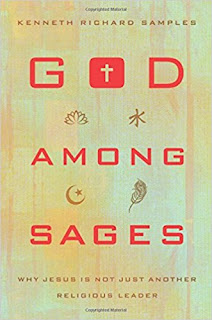
"God Among Sages" (Kenneth Richard Samples)

TITLE: God among Sages: Why Jesus Is Not Just Another Religious Leader
AUTHOR: Kenneth Richard Samples
PUBLISHER: Grand Rapids, MI: Baker Books, 2017, (288 pages).

Who is Jesus? Is he simply another religious leader like those of the other major religions of the world? Who does he claim he is? Is he God? This book sets out the facts and compares the various philosophies, religions, worldviews in this world of pluralistic thinking and beliefs. Author Kenneth Richard Samples asserts that Jesus is matchless throughout history in terms of his self-understanding; his identity; his way of life and consistency in teaching. Part One essentially deals with what Jesus talks about himself. Part Two deals with the lives and accomplishments of four major religions and then each is compared with Jesus. The four major religious leaders are Krishna (Hinduism); Buddha (Buddhism); Confucius (Confucionism); and Muhammad (Islam). Part Three goes beyond these four religions to cover a bigger sphere of the world's perspective on Jesus. This includes the different types of pluralistic beliefs; tolerance/intolerance; inclusivism/exclusivism; and many more. Simply put, this book is about understanding who the Person if Jesus is both to Christians, other religions, and the world at large. Though not all perspectives are covered, the selected ones represent a large proportion of the world.


Tuesday, July 4, 2017

"The Bible from 30,000 Feet" (Skip Heitzig)

TITLE: The Bible from 30,000 Feet: Soaring Through the Scriptures from Genesis to Revelation
AUTHOR: Skip Heitzig
PUBLISHER: Eugene, OR: Harvest House Publishers, 2017, (640 pages).

The Bible is the world's bestselling book. It has been read and revered through the centuries. Instead of multiple books of disconnected stories, there is a general narrative from Genesis to Revelation. Trained Bible scholars will be able to do many connections from the Old Testament to the New Testament. For the rest of us, we have to rely on teachers to guide us. Author Skip Heitzig is one such teacher. Sharing his wealth of knowledge about the Bible, this book is a bird's eye view of the whole thrust of Scripture. It is free from difficult terminology or technical details. Heitzig makes the learning interesting by using the metaphor of a plane. He begins with a flight plan where the facts are first laid out. He gives short notes on who the author(s) was, when it was written, landmarks of the expedition, and an itinerary or outline of the chapter. Along with this initial flight plan is an overview of the gospel's relevance to that particular book and some historical background.

The "in-flight" segment is the main part of the book where it becomes a mini-commentary. Heitzig describes the key characters; main events; significant stories; major themes; concise messages; and practical examples for modern readers. The chapters appear like mini-sermons that double up as an overview of the Bible book. The strengths of this book include:

  • Ease of understanding with a creative metaphor
  • Modern use of language
  • Big Picture Overview to help readers keep to the main message
  • Stirs up imagination about how we can design our own flight plans
  • Convenient reference book